Unknown maker
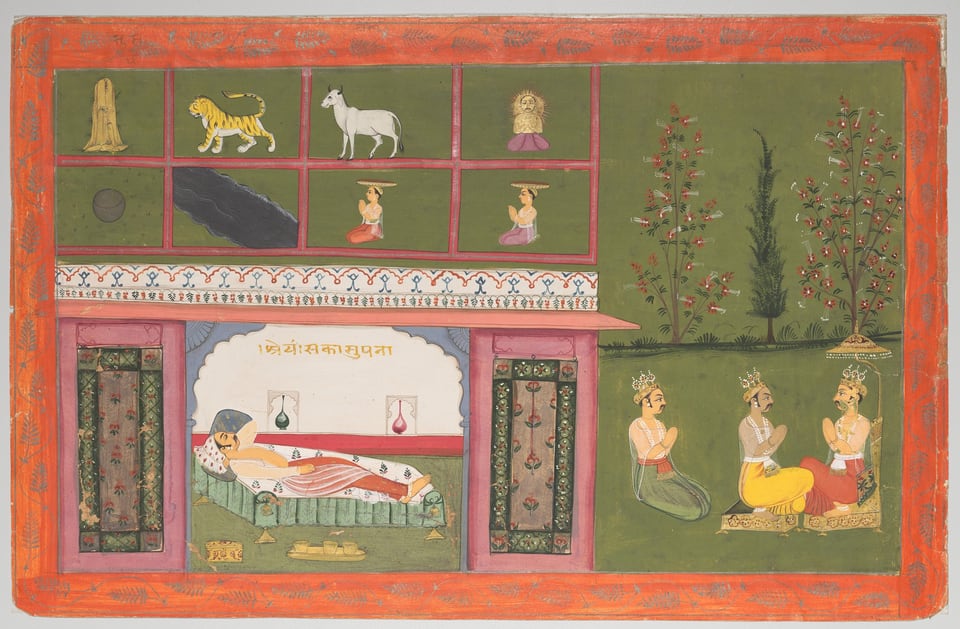
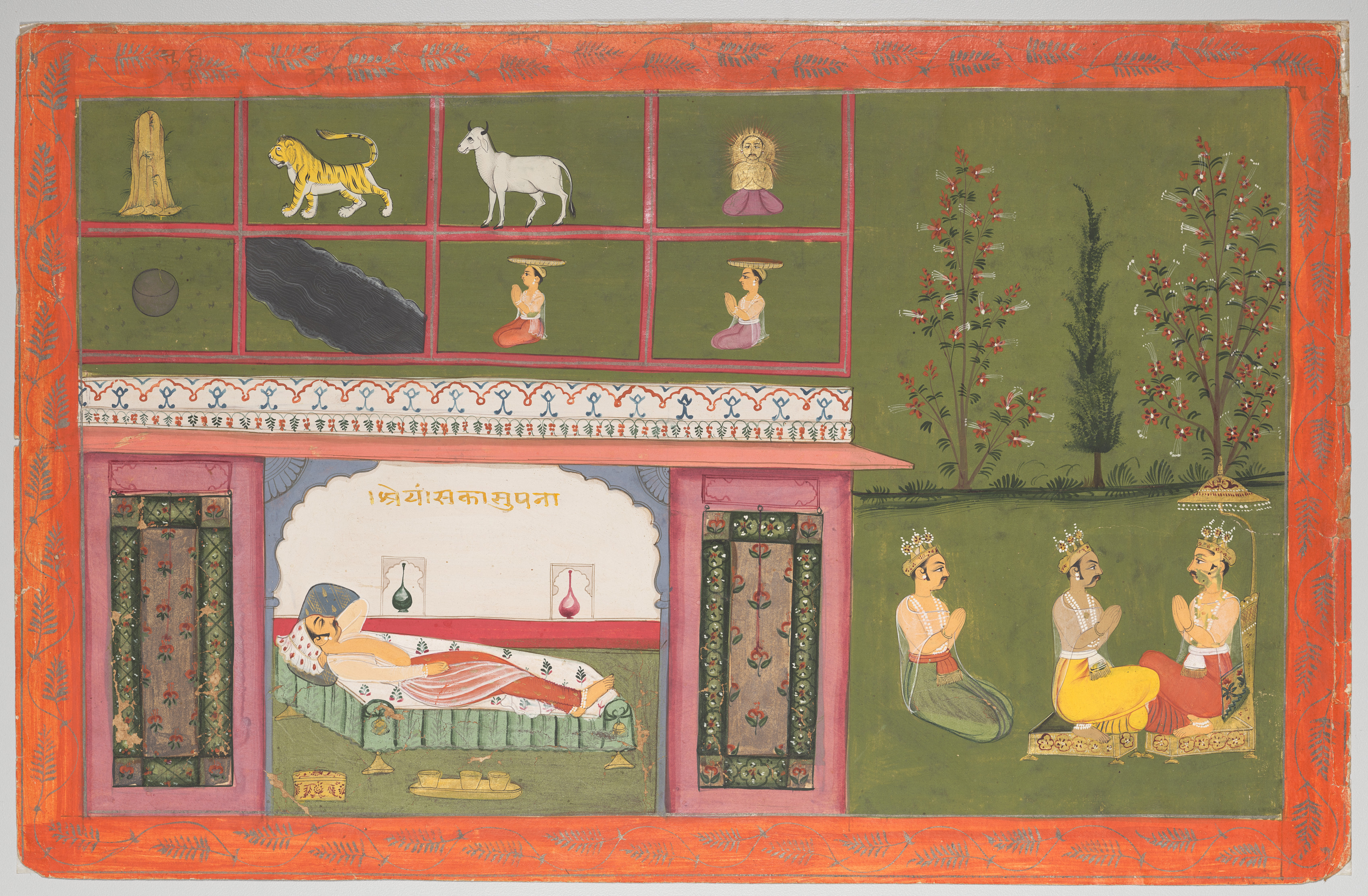
Prince Shreyamsa dreams of the coming of Rishabha, from a Panchakalyanaka (Five Auspicious Events)1670–80
Dreams foretell important events in Indian literature. In this painting a prince lies half asleep and experiences eight visions, pictured above the reclining figure. More about this work
About this work
Dreams foretell important events in Indian literature. In this painting a prince lies half asleep and experiences eight visions, pictured above the reclining figure. At the right, the prince on the throne with the royal umbrella seeks help interpreting the dreams. They predicted the coming of Rishabha, the first Jina, who has been fasting for a full year. The prince then became the first person in the world to give proper alms, or pious offerings, to a Jina. This painting is from a group that is recognized as the first Jain manuscript made in the form of a pictorial series, rather than a handwritten manuscript.
Text from the Cleveland Museum of Art.
How it was made
- Opaque watercolour
- Watercolour made opaque with white or chalk and laid in flat, even layers. Persian and Indian painters ground their colours from minerals, applied them with the finest brushes and burnished the finished page.
- Tempera
- Pigment bound with egg yolk. It dries in minutes and can’t be blended wet, so painters built up form with fine, hatched strokes. It was Europe’s main panel technique before oil.
- Ink on paper
- Ink made from soot and animal glue, ground with water on an inkstone. A single brush can give a hair-fine line or a broad wash, and nothing can be corrected.
Rights and the museum’s record
Public domain. The Cleveland Museum of Art has dedicated this image to the public domain under CC0, so anyone may copy, adapt and use it, for any purpose, without asking. Our prints and files are reproductions made from the museum’s image; the museum doesn’t endorse them.
- Object number
- 2021.12
- Credit
- Courtesy of the Cleveland Museum of Art
- Type
- Painting
- Department
- Indian and Southeast Asian Art
- Licence
- CC0 1.0 Universal
- Museum record
- See it on the museum’s site
Report this work
Close in colour