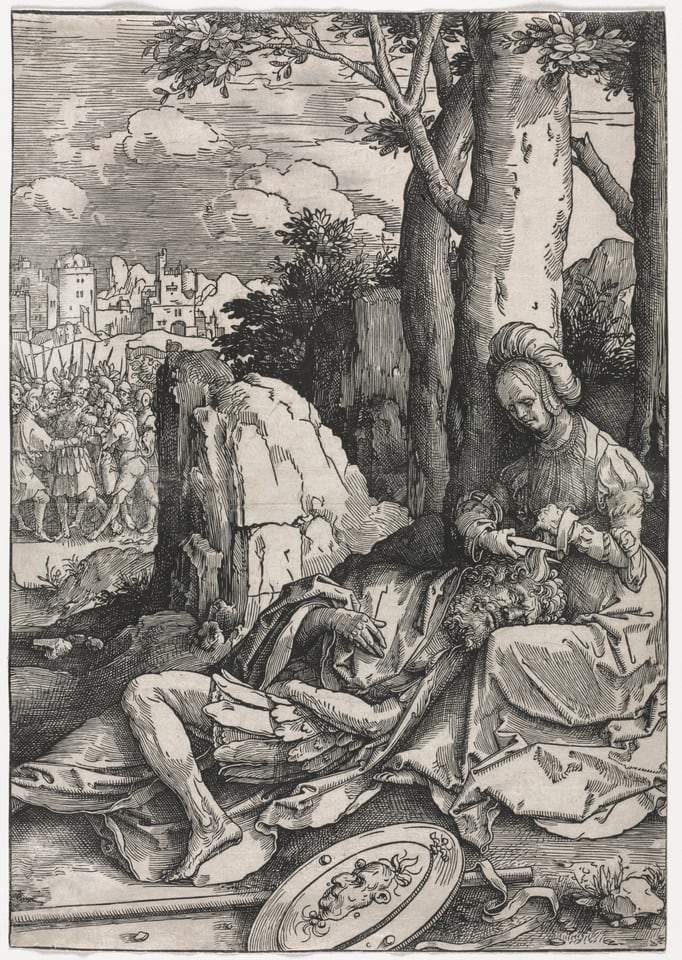
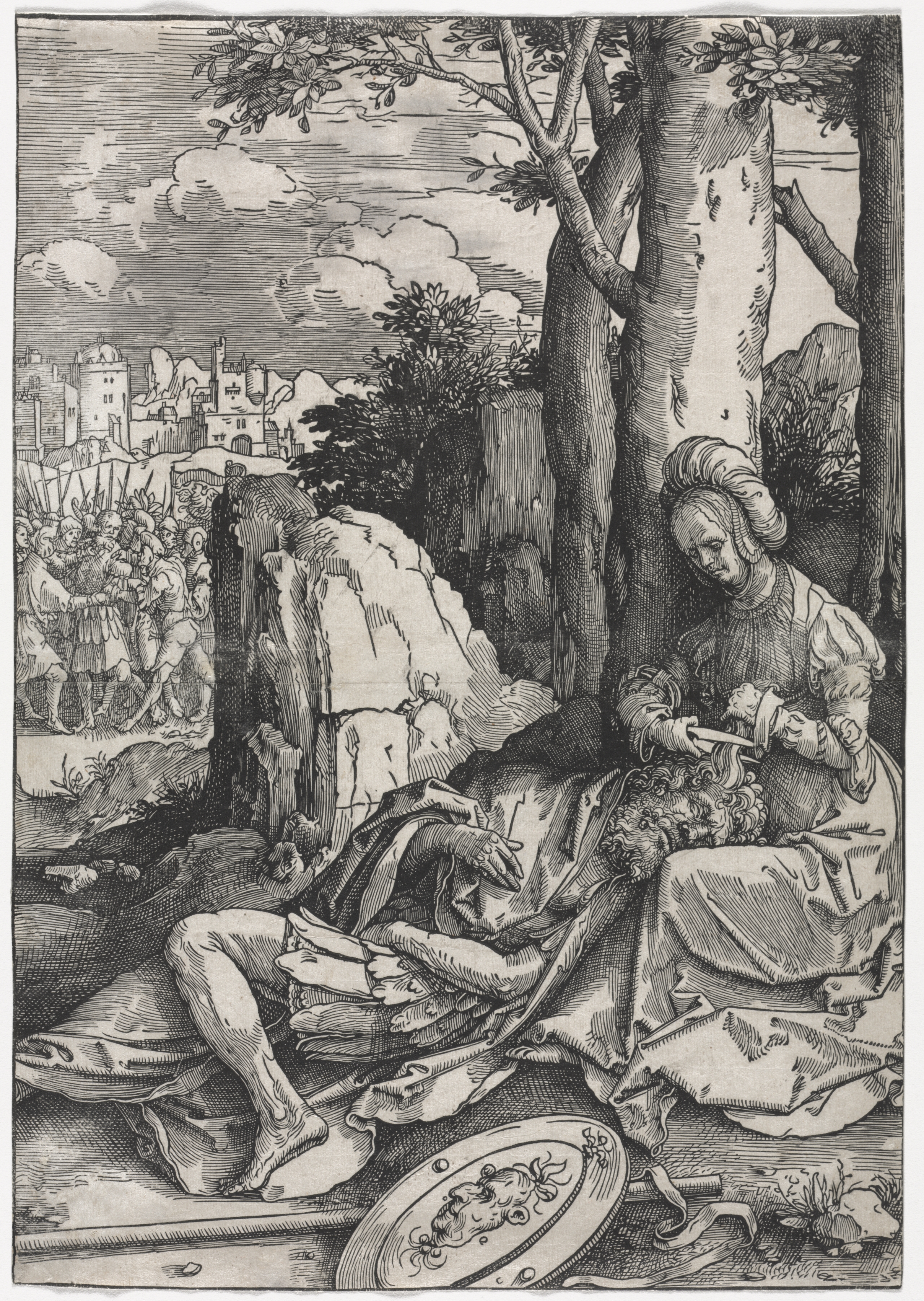
The Power of Women: Samson and Delilahc. 1512
The publication of Albrecht Dürer's three impressive woodcut series in 1511— The Large Passion , The Apocalypse , and The Life of the Virgin —had an immediate impact on Northern painters such as Lucas. More about this work
About this work
The publication of Albrecht Dürer's three impressive woodcut series in 1511— The Large Passion , The Apocalypse , and The Life of the Virgin —had an immediate impact on Northern painters such as Lucas. Lucas's first major designs for woodcuts were six large images whose theme was the power of women, that is, women's ability to dominate man by using wiles and beauty was a subject with broad, popular appeal at the time. The woodcut medium was eminently suitable for the bold, straightforward manner in which Lucas presented his subjects. The moment representing woman's treachery is always depicted as a restrained confrontation: here, Delilah cuts Samson's hair, sapping his extraordinary strength and leaving him vulnerable to the Philistines who wait in the background to seize him. In size, these woodcuts rival Dürer's largest sheets. The motionless figures possess a monumentality that contributes to the dramatic impact.
Text from the Cleveland Museum of Art.
How it was made
- Woodcut
- A relief print. The block is cut away around the lines, so the lines stand up to take the ink, and the sheet is pressed onto them.
Renaissance
European art from about 1400 to 1600, when painters rediscovered perspective and the classical past.
Rights and the museum’s record
Public domain. The Cleveland Museum of Art has dedicated this image to the public domain under CC0, so anyone may copy, adapt and use it, for any purpose, without asking. Our prints and files are reproductions made from the museum’s image; the museum doesn’t endorse them.
- Object number
- 1935.117
- Credit
- Courtesy of the Cleveland Museum of Art
- Type
- Department
- Prints
- Licence
- CC0 1.0 Universal
- Museum record
- See it on the museum’s site
Report this work
More by Lucas van Leyden
All their works
Close in colour