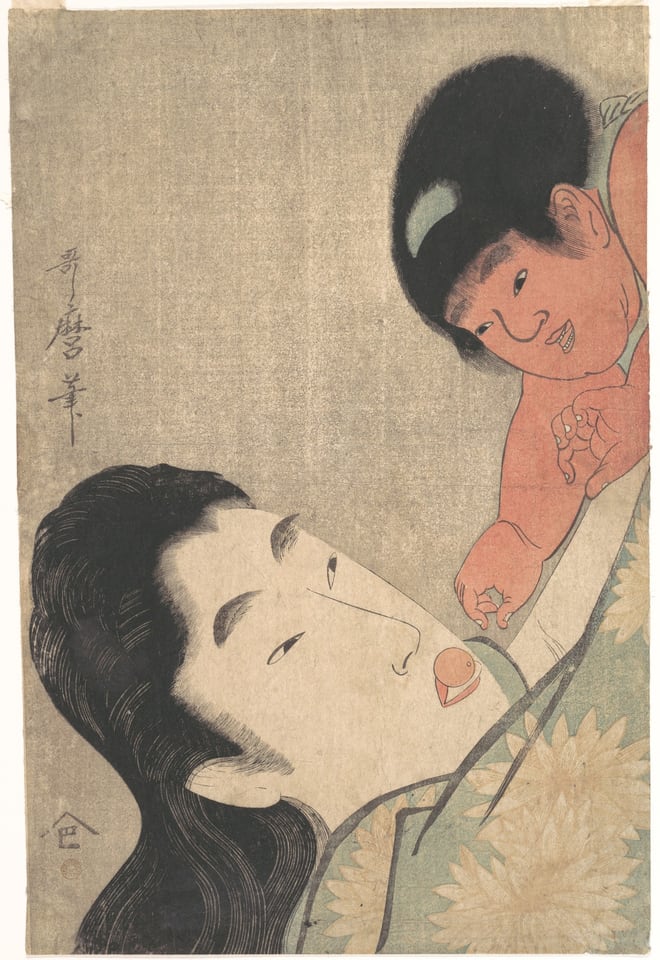
Yamauba and Kintarō Playing with a Cherryca. 1795
Yamauba, the wild woman of the mountains, plays with her son Kintarō, the boy of superhuman strength who grows up to be a famous warrior, the two of them sharing a cherry. More about this work
About this work
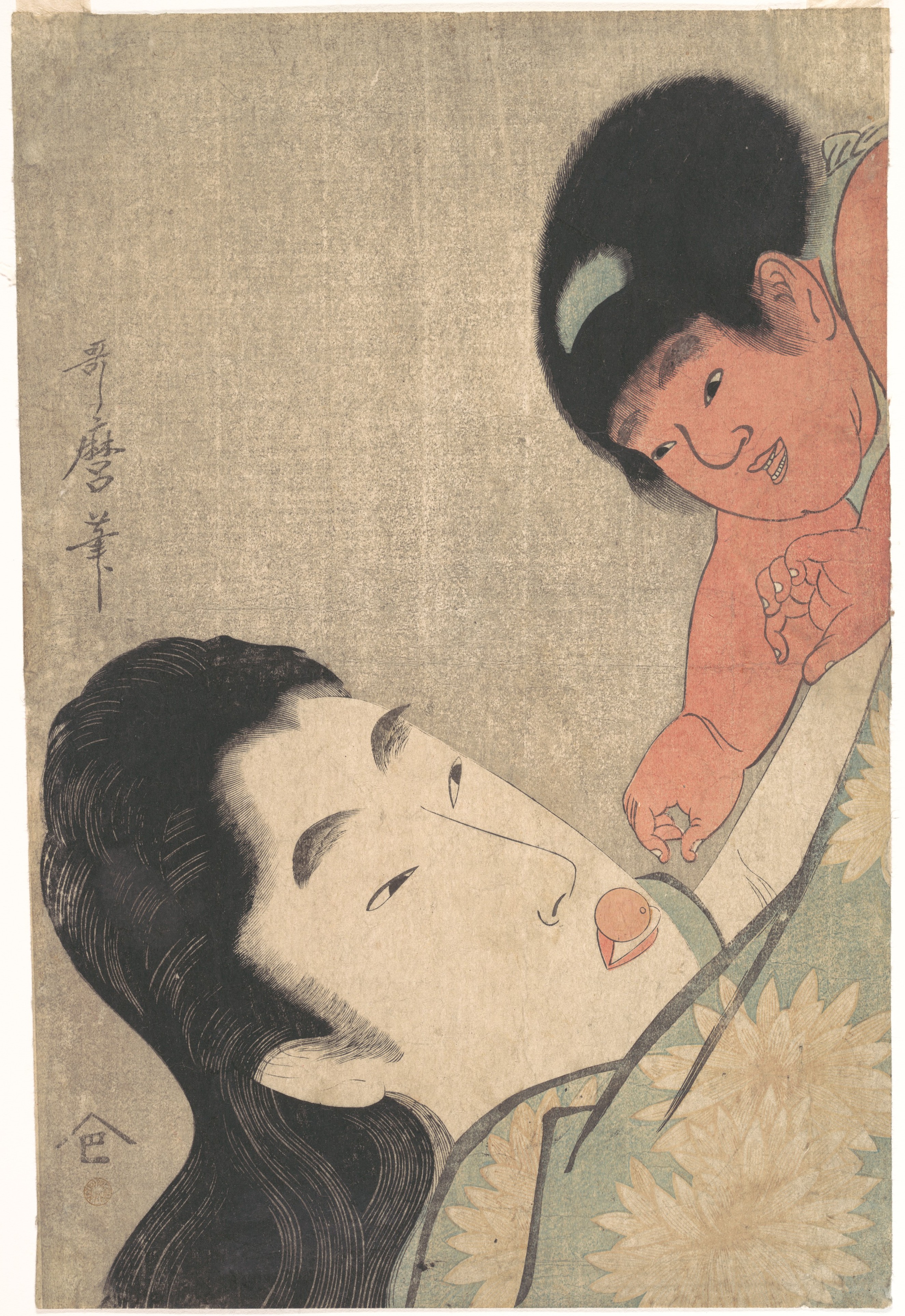
Yamauba, the wild woman of the mountains, plays with her son Kintarō, the boy of superhuman strength who grows up to be a famous warrior, the two of them sharing a cherry. Utamaro designed many prints of the pair in the 1790s and early 1800s, turning the folk legend into tender, slightly unsettling images of mother and child, with Yamauba’s long, unkempt black hair framing her pale face and Kintarō’s ruddy body set against it. The mixture of intimacy and wildness made them highly popular.
Written by Ochre Editions.
How it was made
- Colour woodblock print
- In Japan these were a team effort. The artist drew the design, a carver cut it into cherry-wood blocks, one block for each colour, and a printer brushed on the pigment and rubbed each sheet by hand. Full-colour prints of this kind were called nishiki-e, “brocade pictures”, from the 1760s on.
Kitagawa Utamaro
Japanese, c.1753–1806
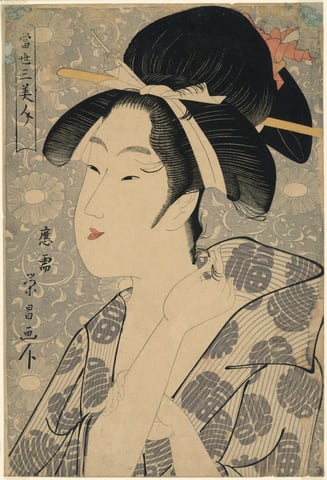
Utamaro trained with the painter Toriyama Sekien and rose to fame in the 1790s with the support of the publisher Tsutaya Jūzaburō. He is best known for his half-length portraits of women, the ōkubi-e or “large head” pictures, which give close attention to expression, gesture and the texture of hair and fabric. He also produced finely observed books of insects, shells and birds. In 1804 he was punished by the authorities for designs depicting the warlord Toyotomi Hideyoshi.
Written by Ochre Editions.
Ukiyo-e
Japanese woodblock prints of the floating world: actors, courtesans, landscapes and the sea.
Rights and the museum’s record
Public domain. The Met has dedicated this image to the public domain under CC0, so anyone may copy, adapt and use it, for any purpose, without asking. Our prints and files are reproductions made from the museum’s image; the museum doesn’t endorse them.
- Object number
- JP1438
- Credit
- Courtesy of The Metropolitan Museum of Art
- Type
- Prints
- Department
- Asian Art
- Licence
- CC0 1.0 Universal
- Museum record
- See it on the museum’s site
Report this work
More by Kitagawa Utamaro
All their works
Close in colour