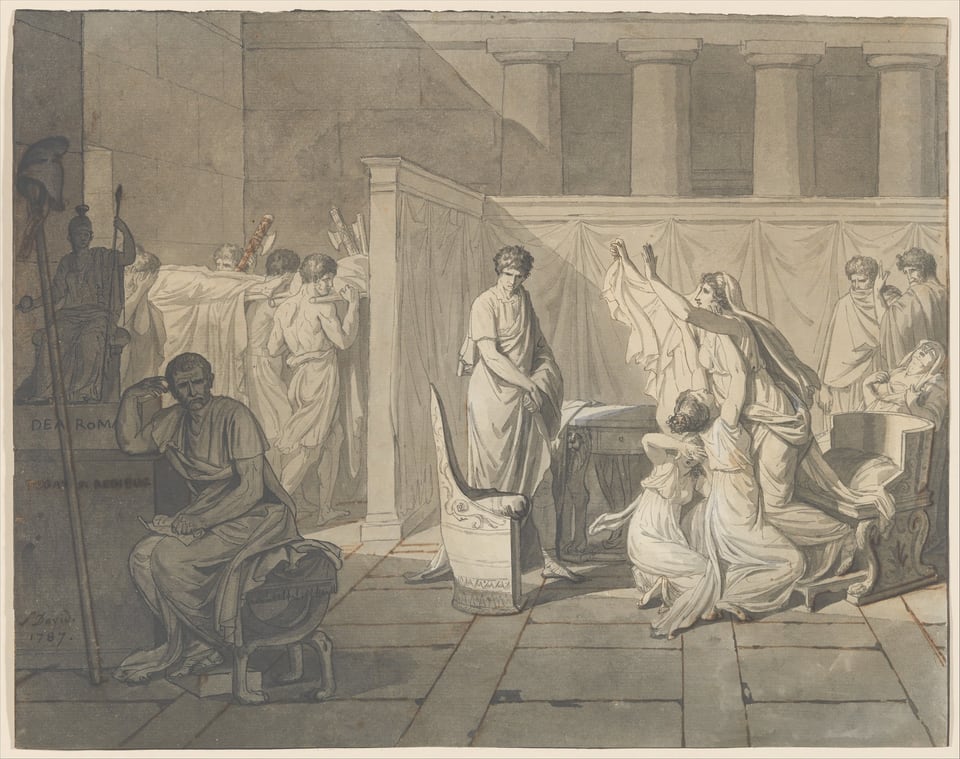
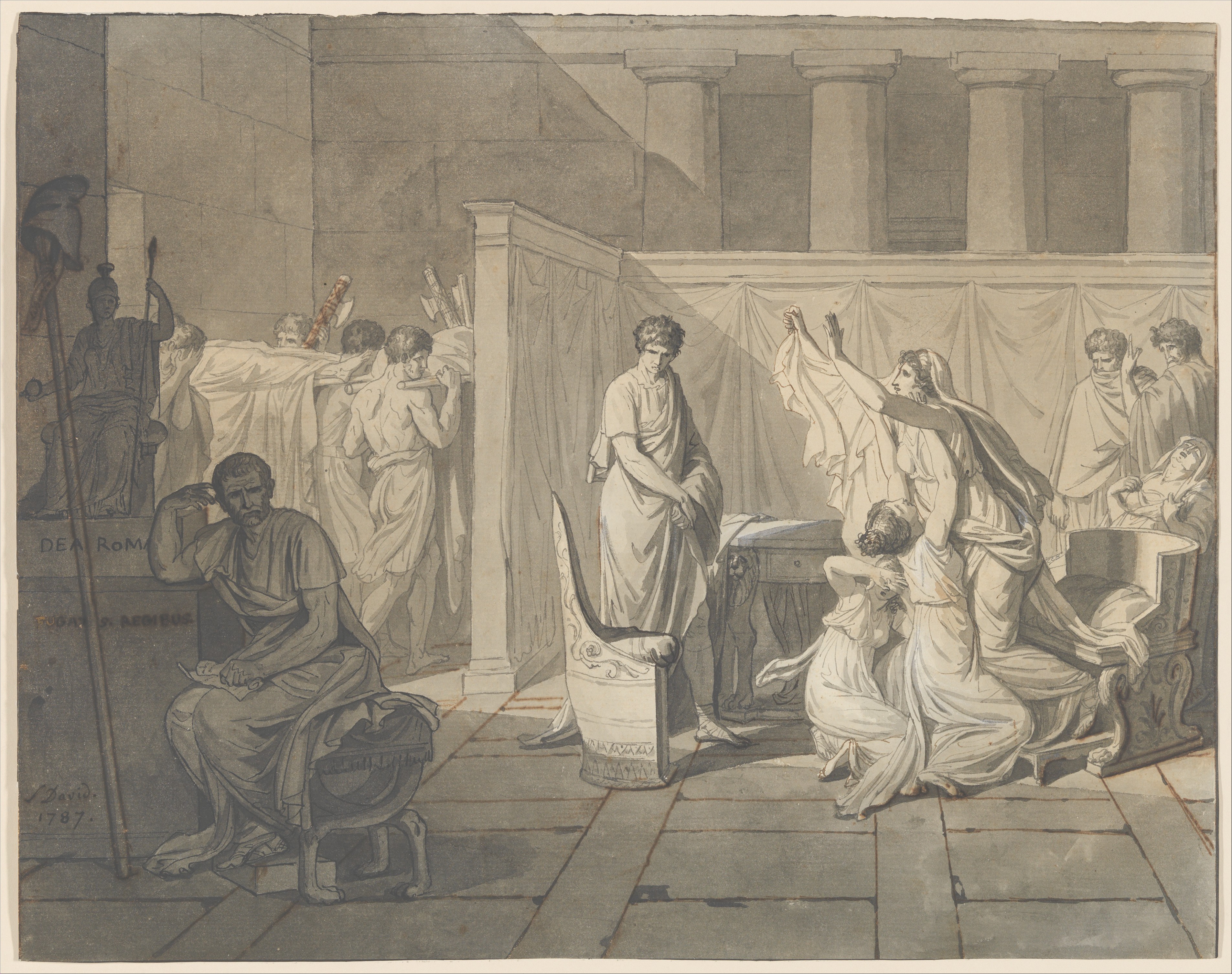
The Lictors Bringing Brutus the Bodies of his Sons1787
Lucius Junius Brutus, founder of the Roman Republic, had condemned his own sons to death for plotting to restore the monarchy; here the lictors carry their bodies home, while the women of his family cry out in grief. More about this work
About this work
Lucius Junius Brutus, founder of the Roman Republic, had condemned his own sons to death for plotting to restore the monarchy; here the lictors carry their bodies home, while the women of his family cry out in grief. Jacques-Louis David made this highly finished compositional drawing in 1787 as he worked towards his painting of the subject, shown at the Salon of 1789, the year the Revolution began. The contrast between the father’s stern sacrifice for the state and the women’s anguish lies at the heart of the design.
Written by Ochre Editions.
How it was made
- Opaque watercolour
- Watercolour made opaque with white or chalk and laid in flat, even layers. Persian and Indian painters ground their colours from minerals, applied them with the finest brushes and burnished the finished page.
- Chalk
- Natural black, red and white chalks. Used together on toned paper they could give the warmth of flesh with very little effort, and they were favourites for studies from life.
- Pen and ink
- Drawn with a quill or reed pen, often with wash added by brush to model light and shadow.
Jacques-Louis David
French, 1748–1825 · Born in Paris; died in Brussels.
David was the leading painter of French Neoclassicism. After winning the Prix de Rome he studied antiquity in Italy, and in the 1780s produced severe, moralising history paintings such as The Oath of the Horatii and The Death of Socrates. During the Revolution he was a deputy who voted for the king’s execution and painted The Death of Marat; he later became first painter to Napoleon. After the Bourbon restoration he lived in exile in Brussels, where he died.
Written by Ochre Editions.
Rights and the museum’s record
Public domain. The Met has dedicated this image to the public domain under CC0, so anyone may copy, adapt and use it, for any purpose, without asking. Our prints and files are reproductions made from the museum’s image; the museum doesn’t endorse them.
- Object number
- 2006.264
- Credit
- Courtesy of The Metropolitan Museum of Art
- Type
- Drawings
- Department
- Drawings and Prints
- Licence
- CC0 1.0 Universal
- Museum record
- See it on the museum’s site
Report this work
More by Jacques-Louis David
All their works
Close in colour