The Death of Socrates1787
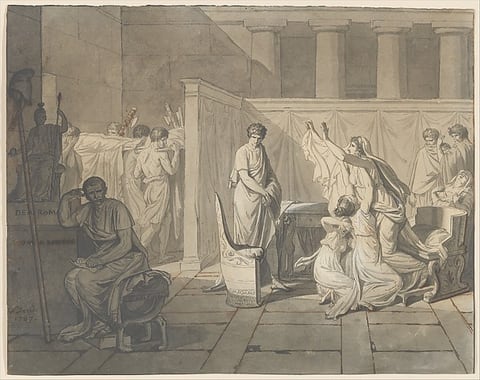
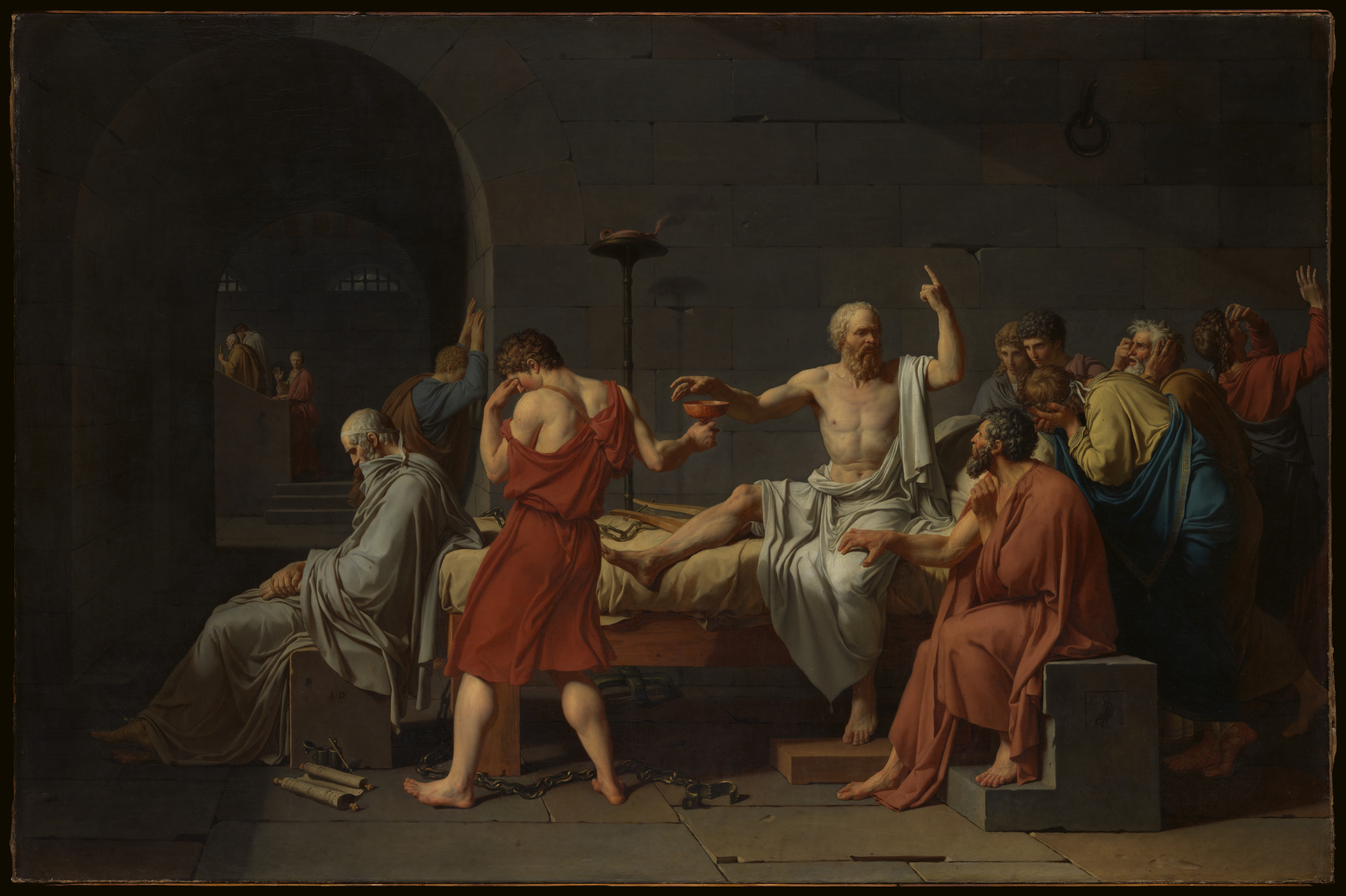
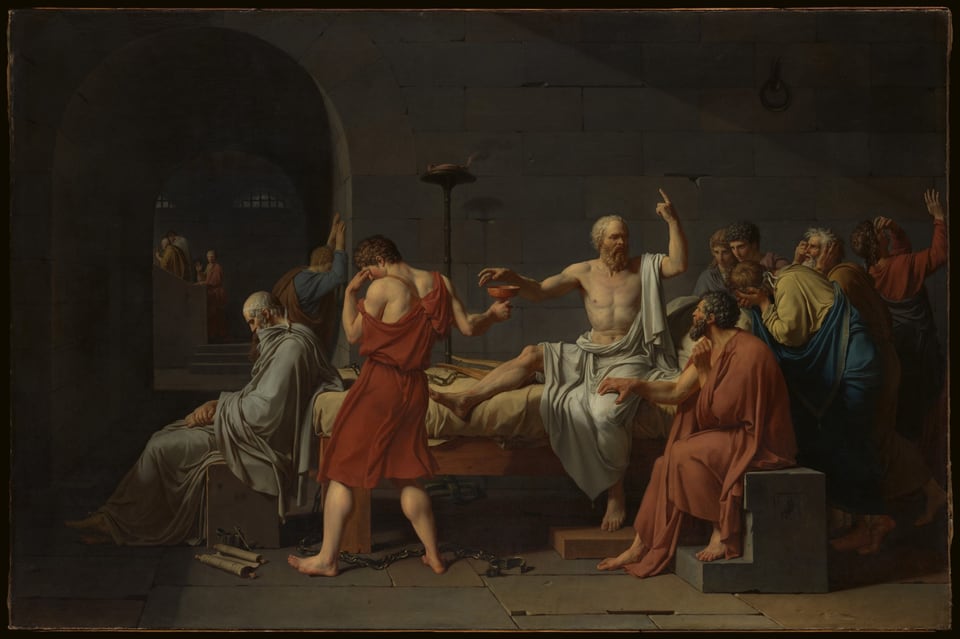
Condemned by Athens for impiety and corrupting the young, the philosopher Socrates reaches for the cup of hemlock while continuing to teach, one finger raised as he speaks of the immortality of the soul. More about this work
About this work
Condemned by Athens for impiety and corrupting the young, the philosopher Socrates reaches for the cup of hemlock while continuing to teach, one finger raised as he speaks of the immortality of the soul. Around him his followers weep and despair; Plato sits at the foot of the bed, turned away, and in the background Socrates’ wife is led out through an archway. Jacques-Louis David exhibited the painting at the Salon of 1787, and its clarity, frieze-like composition and message of principled sacrifice made it a model of Neoclassical painting on the eve of the French Revolution.
Written by Ochre Editions.
How it was made
- Oil paint
- Pigment ground in a drying oil, usually linseed. It dries slowly, so painters could blend on the canvas, build up thin translucent glazes, and rework a picture over weeks. Canvas replaced wooden panels in the 1500s because it is lighter and can be rolled.
Jacques-Louis David
French, 1748–1825 · Born in Paris; died in Brussels.
David was the leading painter of French Neoclassicism. After winning the Prix de Rome he studied antiquity in Italy, and in the 1780s produced severe, moralising history paintings such as The Oath of the Horatii and The Death of Socrates. During the Revolution he was a deputy who voted for the king’s execution and painted The Death of Marat; he later became first painter to Napoleon. After the Bourbon restoration he lived in exile in Brussels, where he died.
Written by Ochre Editions.
Rights and the museum’s record
Public domain. The Met has dedicated this image to the public domain under CC0, so anyone may copy, adapt and use it, for any purpose, without asking. Our prints and files are reproductions made from the museum’s image; the museum doesn’t endorse them.
- Object number
- 31.45
- Credit
- Courtesy of The Metropolitan Museum of Art
- Type
- Paintings
- Department
- European Paintings
- Licence
- CC0 1.0 Universal
- Museum record
- See it on the museum’s site