Jean Louis André Théodore Géricault
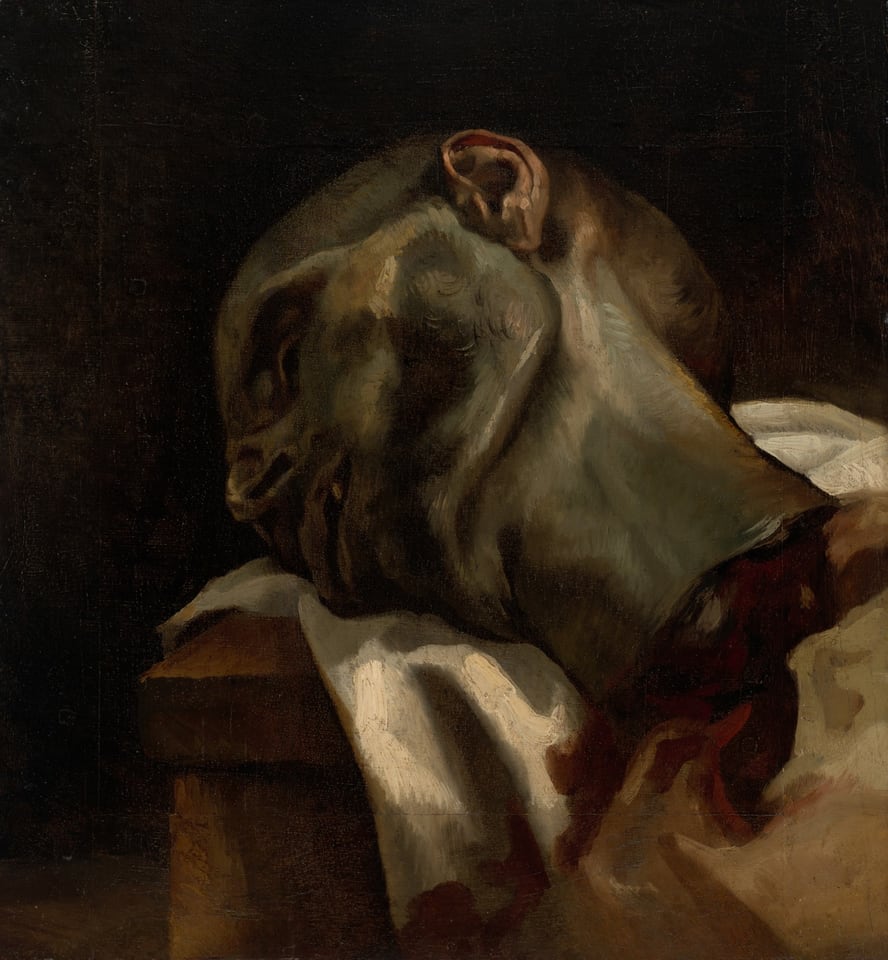
Head of a Guillotined Man1818–19
This painting is one of several that Géricault produced of decapitated heads and severed limbs, and he likely painted it directly from life. More about this work
About this work
This painting is one of several that Géricault produced of decapitated heads and severed limbs, and he likely painted it directly from life. The artist is known to have acquired corpses from his local morgue to study anatomy and the effects of decomposition. The head probably belonged to a convicted criminal. At that time in France, executions were carried out by the guillotine, a bladed device that sliced through the necks of its victims.
Text from the Art Institute of Chicago.
What you’re looking at
A work made of oil on panel.
Description from the Art Institute of Chicago.
How it was made
- Oil on panel
- Oil paint on prepared wooden boards, usually oak in the north and poplar in Italy. The rigid, smooth surface suits fine detail and thin, glowing glazes.
- Oil paint
- Pigment ground in a drying oil, usually linseed. It dries slowly, so painters could blend on the canvas, build up thin translucent glazes, and rework a picture over weeks. Canvas replaced wooden panels in the 1500s because it is lighter and can be rolled.
Jean Louis André Théodore Géricault
French, 1791–1824 · Born in Rouen; died in Paris.
Géricault trained with Carle Vernet and Pierre-Narcisse Guérin and studied the old masters in the Louvre, but his passion for horses and modern events shaped his art. The Raft of the Medusa, shown in 1819, turned a recent shipwreck scandal into a vast, harrowing painting, prepared through studies of corpses and severed heads. He spent 1820–21 in England, where he made lithographs of street life and horses. He died at thirty-two after a series of riding accidents.
Written by Ochre Editions.
Rights and the museum’s record
Public domain. The Art Institute of Chicago has dedicated this image to the public domain under CC0, so anyone may copy, adapt and use it, for any purpose, without asking. Our prints and files are reproductions made from the museum’s image; the museum doesn’t endorse them.
- Object number
- 1992.628
- Credit
- Courtesy of the Art Institute of Chicago
- Type
- Painting
- Department
- Painting and Sculpture of Europe
- Licence
- CC0 1.0 Universal
- Museum record
- See it on the museum’s site