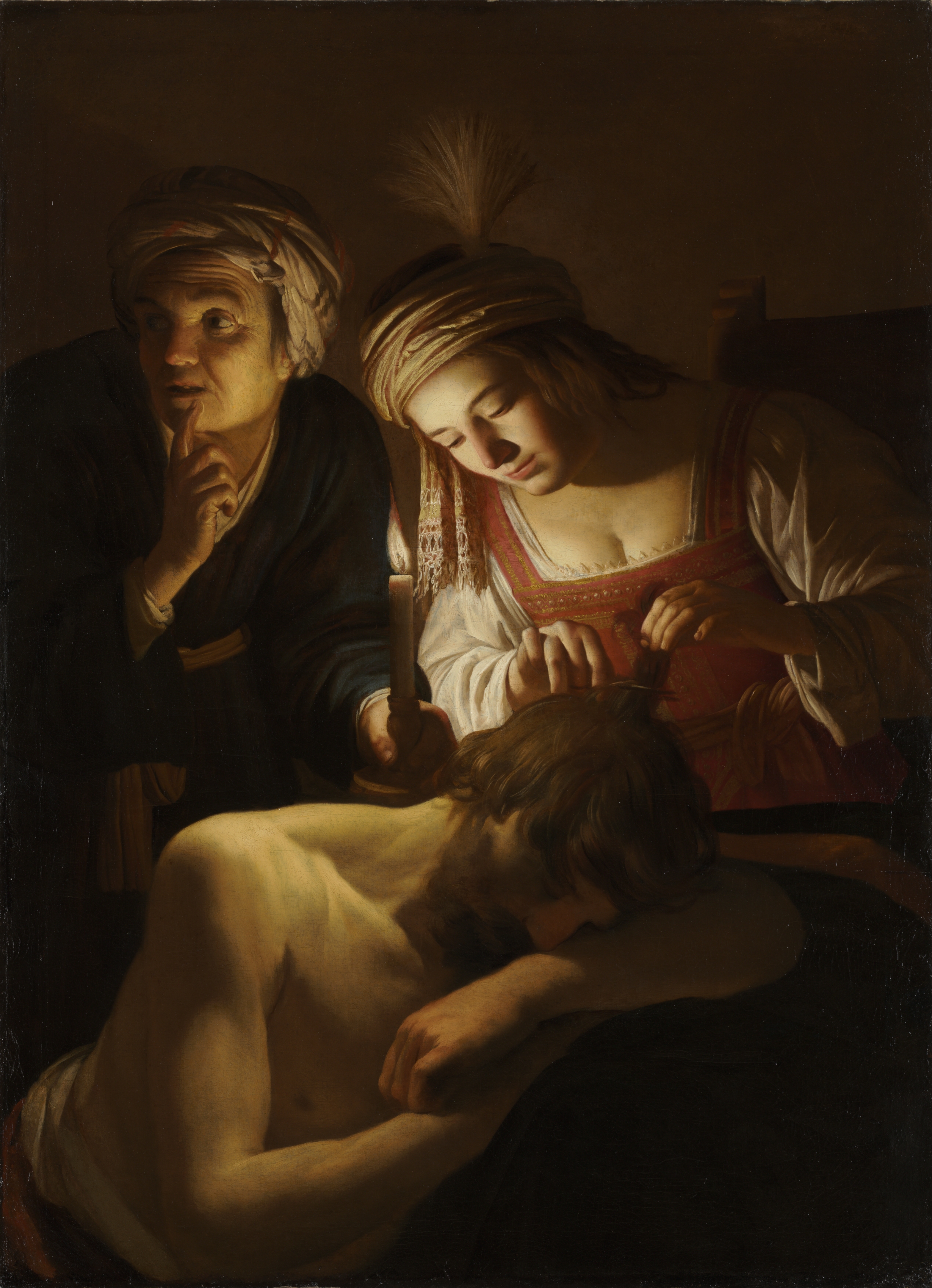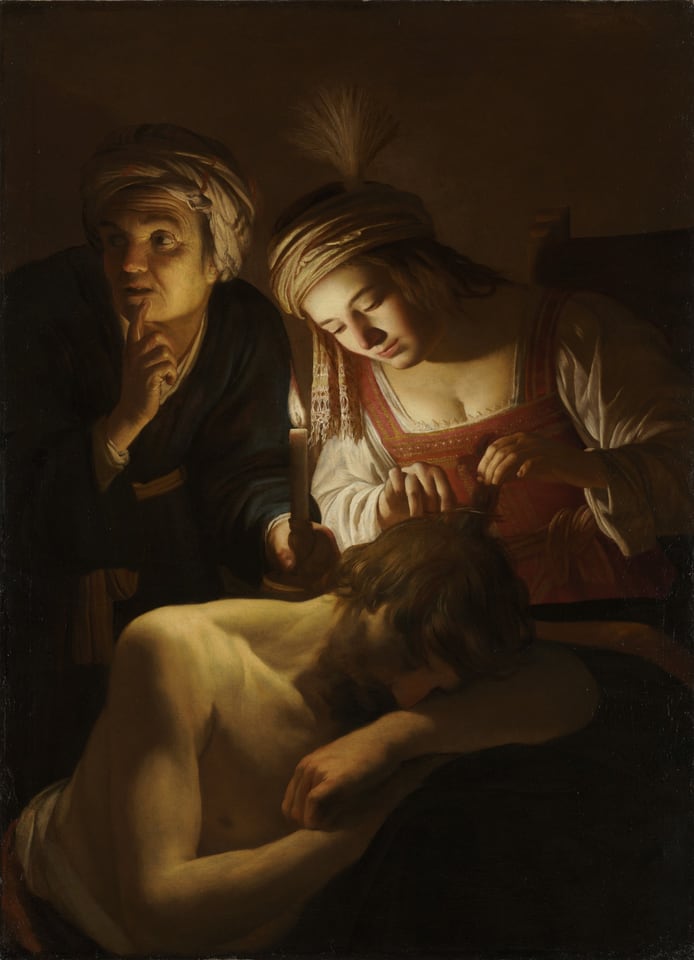
Samson and Delilahc. 1616
In retaliation for Samson’s single-handed decimation of their army, the Philistines bribed his lover Delilah to discover the source of his strength: his hair, uncut since birth. More about this work
About this work
In retaliation for Samson’s single-handed decimation of their army, the Philistines bribed his lover Delilah to discover the source of his strength: his hair, uncut since birth. Samson’s hair was shorn as he lay sleeping in Delilah’s lap, draining his strength and allowing the Philistines to capture him. Honthorst intensified the inherent drama of the scene by limiting his depiction to just three closely packed figures, starkly illuminated by a single candle. The old woman’s silencing gesture involves the viewer in the action, making us complicit in Delilah’s deceit.
Text from the Cleveland Museum of Art.
How it was made
- Oil paint
- Pigment ground in a drying oil, usually linseed. It dries slowly, so painters could blend on the canvas, build up thin translucent glazes, and rework a picture over weeks. Canvas replaced wooden panels in the 1500s because it is lighter and can be rolled.
Gerrit van Honthorst
Dutch, 1590–1656
Dutch Golden Age
Seventeenth-century painting from the Dutch Republic: still lifes, interiors, portraits and flat, wide skies.
Rights and the museum’s record
Public domain. The Cleveland Museum of Art has dedicated this image to the public domain under CC0, so anyone may copy, adapt and use it, for any purpose, without asking. Our prints and files are reproductions made from the museum’s image; the museum doesn’t endorse them.
- Object number
- 1968.23
- Credit
- Courtesy of the Cleveland Museum of Art
- Type
- Painting
- Department
- European Painting and Sculpture
- Licence
- CC0 1.0 Universal
- Museum record
- See it on the museum’s site