The Artist's Daughter with a Parakeet1890
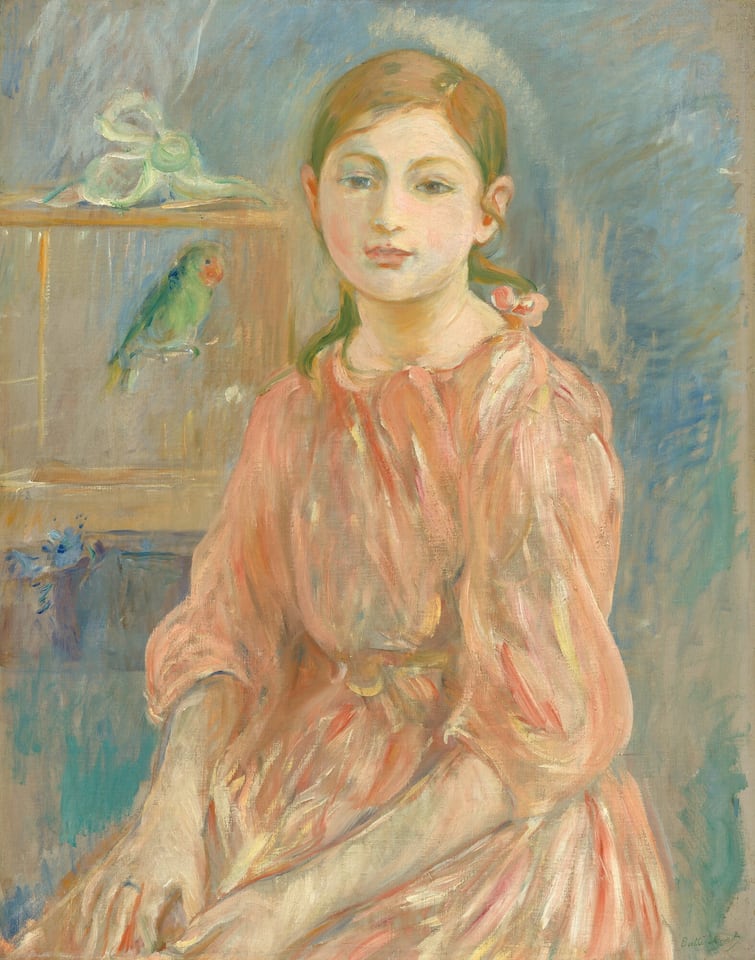
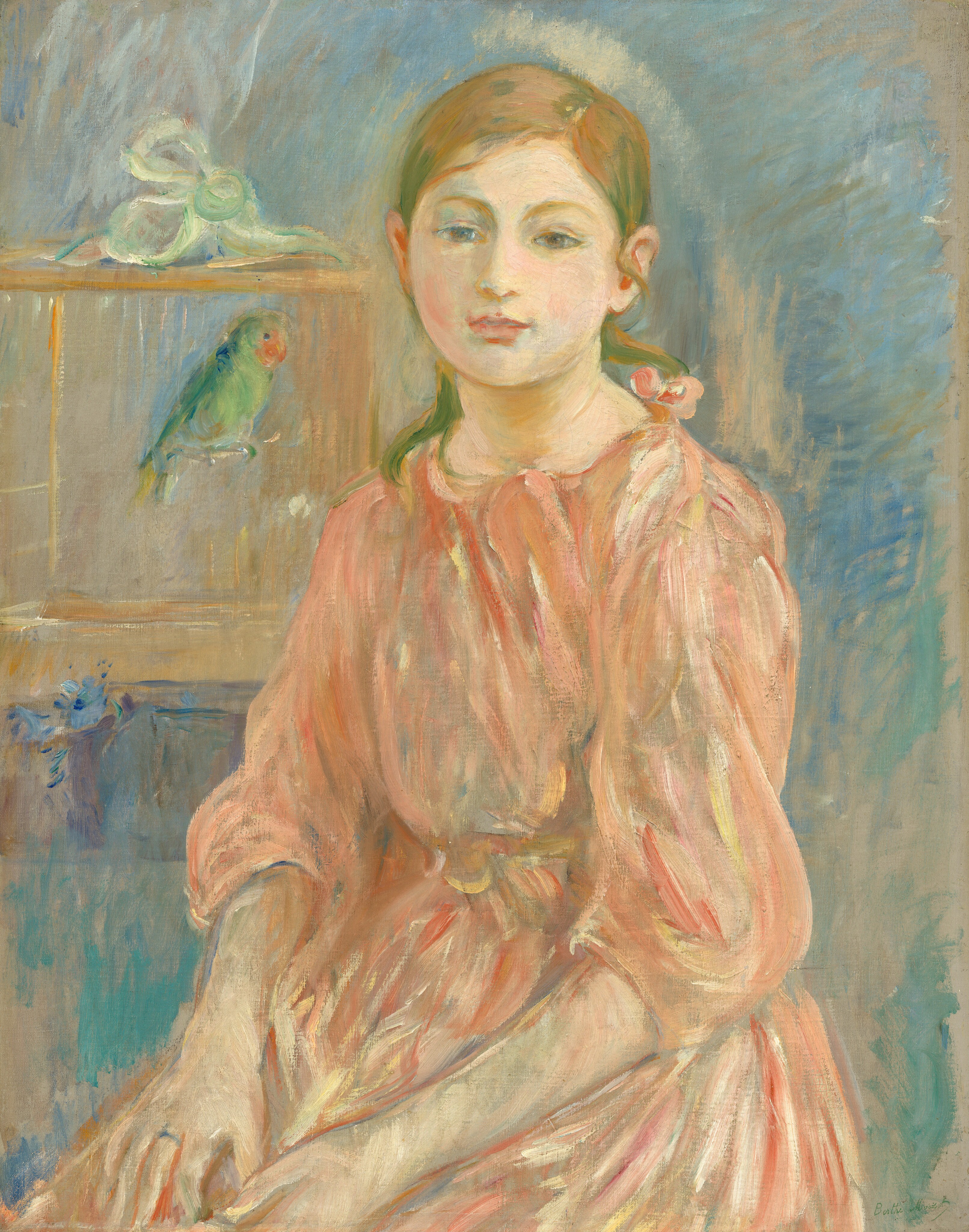
Julie Manet, the painter’s only child, sits in a coral-peach dress with her hands in her lap, looking calmly out at us, while an emerald-green parakeet perches in a wooden cage over her shoulder. More about this work
About this work
Julie Manet, the painter’s only child, sits in a coral-peach dress with her hands in her lap, looking calmly out at us, while an emerald-green parakeet perches in a wooden cage over her shoulder. Berthe Morisot painted her daughter again and again as she grew up, and by 1890 her brushwork had become remarkably free: the dress is a weave of long strokes of pink, butter yellow and ivory, the background a few sweeps of electric and cobalt blue, with bare canvas showing at the edges. Julie, whose father was Édouard Manet’s brother Eugène, was about eleven at the time.
Written by Ochre Editions.
What you’re looking at
Shown from the knees up, a young girl with pale skin, wearing a coral-peach dress, sits facing and looking at us in this loosely painted, vertical portrait. Her knees are angled slightly to our left, and her hands rest in her lap. She has a round face and smooth, lightly flushed cheeks. She has brown eyes under arched brows, a delicate, snub nose, and her rose-pink lips are closed. Her hair, which is painted with broad strokes of caramel brown and moss green, is parted on one side and pulled smoothly back, presumably tied behind her head. Tendrils fall over her shoulders. Her dress is gathered around her neck and tied with a bow at the back. The loose sleeves fall to just below her elbows, and the dress is belted around the waist. A curving swipe of canary-yellow paint could be a buckle at the front. The fabric of the dress is painted with long, visible strokes of shell and rose pink, butter yellow, and ivory white, and a few touches of sage green and periwinkle blue for shadows. She wears a ring on the middle finger of her right hand. The space around her is loosely painted with strokes of electric and cobalt blue, with unpainted canvas visible at some of the edges. To our left, over the girl's shoulder, a wooden bird cage holds an emerald-green parakeet. The bird is streaked with royal blue along its back, and the area around its hooked beak is apple red. The cage has a mint-green bow and ribbon along the top. The artist signed the painting in green on the lower right corner: “Berthe Morisot.”
Description from the National Gallery of Art.
How it was made
- Oil paint
- Pigment ground in a drying oil, usually linseed. It dries slowly, so painters could blend on the canvas, build up thin translucent glazes, and rework a picture over weeks. Canvas replaced wooden panels in the 1500s because it is lighter and can be rolled.
Berthe Morisot
French, 1841–1895 · Born in Bourges; died in Paris.
Morisot studied with Corot and was a founding member of the Impressionist group, exhibiting in seven of its eight exhibitions. Barred as a woman from much of public life, she painted the world open to her: mothers and children, women at their toilette, gardens and interiors, with brushwork among the freest of the movement. She married Eugène Manet, brother of the painter Édouard, and their daughter Julie appears in many of her later works.
Written by Ochre Editions.
Impressionism
Painters in 1870s Paris who worked quickly, often outdoors, to catch light as it changed.
Rights and the museum’s record
Public domain. The National Gallery of Art has dedicated this image to the public domain under CC0, so anyone may copy, adapt and use it, for any purpose, without asking. Our prints and files are reproductions made from the museum’s image; the museum doesn’t endorse them.
- Object number
- 1963.10.50
- Credit
- Courtesy National Gallery of Art, Washington
- Type
- Painting
- Licence
- CC0 1.0 Universal
- Museum record
- See it on the museum’s site
Report this work
More by Berthe Morisot
All their works
Close in colour