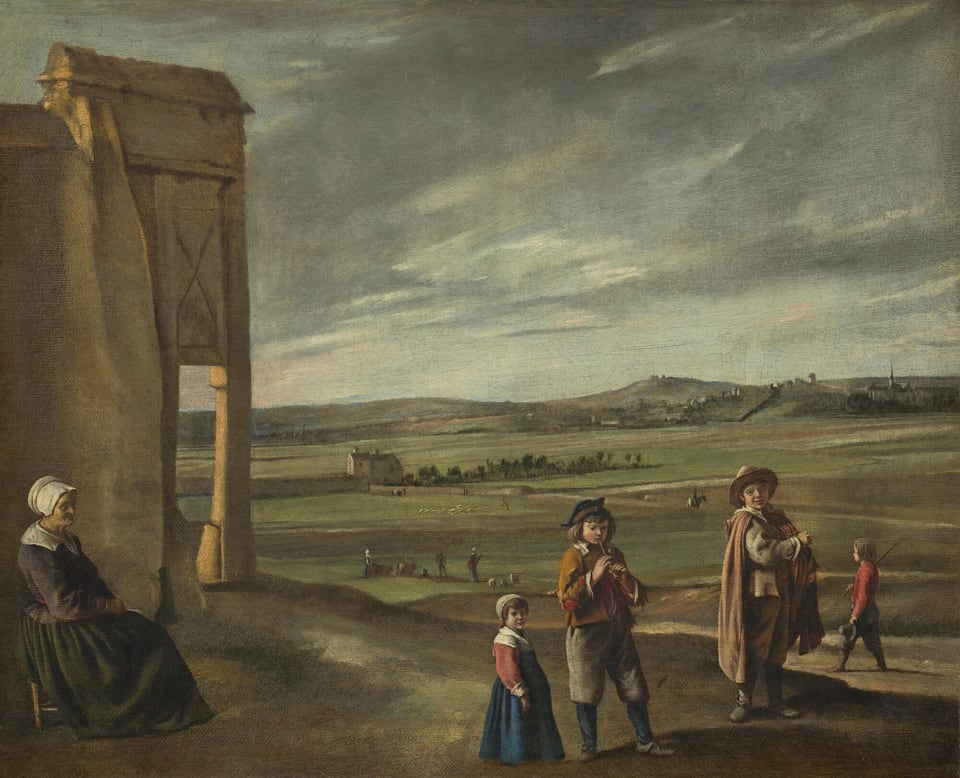
Landscape with Peasantsc. 1640
Louis Le Nain painted this in about 1640, aged 40. It is now at the National Gallery of Art in Washington, DC. More about this work
About this work
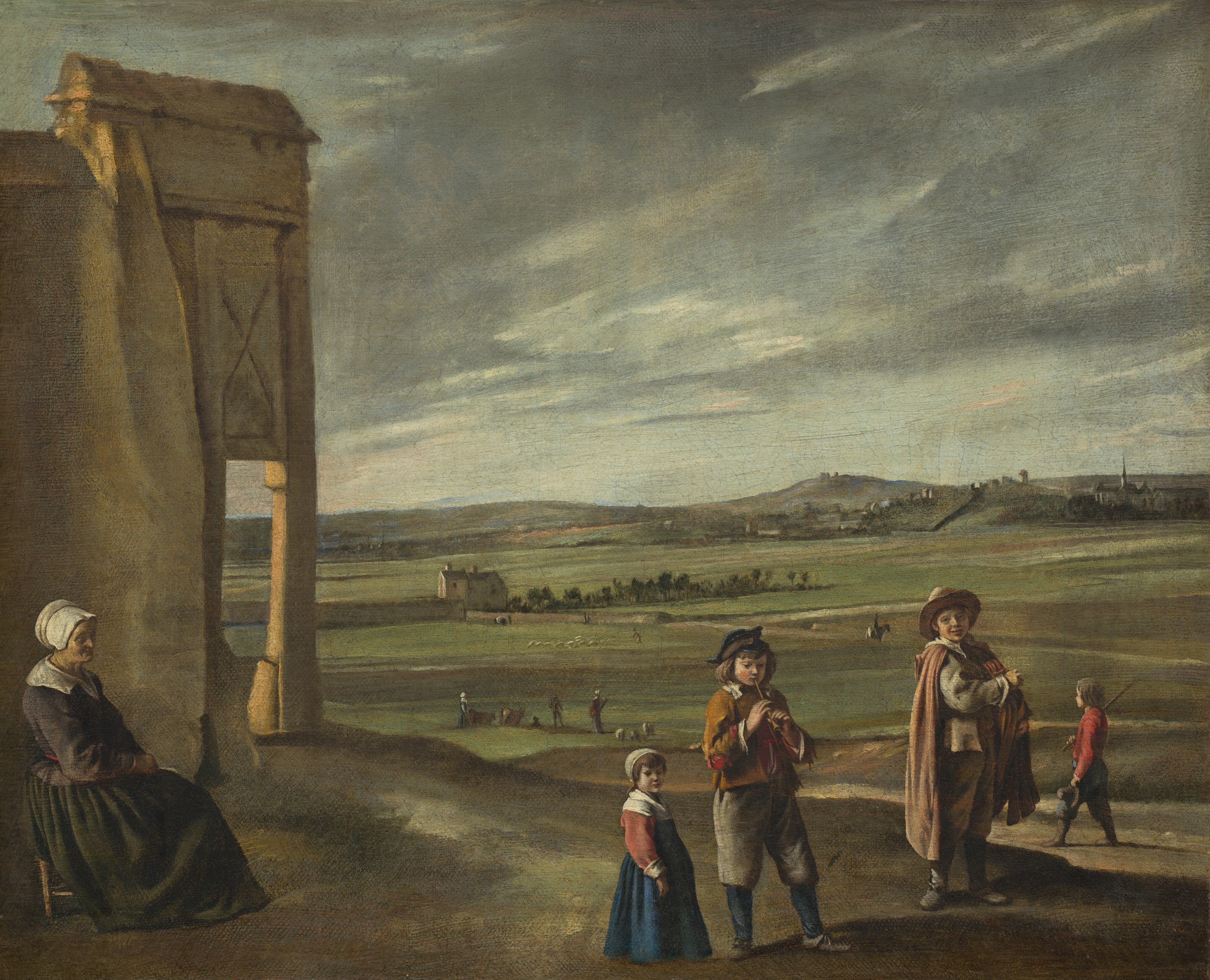
An elderly woman sits on a small stool and four children stand along the foreground of a landscape with rolling, olive-green fields leading back to low, slate-gray mountains in this nearly square painting. The horizon comes about halfway up the painting, and the sky above is filled with a sheet of steel-gray clouds that break to reveal patches of ice-blue sky. Closest to us and along the left edge of the painting, the woman sits near a structure with a fragment of wall and a column that could be made from tan-colored stone. The woman faces our right in profile and looks at or toward three children gathered on a low hill to our right. Her lined face is partially cast in shadow by her white bonnet, but her skin is yellowed where the light falls across the side closer to us. A wide, white collar lies over the shoulders of her muted, plum-purple jacket, which is tied with a narrow red belt. Her hands rest in the lap of her full, moss-green skirt that falls to her feet and covers most of the stool. To our right, two boys and a little girl stand on a low hill. They all stand with their bodies angled to our right, and all have pale skin and brown hair. To our left in the trio, the young girl wears a royal-blue dress with brick-red, long sleeves and a wide, white collar, cuffs, and cap. Next to her, a slightly older boy wearing gray knee-britches, a honey-orange jacket with a white collar, and a blue tricorn hat looks down and plays a thin pipe. His jacket is torn at the elbows, revealing a red shirt beneath. To our right, the oldest boy wears a brown cloak over a gray jacket, tan trousers, and a tan brimmed hat. He holds his right arm, closer to us, across his chest as he touches an instrument nestled in the crook of his other elbow. Another bareheaded boy wearing a red shirt and blue trousers walks beyond this trio, holding a short pole over one shoulder and a brimmed hat in his other hand. He walks to our left and looks to the horizon. More people with sheep, cows, and a person on horseback dot the rolling fields that stretch back to low hills. One house sits next to a line of trees to the left of center, in the middle distance, and more buildings, including a church spire, cluster on the horizon to our right.
Description from the National Gallery of Art.
Louis Le Nain painted this in about 1640, aged 40. It is now at the National Gallery of Art in Washington, DC.
How it was made
- Oil paint
- Pigment ground in a drying oil, usually linseed. It dries slowly, so painters could blend on the canvas, build up thin translucent glazes, and rework a picture over weeks. Canvas replaced wooden panels in the 1500s because it is lighter and can be rolled.
Louis Le Nain
French, c. 1600/1603–1648
Rights and the museum’s record
Public domain. The National Gallery of Art has dedicated this image to the public domain under CC0, so anyone may copy, adapt and use it, for any purpose, without asking. Our prints and files are reproductions made from the museum’s image; the museum doesn’t endorse them.
- Object number
- 1946.7.11
- Credit
- Courtesy National Gallery of Art, Washington
- Type
- Painting
- Licence
- CC0 1.0 Universal
- Museum record
- See it on the museum’s site
Report this work
Close in colour