The Landing of Columbusc. 1837
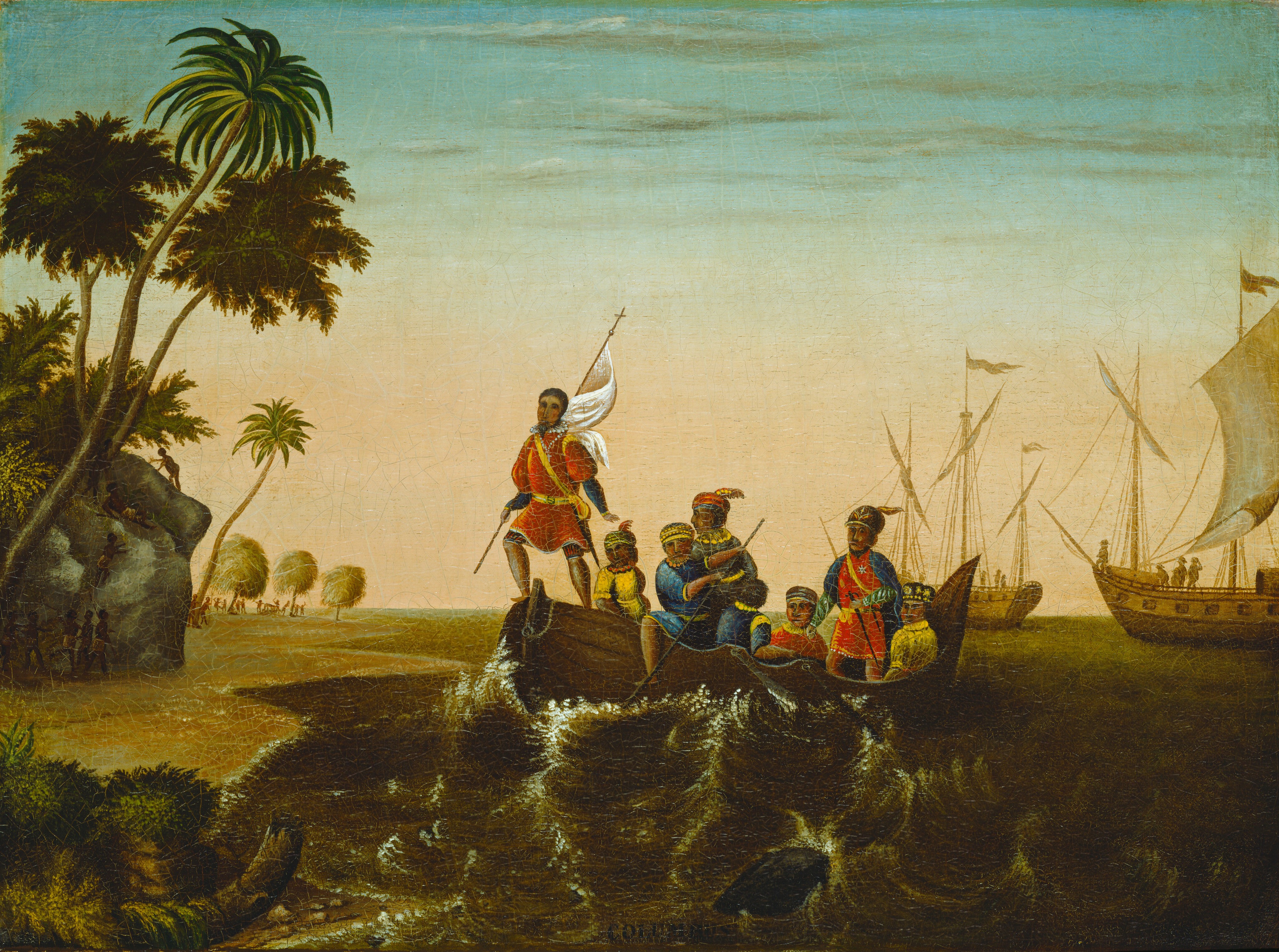
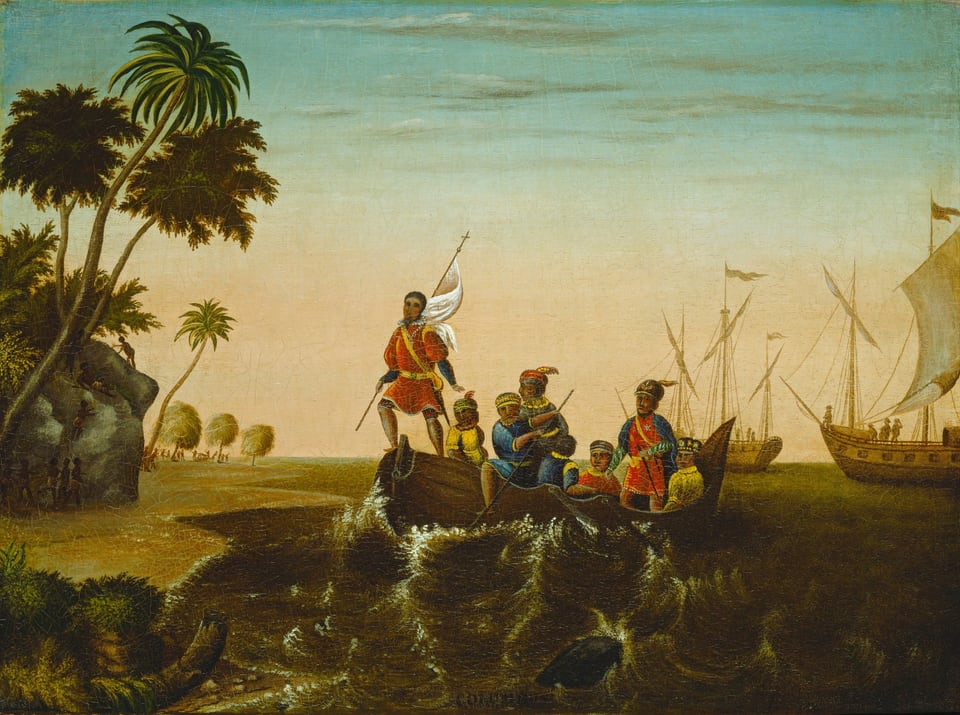
Columbus and his companions, in plumed helmets and bright red, blue and gold, row towards a palm-fringed shore, one man standing in the prow with a white banner, while their ships wait offshore and the island’s inhabitants watch from the hillside and trees. More about this work
About this work
Columbus and his companions, in plumed helmets and bright red, blue and gold, row towards a palm-fringed shore, one man standing in the prow with a white banner, while their ships wait offshore and the island’s inhabitants watch from the hillside and trees. Edward Hicks, best known for his Peaceable Kingdoms, also painted scenes from history, often adapting compositions from prints. The glowing sky and stiff, decorative figures show how he turned borrowed images into something distinctively his own.
Written by Ochre Editions.
What you’re looking at
The painting features a scene showing men in a boat landing on a shore. The horizon is low, with larger sailing ships seen in the distance on the right, floating on the dark green water. The central boat has around eight men in it, all with tan skin and dark hair, dressed in bright garments in shades of red, blue, and gold. Many of them wear plumed helmets and have jewelry or badges adorning them. The boat is heading towards land on the left, and one man stands at the front of the boat, holding a white flag. The land on the left is green, with tall palm trees and a rocky gray mountain. People with dark skin can be seen in on the land in the distance, some climbing the mountain and others standing beneath trees. The sky is a gradient from pinkish-orange near the horizon to light blue at the top of the painting, with a few faint gray clouds.
Description from the National Gallery of Art.
How it was made
- Oil paint
- Pigment ground in a drying oil, usually linseed. It dries slowly, so painters could blend on the canvas, build up thin translucent glazes, and rework a picture over weeks. Canvas replaced wooden panels in the 1500s because it is lighter and can be rolled.
Edward Hicks
American, 1780–1849 · Born in Langhorne, Pennsylvania; died in Newtown, Pennsylvania.
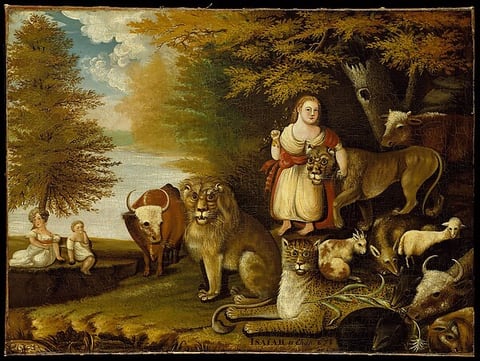
Hicks was a Quaker minister in Bucks County, Pennsylvania, who earned his living as a coach and sign painter. He is best known for the Peaceable Kingdom, a subject drawn from Isaiah’s prophecy of animals lying down together, which he painted more than sixty times, often with William Penn’s treaty with the Lenape in the background. The pictures reflect his faith and the divisions within his own Quaker community. He also painted farm scenes and historical subjects.
Written by Ochre Editions.
Rights and the museum’s record
Public domain. The National Gallery of Art has dedicated this image to the public domain under CC0, so anyone may copy, adapt and use it, for any purpose, without asking. Our prints and files are reproductions made from the museum’s image; the museum doesn’t endorse them.
- Object number
- 1980.62.13
- Credit
- Courtesy National Gallery of Art, Washington
- Type
- Painting
- Licence
- CC0 1.0 Universal
- Museum record
- See it on the museum’s site