Portrait of a Childc. 1840
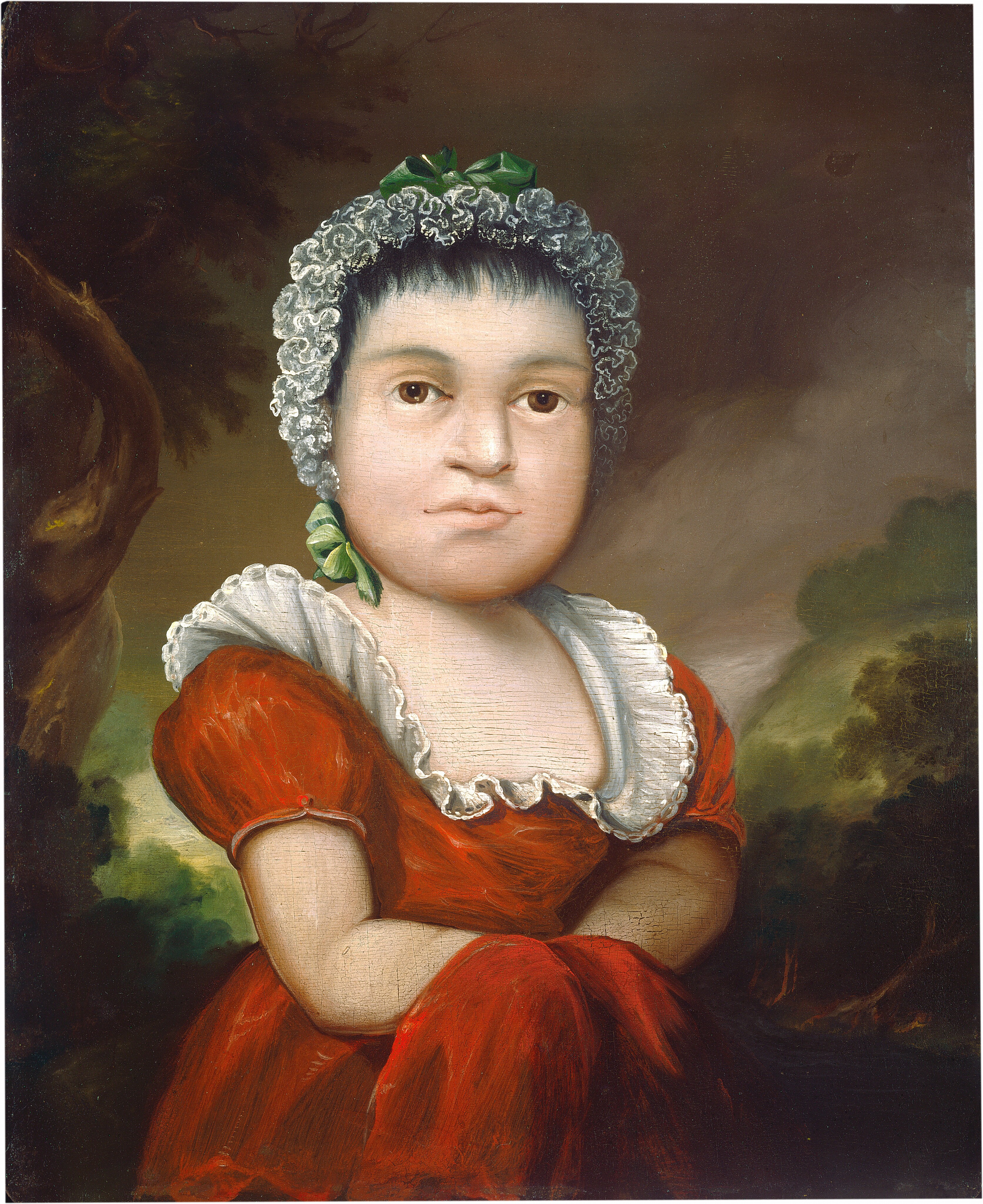
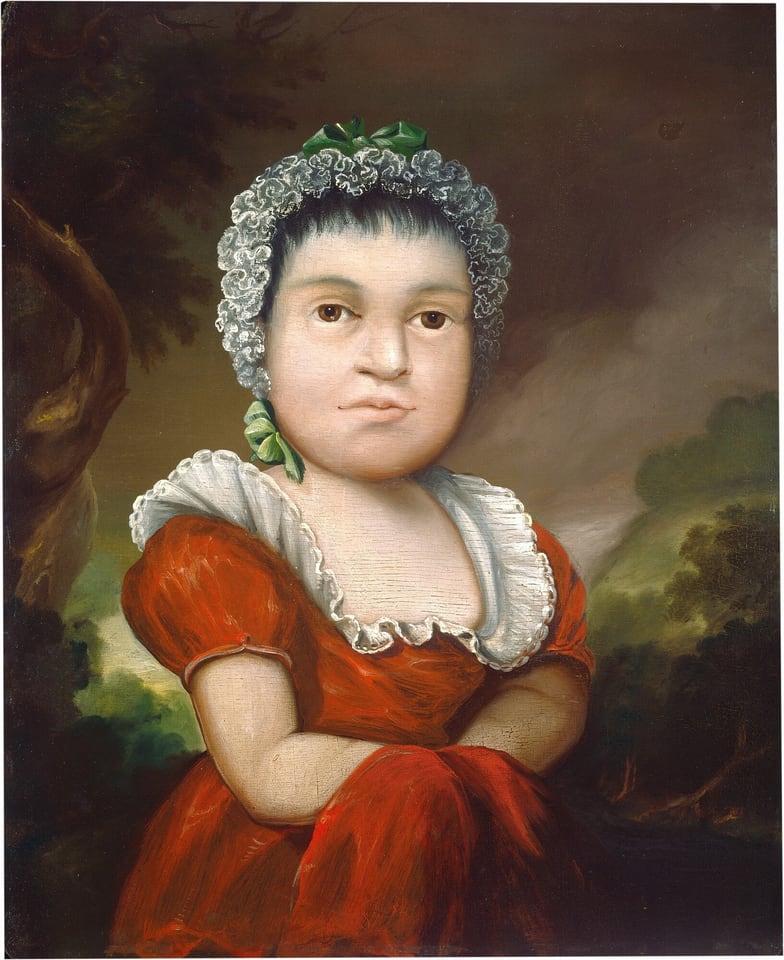
A small girl in a crimson dress and frothy lace bonnet stands before a dark forest, her large head and solemn face giving her the look of a tiny adult. More about this work
About this work
A small girl in a crimson dress and frothy lace bonnet stands before a dark forest, her large head and solemn face giving her the look of a tiny adult. Portraits are unusual in the work of Edward Hicks, the Pennsylvania Quaker minister and sign painter famous for his Peaceable Kingdoms, and this one shares their flat, decorative manner: bright local colour, crisp outlines and a gnarled tree framing the figure. Its stiffness has its own charm and a direct, unflinching presence.
Written by Ochre Editions.
What you’re looking at
A pale-skinned child wearing a short-sleeved red dress and a white bonnet stands before a shadowy green forest under dark clouds in this vertical portrait painting. The child’s over-large head is out of scale with the rest of her body. She looks toward us with brown eyes in her wide, round-jawed face. She has a broad nose, and her pale lips are set in a line. Her lace bonnet lines her black hair like frothy seafoam and is tied with spring-green bows at the top and under her right ear, to our left. The low neckline of her crimson dress is lined with a wide white ruffle. Red fabric covers her hands, which are gathered in front of her waist. Gray clouds sweep over the hazy green forest in the background. A gnarled tree grows up the left side of the painting, framing the girl.
Description from the National Gallery of Art.
How it was made
- Oil on panel
- Oil paint on prepared wooden boards, usually oak in the north and poplar in Italy. The rigid, smooth surface suits fine detail and thin, glowing glazes.
- Oil paint
- Pigment ground in a drying oil, usually linseed. It dries slowly, so painters could blend on the canvas, build up thin translucent glazes, and rework a picture over weeks. Canvas replaced wooden panels in the 1500s because it is lighter and can be rolled.
Edward Hicks
American, 1780–1849 · Born in Langhorne, Pennsylvania; died in Newtown, Pennsylvania.
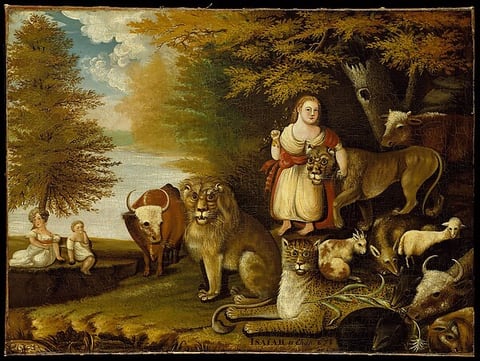
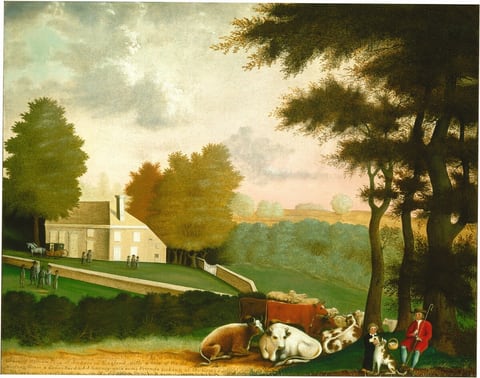
Hicks was a Quaker minister in Bucks County, Pennsylvania, who earned his living as a coach and sign painter. He is best known for the Peaceable Kingdom, a subject drawn from Isaiah’s prophecy of animals lying down together, which he painted more than sixty times, often with William Penn’s treaty with the Lenape in the background. The pictures reflect his faith and the divisions within his own Quaker community. He also painted farm scenes and historical subjects.
Written by Ochre Editions.
Rights and the museum’s record
Public domain. The National Gallery of Art has dedicated this image to the public domain under CC0, so anyone may copy, adapt and use it, for any purpose, without asking. Our prints and files are reproductions made from the museum’s image; the museum doesn’t endorse them.
- Object number
- 1980.62.14
- Credit
- Courtesy National Gallery of Art, Washington
- Type
- Painting
- Licence
- CC0 1.0 Universal
- Museum record
- See it on the museum’s site