The Grave of William Pennc. 1847/1848
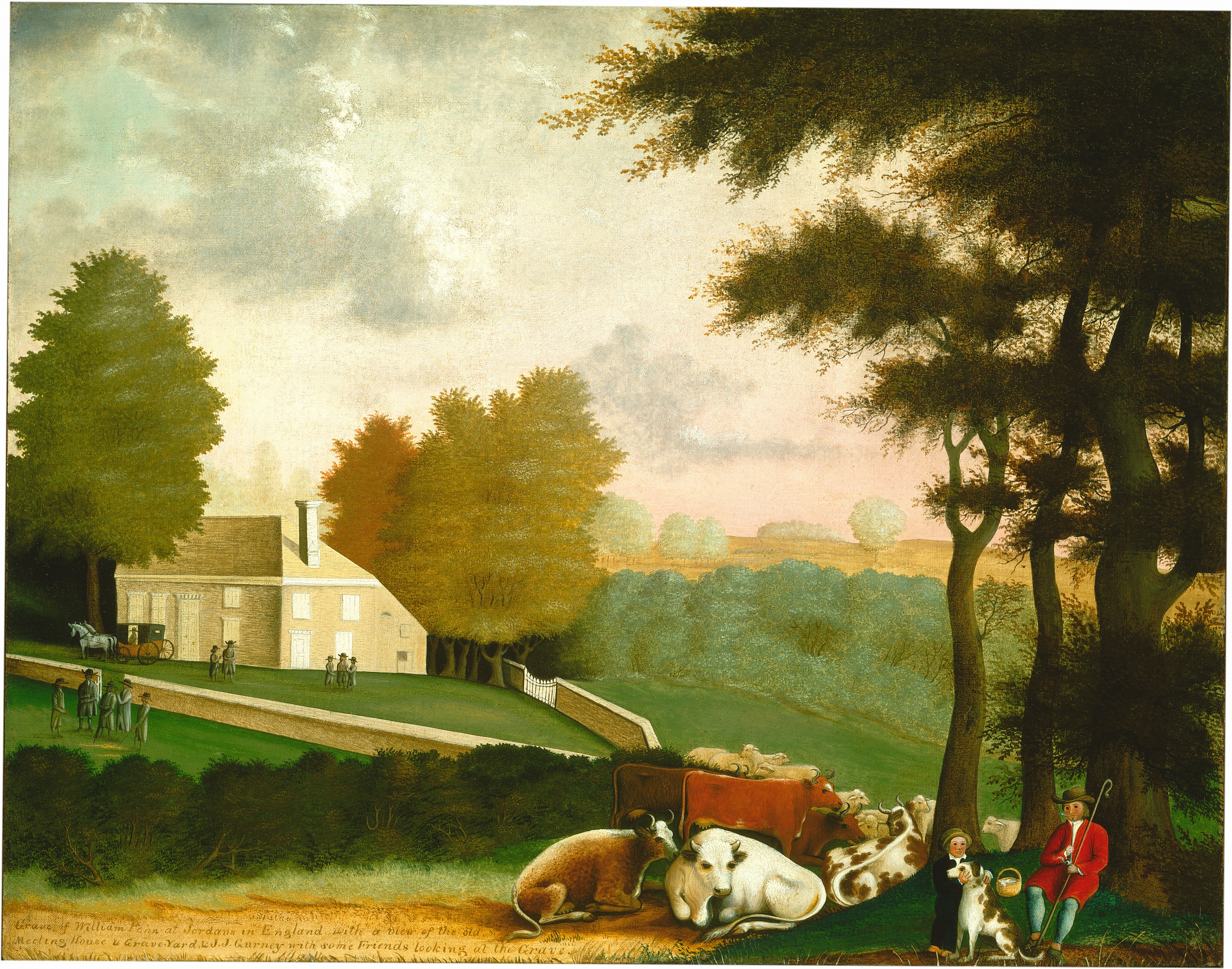
Herdsmen rest beneath a tree with a dog, a basket and a herd of cows and sheep, while in the distance figures and a wagon gather before a large house on a hill. More about this work
About this work
Herdsmen rest beneath a tree with a dog, a basket and a herd of cows and sheep, while in the distance figures and a wagon gather before a large house on a hill. The setting is Jordans in Buckinghamshire, where William Penn, the Quaker founder of Pennsylvania, was buried in 1718. Edward Hicks, himself a Quaker minister, painted the scene in the last years of his life, and as was his habit he lettered an inscription onto the canvas, here on a patch of ground at lower left. The pastel sky and gentle, orderly landscape make Penn’s resting place an image of the peace he stood for.
Written by Ochre Editions.
What you’re looking at
This painting shows a pastoral setting with a large white-and-gray house on a hill to the left. Distant people stand in front of the house, along with a horse-drawn wagon. In the bottom right corner, two people sit in the grass under a tree, one dressed in red holding a tall crook and the other wearing a black garment and a yellow hat and petting a large brown-and-white dog. There is a basket on the ground between them, and next to them is a large herd of cows and sheep, all resting on the grass. The landscape includes trees with green leaves and yellow hills in the distance. The sky above is in pastel shades of pink and blue, with fluffy clouds. In the bottom left, a patch of yellow ground has several lines of text written over it.
Description from the National Gallery of Art.
How it was made
- Oil paint
- Pigment ground in a drying oil, usually linseed. It dries slowly, so painters could blend on the canvas, build up thin translucent glazes, and rework a picture over weeks. Canvas replaced wooden panels in the 1500s because it is lighter and can be rolled.
Edward Hicks
American, 1780–1849 · Born in Langhorne, Pennsylvania; died in Newtown, Pennsylvania.
Hicks was a Quaker minister in Bucks County, Pennsylvania, who earned his living as a coach and sign painter. He is best known for the Peaceable Kingdom, a subject drawn from Isaiah’s prophecy of animals lying down together, which he painted more than sixty times, often with William Penn’s treaty with the Lenape in the background. The pictures reflect his faith and the divisions within his own Quaker community. He also painted farm scenes and historical subjects.
Written by Ochre Editions.
Rights and the museum’s record
Public domain. The National Gallery of Art has dedicated this image to the public domain under CC0, so anyone may copy, adapt and use it, for any purpose, without asking. Our prints and files are reproductions made from the museum’s image; the museum doesn’t endorse them.
- Object number
- 1980.62.12
- Credit
- Courtesy National Gallery of Art, Washington
- Type
- Painting
- Licence
- CC0 1.0 Universal
- Museum record
- See it on the museum’s site