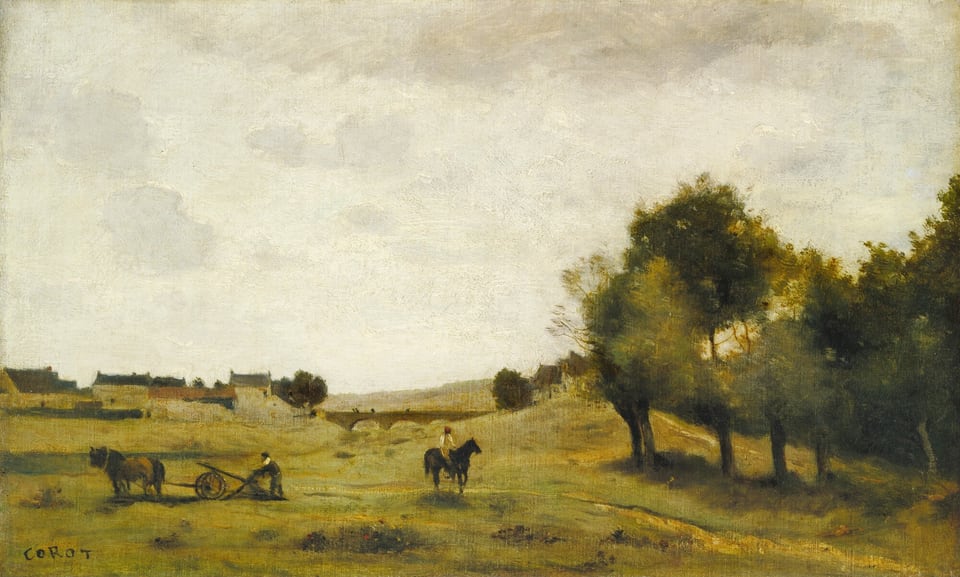
View near Epernon1850/1860
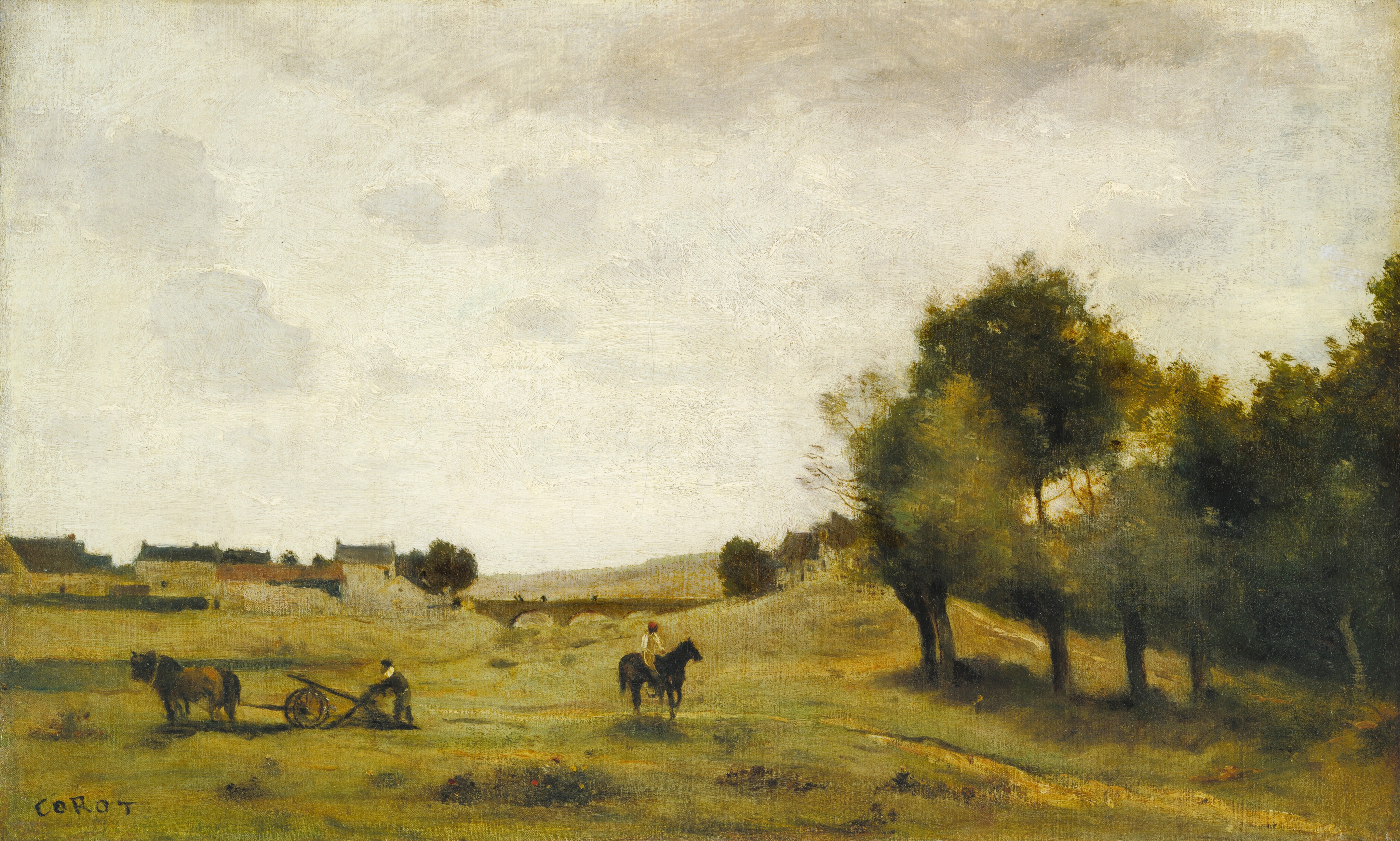
A ploughman works a field behind his horse while a rider in a red cap crosses the meadow, and a row of houses with tan walls and red roofs lines the far side beyond a small arched bridge. More about this work
About this work
A ploughman works a field behind his horse while a rider in a red cap crosses the meadow, and a row of houses with tan walls and red roofs lines the far side beyond a small arched bridge. Corot painted this view near Épernon, a town west of Paris on the road to Chartres, with loose, quick strokes and a palette of muted greens under a pale, milky sky. The small figures, the flowers scattered through the foreground and the even, silvery light make an ordinary agricultural scene quietly poetic.
Written by Ochre Editions.
What you’re looking at
A person at the center of this loosely painted horizontal landscape rides a dark horse across a field as a man to the left works the field behind a horse-drawn plow. The field is carpeted with muted and gold-shaded green, and a grove of trees in the right third of the composition are painted in fern, olive, and dark green. A patch of darker green near us and to left of center is dotted with red and yellow to suggest flowers. The men and horses are small in relation to the composition. The people have brown skin and are painted with a few strokes in dark gray and muted green for the man behind the plow to the left and pale yellow and white and a red cap for the person on horseback. A band of houses with tan or light yellow walls and gray or terracotta red roofs line the far side of the field to the left, and an arched bridge crosses what appears to be a shallow, grassy ravine near the center. The horizon comes about a third of the way up this composition and a few smoke-gray clouds line the upper edge of the otherwise milk-white sky. The artist signed the lower left corner, “COROT.”
Description from the National Gallery of Art.
How it was made
- Oil paint
- Pigment ground in a drying oil, usually linseed. It dries slowly, so painters could blend on the canvas, build up thin translucent glazes, and rework a picture over weeks. Canvas replaced wooden panels in the 1500s because it is lighter and can be rolled.
Jean Baptiste Camille Corot
French, 1796–1875 · Born and died in Paris.
Corot trained with the landscape painters Achille-Etna Michallon and Jean-Victor Bertin, then spent 1825–28 in Italy, where his small oil sketches of Rome and the Campagna caught its clear light with great economy. He returned to Italy twice and travelled widely in France. His Salon pictures moved from classical landscape to the silvery, misty reveries that made him famous in the 1850s and 1860s, and late in life he painted thoughtful figure studies of models in costume.
Written by Ochre Editions.
Rights and the museum’s record
Public domain. The National Gallery of Art has dedicated this image to the public domain under CC0, so anyone may copy, adapt and use it, for any purpose, without asking. Our prints and files are reproductions made from the museum’s image; the museum doesn’t endorse them.
- Object number
- 1942.9.13
- Credit
- Courtesy National Gallery of Art, Washington
- Type
- Painting
- Licence
- CC0 1.0 Universal
- Museum record
- See it on the museum’s site
Report this work
More by Jean Baptiste Camille Corot
All their works
Close in colour