The Forest of Coubron1872
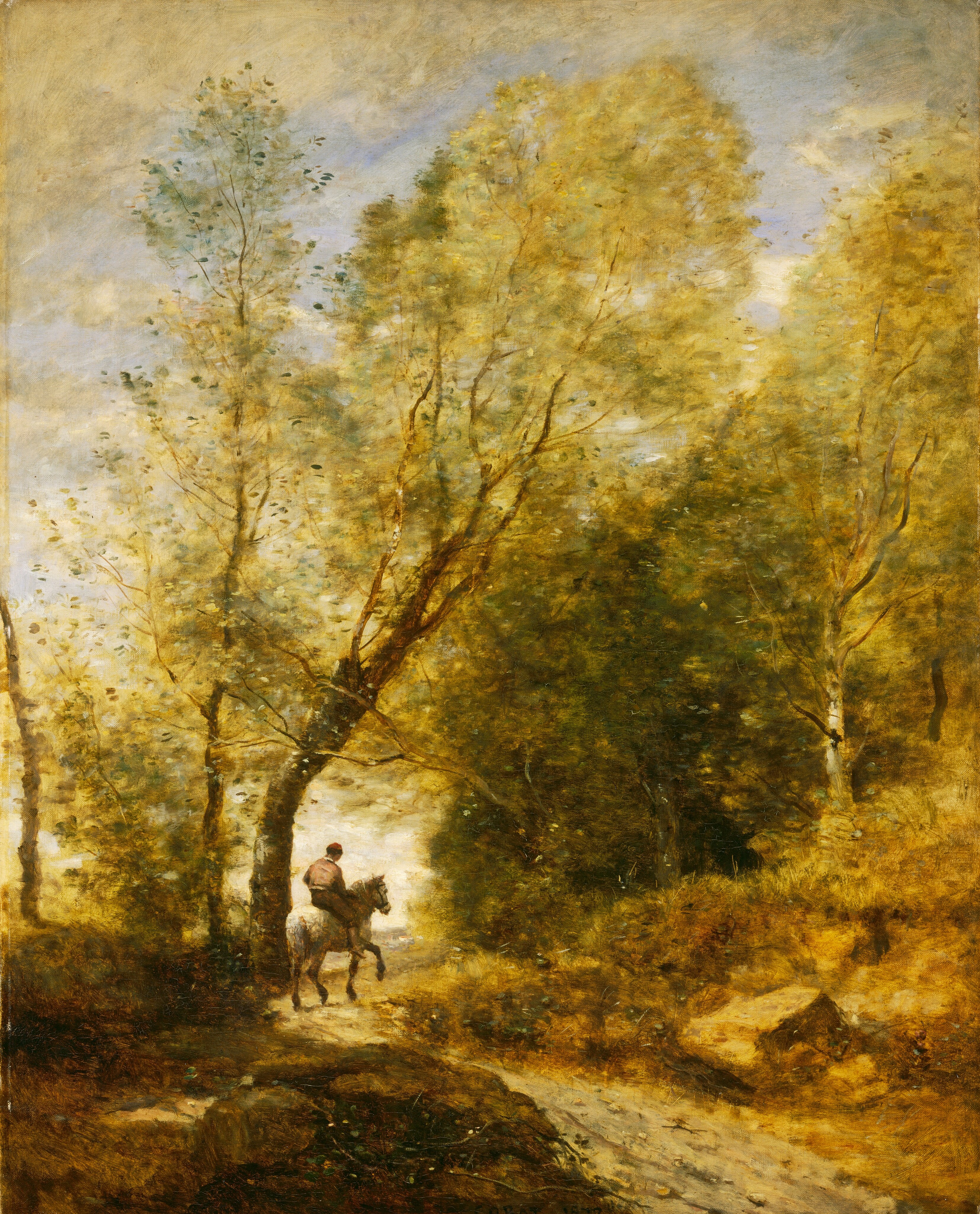
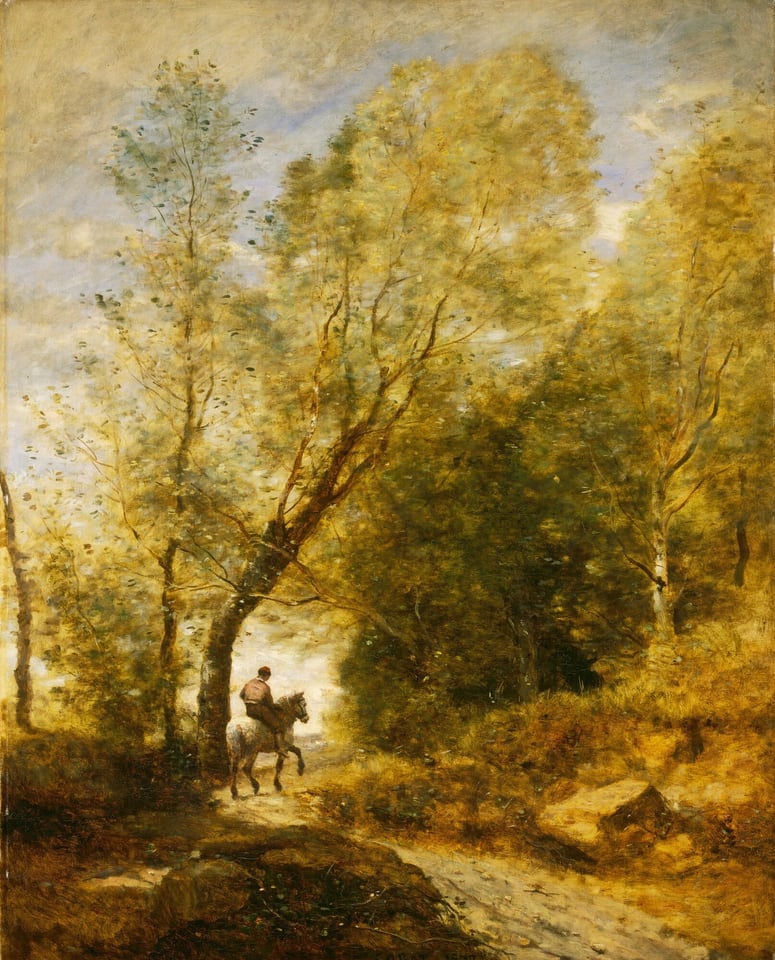
A rider on a white horse follows a narrow path that curves away through a forest of tall, golden trees, past a backlit boulder, towards a pale gap of sky. More about this work
About this work
A rider on a white horse follows a narrow path that curves away through a forest of tall, golden trees, past a backlit boulder, towards a pale gap of sky. Corot painted this late landscape in 1872 after visits to Coubron, a village east of Paris, and it shows the soft, feathery touch and silvery light that made his late work so popular. Rather than describing each leaf, he suggests the shimmer of the foliage and the hush of the woods, inviting us to follow the rider into the picture.
Written by Ochre Editions.
What you’re looking at
A person rides a horse away from us on a narrow dirt path curving through a forest dominated by golden yellow trees in this vertical landscape painting. A boulder about twice the width of the path is backlit where it sits just left of the lower center of the canvas. The path begins near the bottom right corner of the painting and curves back and to the right. The horse is white, and the rider wears dark brown pants and a hat, and a lighter brown shirt. Trees towering over the rider to either side of the curve nearly reach the top of the composition. The horizon comes less than a third of the way up the painting. Pearly white sky fills in the gap between the trees around the rider, and ivory-colored clouds frame an icy blue sky above. The scene is painted with textured and blended strokes, which gives the painting a soft look even though some of the brushstrokes are visible. The artist signed and dated the lower center of the canvas, though it is partially cut off: “COROT 1872.”
Description from the National Gallery of Art.
How it was made
- Oil paint
- Pigment ground in a drying oil, usually linseed. It dries slowly, so painters could blend on the canvas, build up thin translucent glazes, and rework a picture over weeks. Canvas replaced wooden panels in the 1500s because it is lighter and can be rolled.
Jean Baptiste Camille Corot
French, 1796–1875 · Born and died in Paris.
Corot trained with the landscape painters Achille-Etna Michallon and Jean-Victor Bertin, then spent 1825–28 in Italy, where his small oil sketches of Rome and the Campagna caught its clear light with great economy. He returned to Italy twice and travelled widely in France. His Salon pictures moved from classical landscape to the silvery, misty reveries that made him famous in the 1850s and 1860s, and late in life he painted thoughtful figure studies of models in costume.
Written by Ochre Editions.
Rights and the museum’s record
Public domain. The National Gallery of Art has dedicated this image to the public domain under CC0, so anyone may copy, adapt and use it, for any purpose, without asking. Our prints and files are reproductions made from the museum’s image; the museum doesn’t endorse them.
- Object number
- 1942.9.12
- Credit
- Courtesy National Gallery of Art, Washington
- Type
- Painting
- Licence
- CC0 1.0 Universal
- Museum record
- See it on the museum’s site