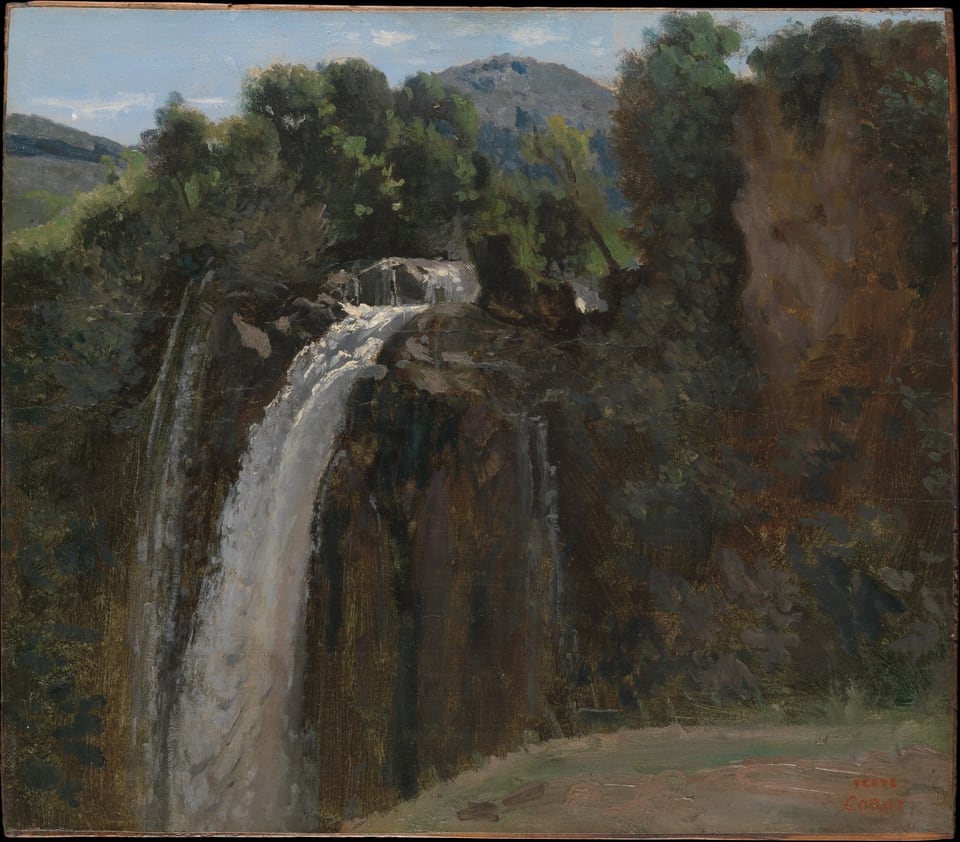
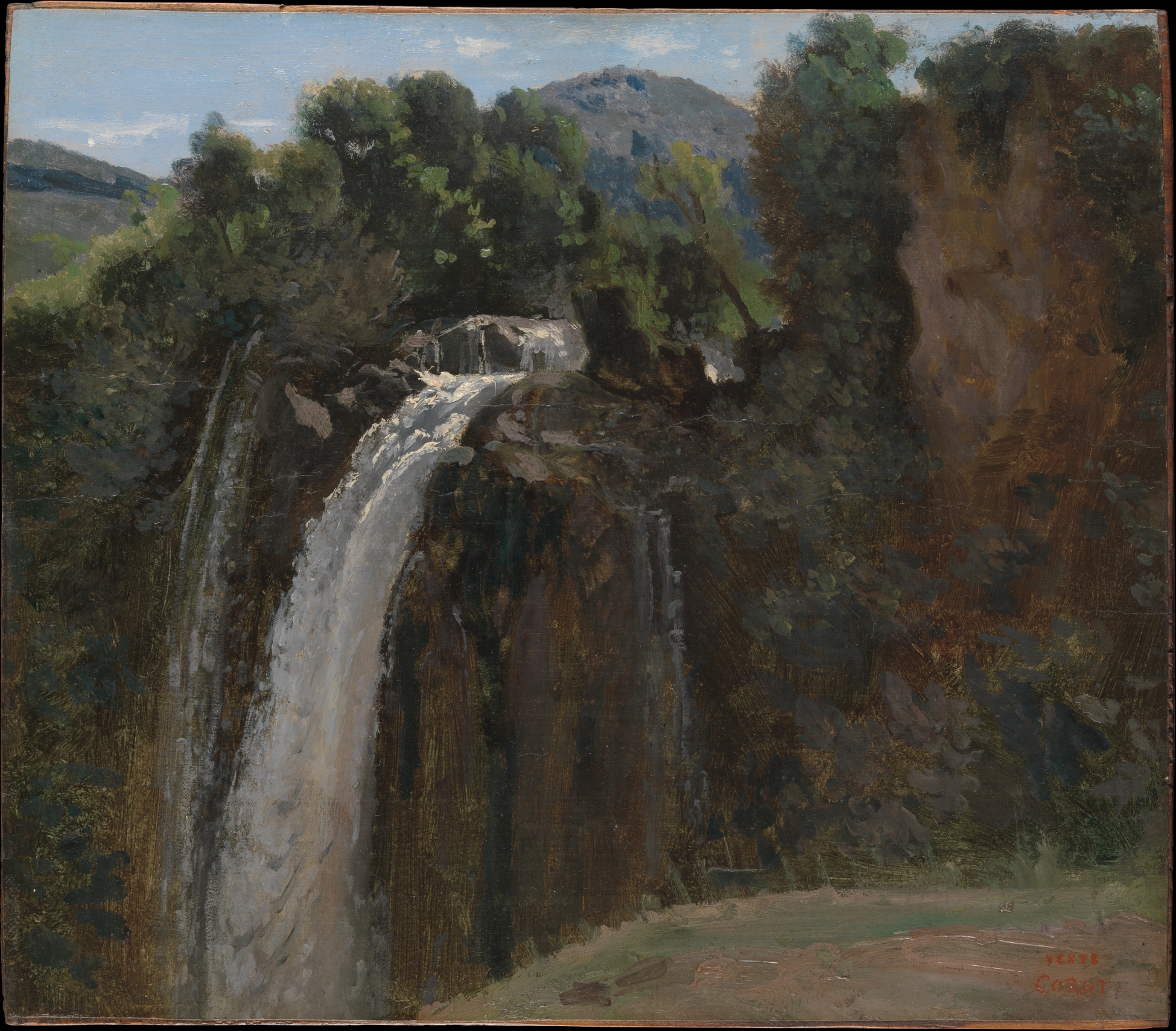
Waterfall at Terni1826
The waterfall at Terni, a celebrated cascade in Umbria visited by generations of travellers, is the subject of this small oil study on paper. More about this work
About this work
The waterfall at Terni, a celebrated cascade in Umbria visited by generations of travellers, is the subject of this small oil study on paper. Corot made it in 1826, during his first stay in Italy, when he worked outdoors directly from nature, setting down the essentials of light, mass and colour quickly before conditions changed. Such sketches were meant as private studies, but today they are admired as some of the freshest landscapes of their century.
Written by Ochre Editions.
How it was made
- Oil paint
- Pigment ground in a drying oil, usually linseed. It dries slowly, so painters could blend on the canvas, build up thin translucent glazes, and rework a picture over weeks. Canvas replaced wooden panels in the 1500s because it is lighter and can be rolled.
Jean Baptiste Camille Corot
French, 1796–1875 · Born and died in Paris.
Corot trained with the landscape painters Achille-Etna Michallon and Jean-Victor Bertin, then spent 1825–28 in Italy, where his small oil sketches of Rome and the Campagna caught its clear light with great economy. He returned to Italy twice and travelled widely in France. His Salon pictures moved from classical landscape to the silvery, misty reveries that made him famous in the 1850s and 1860s, and late in life he painted thoughtful figure studies of models in costume.
Written by Ochre Editions.
Rights and the museum’s record
Public domain. The Met has dedicated this image to the public domain under CC0, so anyone may copy, adapt and use it, for any purpose, without asking. Our prints and files are reproductions made from the museum’s image; the museum doesn’t endorse them.
- Object number
- 2003.42.13
- Credit
- Courtesy of The Metropolitan Museum of Art
- Type
- Paintings
- Department
- European Paintings
- Licence
- CC0 1.0 Universal
- Museum record
- See it on the museum’s site
Report this work
More by Jean Baptiste Camille Corot
All their works
Close in colour