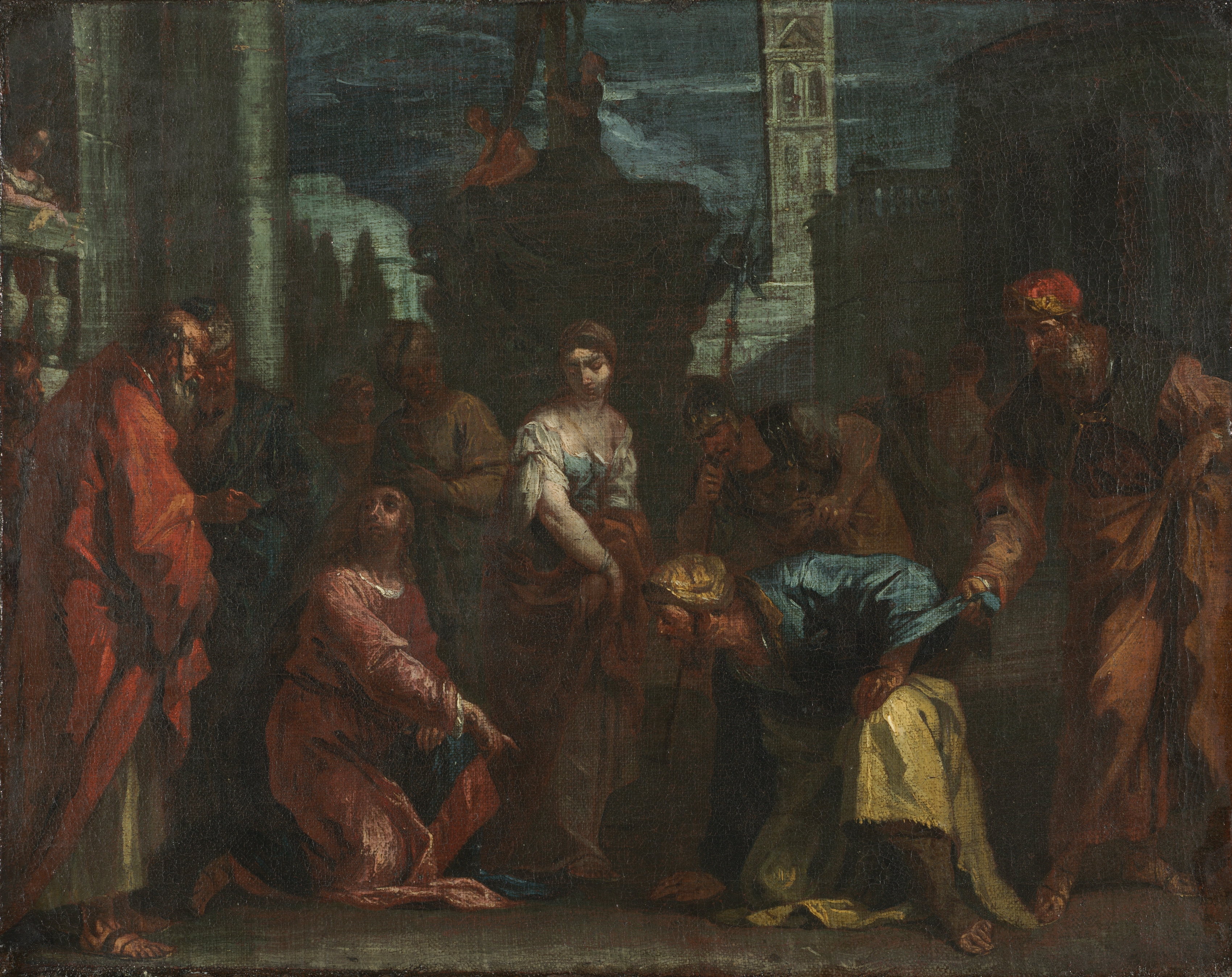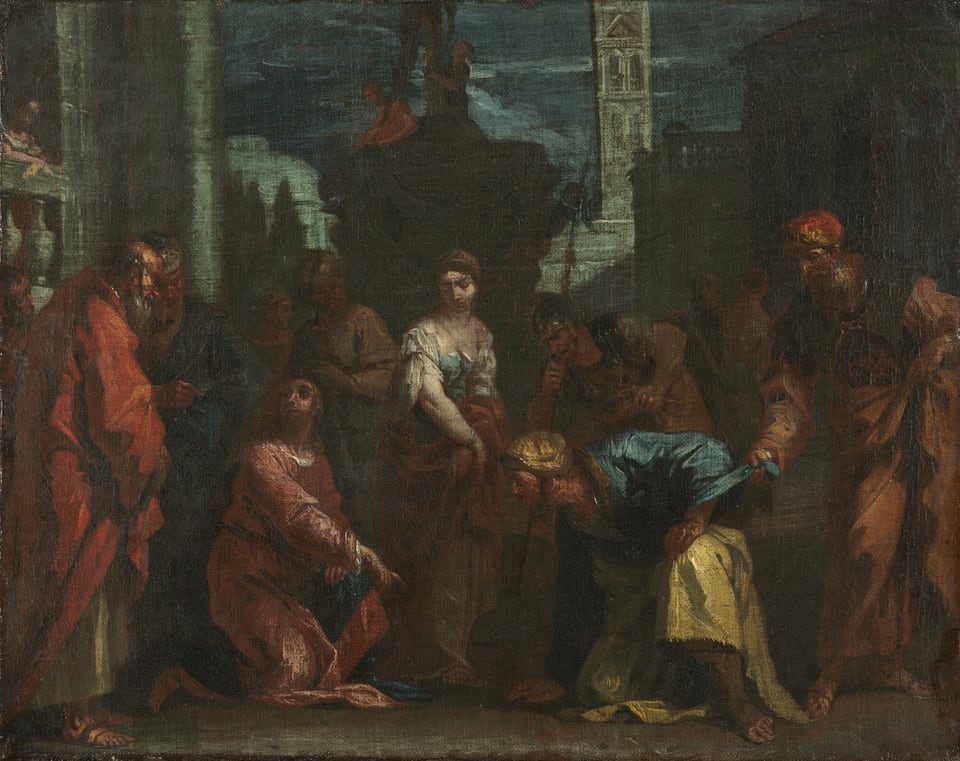
Christ and the Woman Taken in Adulterymid-1700s
The subject originates in the Gospel of John 7:53-8:11, where Pharisees bring a woman accused of adultery to Christ, attempting to trick him into disobeying the Old Testament precept that she be stoned. More about this work
About this work
The subject originates in the Gospel of John 7:53-8:11, where Pharisees bring a woman accused of adultery to Christ, attempting to trick him into disobeying the Old Testament precept that she be stoned. In response, Christ interrupted his writing on the ground, stating: "Let anyone among you who is without sin be the first to throw a stone at her." The Pharisees, unable to retort, gradually disperse, and Christ eventually sends the woman away with an admonition not to sin again. The subject was popular in 18th-century Venice, partly because magnanimity was an important value, celebrated in visual, musical, and literary culture. The showy, exotic subject and the public presentation of an openly sexualized woman also enjoyed popularity in 18th-century Venetian painting. This work is a copy of the picture at the Minneapolis Institute of Arts, perhaps by a student (and certainly not by Ricci himself)
Text from the Cleveland Museum of Art.
How it was made
- Oil paint
- Pigment ground in a drying oil, usually linseed. It dries slowly, so painters could blend on the canvas, build up thin translucent glazes, and rework a picture over weeks. Canvas replaced wooden panels in the 1500s because it is lighter and can be rolled.
Sebastiano Ricci
Italian, 1659–1734
Rights and the museum’s record
Public domain. The Cleveland Museum of Art has dedicated this image to the public domain under CC0, so anyone may copy, adapt and use it, for any purpose, without asking. Our prints and files are reproductions made from the museum’s image; the museum doesn’t endorse them.
- Object number
- 1916.785
- Credit
- Courtesy of the Cleveland Museum of Art
- Type
- Painting
- Department
- European Painting and Sculpture
- Licence
- CC0 1.0 Universal
- Museum record
- See it on the museum’s site