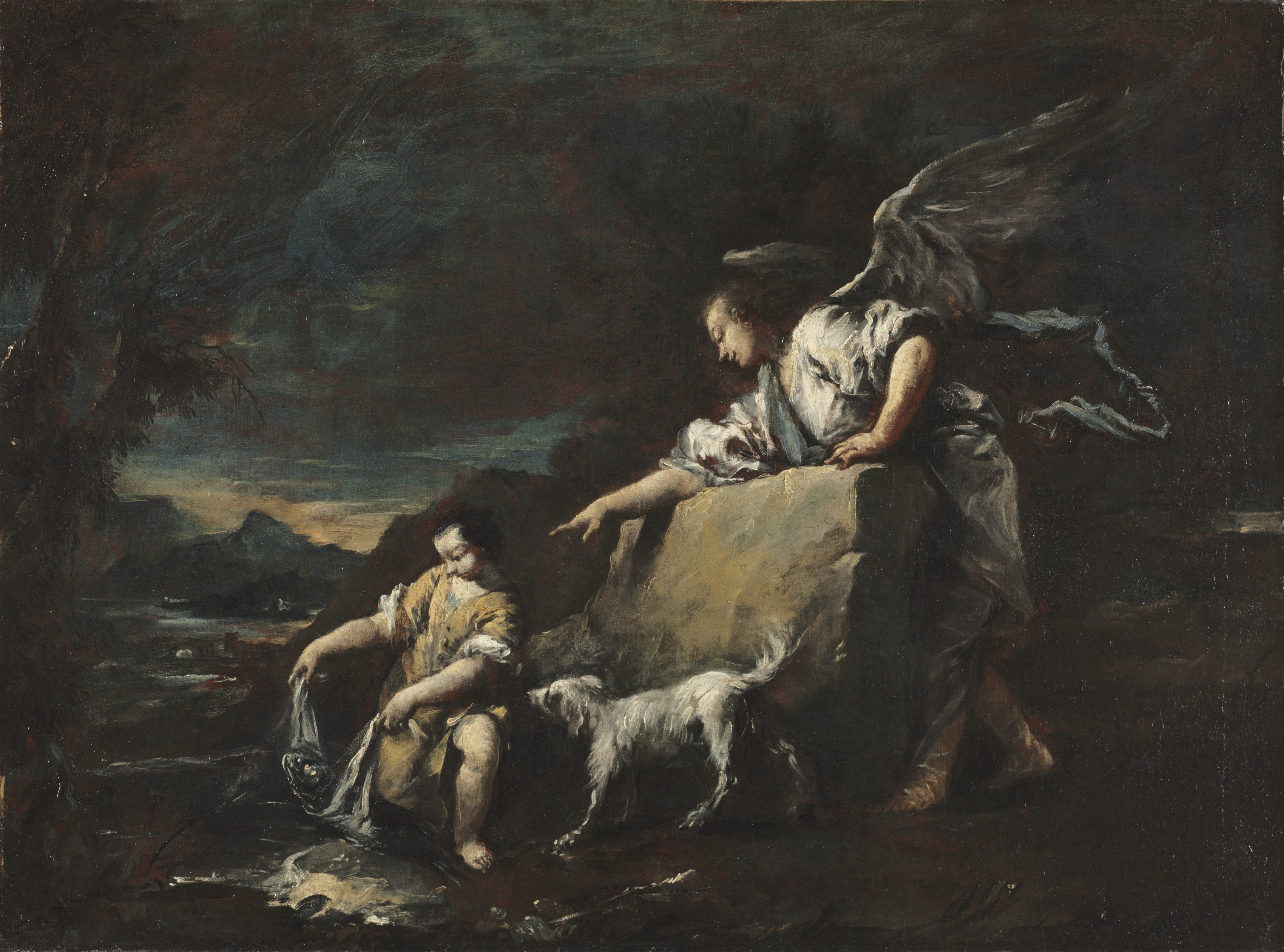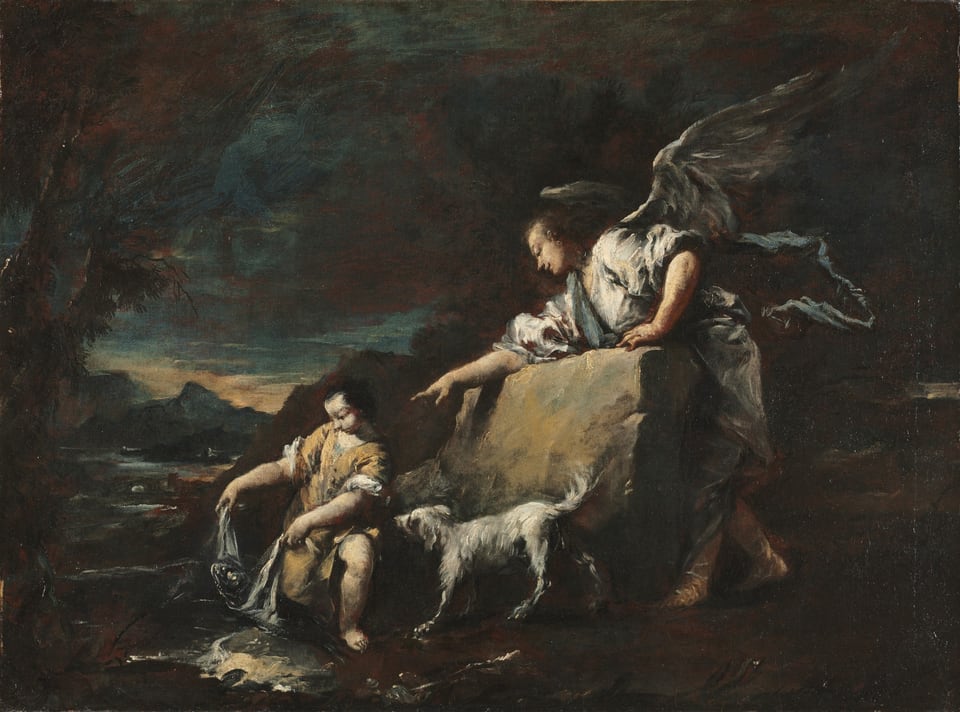
Tobias and the Angel1750s
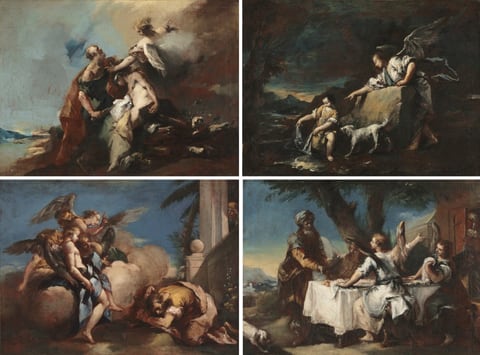
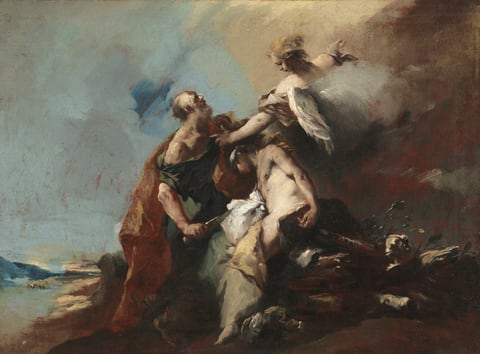
This series of paintings predominantly tells the Old Testament story of Abraham and Isaac, and each of the canvases treats the interaction of humans and angels. More about this work
About this work
This series of paintings predominantly tells the Old Testament story of Abraham and Isaac, and each of the canvases treats the interaction of humans and angels. In three works, angels appear to Abraham. However, the narrative of Tobias and the Angel comes from an entirely different book of the Bible. The blind Tobit sends his son Tobias off to collect a sum of money in the distant town of Media, with the angel Raphael accompanying him in disguise as a human. This particular work depicts Raphael overseeing Tobias catching a fish, which would later be used to cure his father's blindness.
Text from the Cleveland Museum of Art.
How it was made
- Oil paint
- Pigment ground in a drying oil, usually linseed. It dries slowly, so painters could blend on the canvas, build up thin translucent glazes, and rework a picture over weeks. Canvas replaced wooden panels in the 1500s because it is lighter and can be rolled.
Francesco Guardi
Italian, 1712–1793 · Born and died in Venice.
Guardi worked for years in the family studio in Venice led by his elder brother Gianantonio, producing altarpieces and figure paintings, and became chiefly a painter of city views, especially after his brother’s death in 1760. Where Canaletto is crisp and exact, Guardi’s views and imaginary capricci are loose and flickering, with dissolving buildings and shimmering water. He also recorded the public ceremonies of the last decades of the Venetian Republic.
Written by Ochre Editions.
Rights and the museum’s record
Public domain. The Cleveland Museum of Art has dedicated this image to the public domain under CC0, so anyone may copy, adapt and use it, for any purpose, without asking. Our prints and files are reproductions made from the museum’s image; the museum doesn’t endorse them.
- Object number
- 1952.235.2
- Credit
- Courtesy of the Cleveland Museum of Art
- Type
- Painting
- Department
- European Painting and Sculpture
- Licence
- CC0 1.0 Universal
- Museum record
- See it on the museum’s site