Floor plan

Artist galleriesJean Baptiste Camille Corot
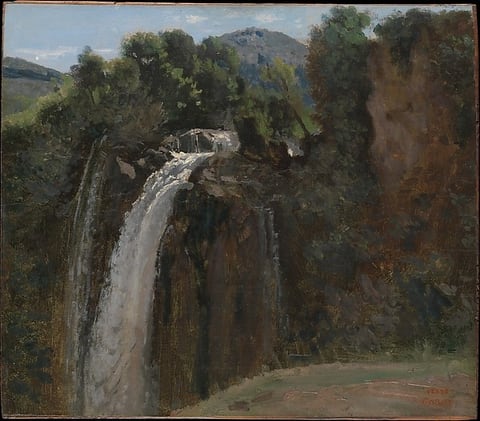
Jean Baptiste Camille Corot
Waterfall at Terni, by Jean Baptiste Camille Corot, 1826
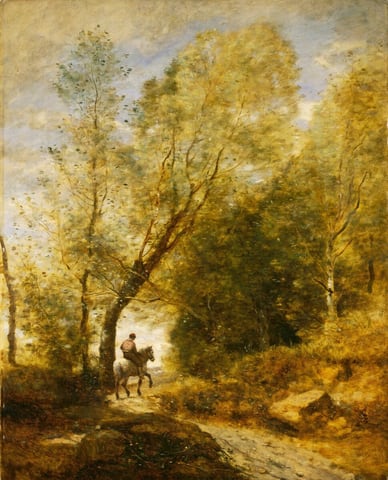
A person rides a horse away from us on a narrow dirt path curving through a forest dominated by golden yellow trees in this vertical landscape painting. A boulder about twice the width of the path is backlit where it sits just left of the lower center of the canvas. The path begins near the bottom right corner of the painting and curves back and to the right. The horse is white, and the rider wears dark brown pants and a hat, and a lighter brown shirt. Trees towering over the rider to either side of the curve nearly reach the top of the composition. The horizon comes less than a third of the way up the painting. Pearly white sky fills in the gap between the trees around the rider, and ivory-colored clouds frame an icy blue sky above. The scene is painted with textured and blended strokes, which gives the painting a soft look even though some of the brushstrokes are visible. The artist signed and dated the lower center of the canvas, though it is partially cut off: “COROT 1872.”
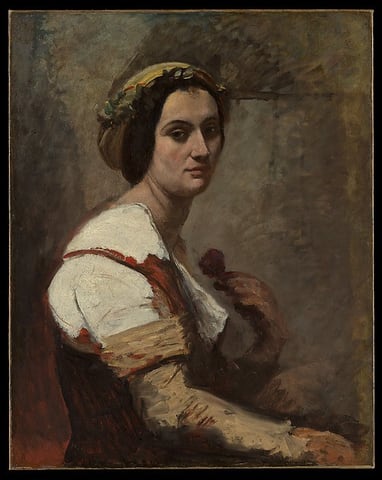
Sibylle, by Jean Baptiste Camille Corot, ca. 1870
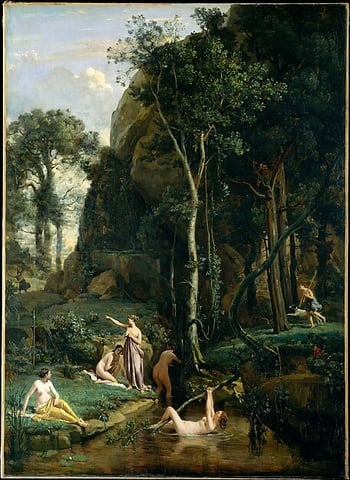
Diana and Actaeon (Diana Surprised in Her Bath), by Jean Baptiste Camille Corot, 1836
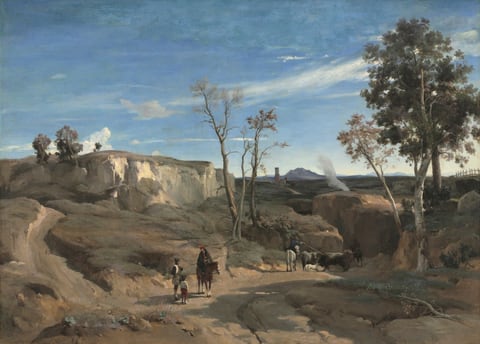
La Cervara, the Roman Campagna, by Jean Baptiste Camille Corot, c. 1830–31
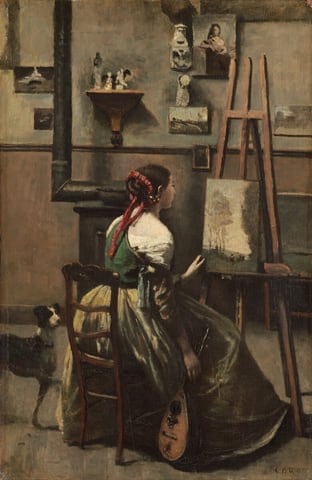
A young, pale-skinned woman sits with her back to us as she looks at a painting on an easel in a studio in this vertical painting. She sits in a ladder-back wood chair so her knees angle away from us, toward the back right corner of the studio. We look onto the side of her right cheek as she leans forward. Her brown hair is combed back and twisted into a bun wrapped with a raspberry-red ribbon that trails down her back. Touches of pearl white, pale pink, and silvery gray suggest flowers by the ear we can see. A cream-white chemise falls off the shoulder closer to us, under a grass-green bodice. She holds a mandolin down by her right side, which is closer to us, to nestle in the folds of her voluminous, olive-green skirt. She reaches forward with her other hand to touch the lower left corner of the painting resting on the easel. That vertically-oriented scene is loosely painted and shows a few people gathered in a landscape. A white and black dog stands with one front leg lifted to the left of the woman's chair, looking at her. The wall opposite us is parchment white over a strip of molding, like a high chair rail, and muted mauve pink below. An L-shaped pipe leads to an iron stove to our left of center. A narrow shelf tucked into the L of the pipe holds three hand-sized sculptures or casts. Small paintings and plaster casts hang around it on the wall above the molding. The artist signed the painting in the lower right: “COROT.”
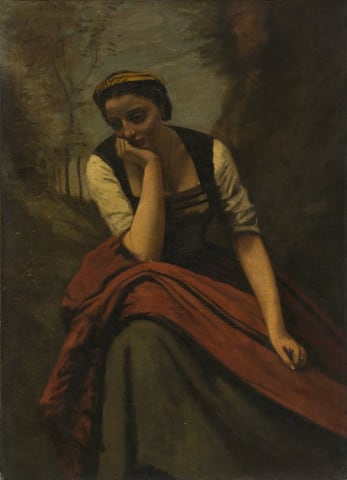
Woman Meditating, by Jean Baptiste Camille Corot, after 1868

The works in this room are listed below.

Works in this room

Jean Baptiste Camille Corot (French, 1796–1875). Every work of theirs in the collection, in today's hang.
Section 1, north wall

  1. Waterfall at Terni, by Jean Baptiste Camille Corot, 1826
    Waterfall at TerniJean Baptiste Camille Corot, 1826Courtesy of The Metropolitan Museum of Art
  2. A person rides a horse away from us on a narrow dirt path curving through a forest dominated by golden yellow trees in this vertical landscape painting. A boulder about twice the width of the path is backlit where it sits just left of the lower center of the canvas. The path begins near the bottom right corner of the painting and curves back and to the right. The horse is white, and the rider wears dark brown pants and a hat, and a lighter brown shirt. Trees towering over the rider to either side of the curve nearly reach the top of the composition. The horizon comes less than a third of the way up the painting. Pearly white sky fills in the gap between the trees around the rider, and ivory-colored clouds frame an icy blue sky above. The scene is painted with textured and blended strokes, which gives the painting a soft look even though some of the brushstrokes are visible. The artist signed and dated the lower center of the canvas, though it is partially cut off: “COROT 1872.”
    The Forest of CoubronJean Baptiste Camille Corot, 1872Courtesy National Gallery of Art, Washington
  3. Sibylle, by Jean Baptiste Camille Corot, ca. 1870
    SibylleJean Baptiste Camille Corot, ca. 1870Courtesy of The Metropolitan Museum of Art
  4. Diana and Actaeon (Diana Surprised in Her Bath), by Jean Baptiste Camille Corot, 1836
    Diana and Actaeon (Diana Surprised in Her Bath)Jean Baptiste Camille Corot, 1836Courtesy of The Metropolitan Museum of Art

Section 1, south wall

  1. La Cervara, the Roman Campagna, by Jean Baptiste Camille Corot, c. 1830–31
    La Cervara, the Roman CampagnaJean Baptiste Camille Corot, c. 1830–31Courtesy of the Cleveland Museum of Art
  2. A young, pale-skinned woman sits with her back to us as she looks at a painting on an easel in a studio in this vertical painting. She sits in a ladder-back wood chair so her knees angle away from us, toward the back right corner of the studio. We look onto the side of her right cheek as she leans forward. Her brown hair is combed back and twisted into a bun wrapped with a raspberry-red ribbon that trails down her back. Touches of pearl white, pale pink, and silvery gray suggest flowers by the ear we can see. A cream-white chemise falls off the shoulder closer to us, under a grass-green bodice. She holds a mandolin down by her right side, which is closer to us, to nestle in the folds of her voluminous, olive-green skirt. She reaches forward with her other hand to touch the lower left corner of the painting resting on the easel. That vertically-oriented scene is loosely painted and shows a few people gathered in a landscape. A white and black dog stands with one front leg lifted to the left of the woman's chair, looking at her. The wall opposite us is parchment white over a strip of molding, like a high chair rail, and muted mauve pink below. An L-shaped pipe leads to an iron stove to our left of center. A narrow shelf tucked into the L of the pipe holds three hand-sized sculptures or casts. Small paintings and plaster casts hang around it on the wall above the molding. The artist signed the painting in the lower right: “COROT.”
    Corot's Studio: Woman Seated Before an Easel, a Mandolin in her HandJean Baptiste Camille Corot, c. 1868Courtesy National Gallery of Art, Washington
  3. Woman Meditating, by Jean Baptiste Camille Corot, after 1868
    Woman MeditatingJean Baptiste Camille Corot, after 1868Courtesy of the Cleveland Museum of Art

Section 2, south wall
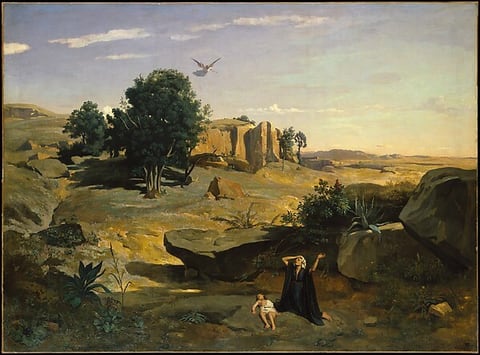
  1. Hagar in the Wilderness, by Jean Baptiste Camille Corot, 1835
    Hagar in the WildernessJean Baptiste Camille Corot, 1835Courtesy of The Metropolitan Museum of Art
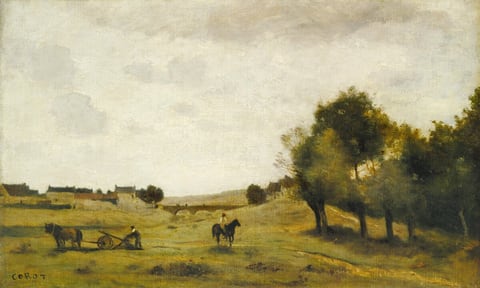
  2. A person at the center of this loosely painted horizontal landscape rides a dark horse across a field as a man to the left works the field behind a horse-drawn plow. The field is carpeted with muted and gold-shaded green, and a grove of trees in the right third of the composition are painted in fern, olive, and dark green. A patch of darker green near us and to left of center is dotted with red and yellow to suggest flowers. The men and horses are small in relation to the composition. The people have brown skin and are painted with a few strokes in dark gray and muted green for the man behind the plow to the left and pale yellow and white and a red cap for the person on horseback. A band of houses with tan or light yellow walls and gray or terracotta red roofs line the far side of the field to the left, and an arched bridge crosses what appears to be a shallow, grassy ravine near the center. The horizon comes about a third of the way up this composition and a few smoke-gray clouds line the upper edge of the otherwise milk-white sky. The artist signed the lower left corner, “COROT.”
    View near EpernonJean Baptiste Camille Corot, 1850/1860Courtesy National Gallery of Art, Washington