The Lackawanna Valleyc. 1856
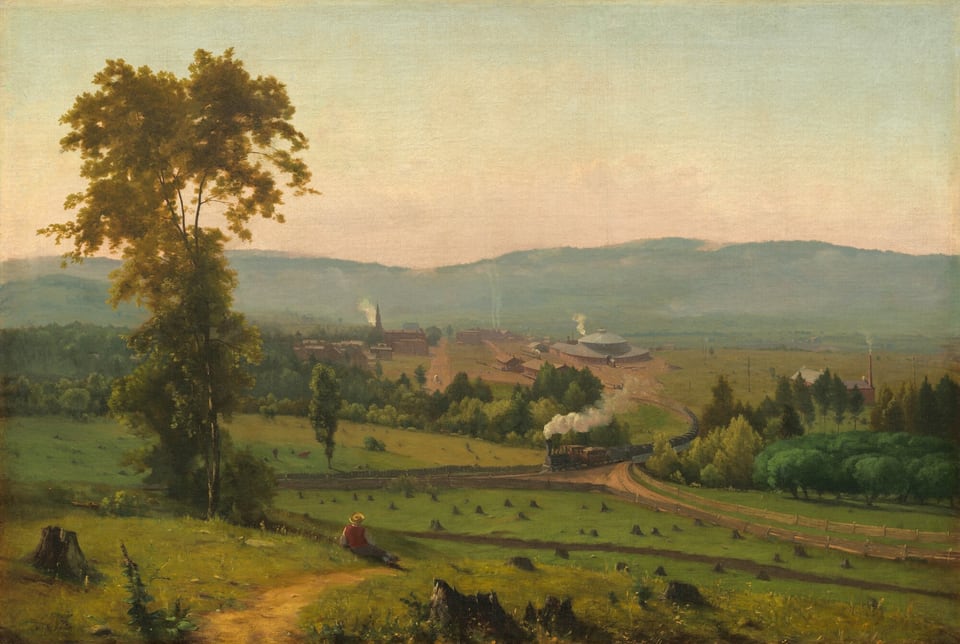
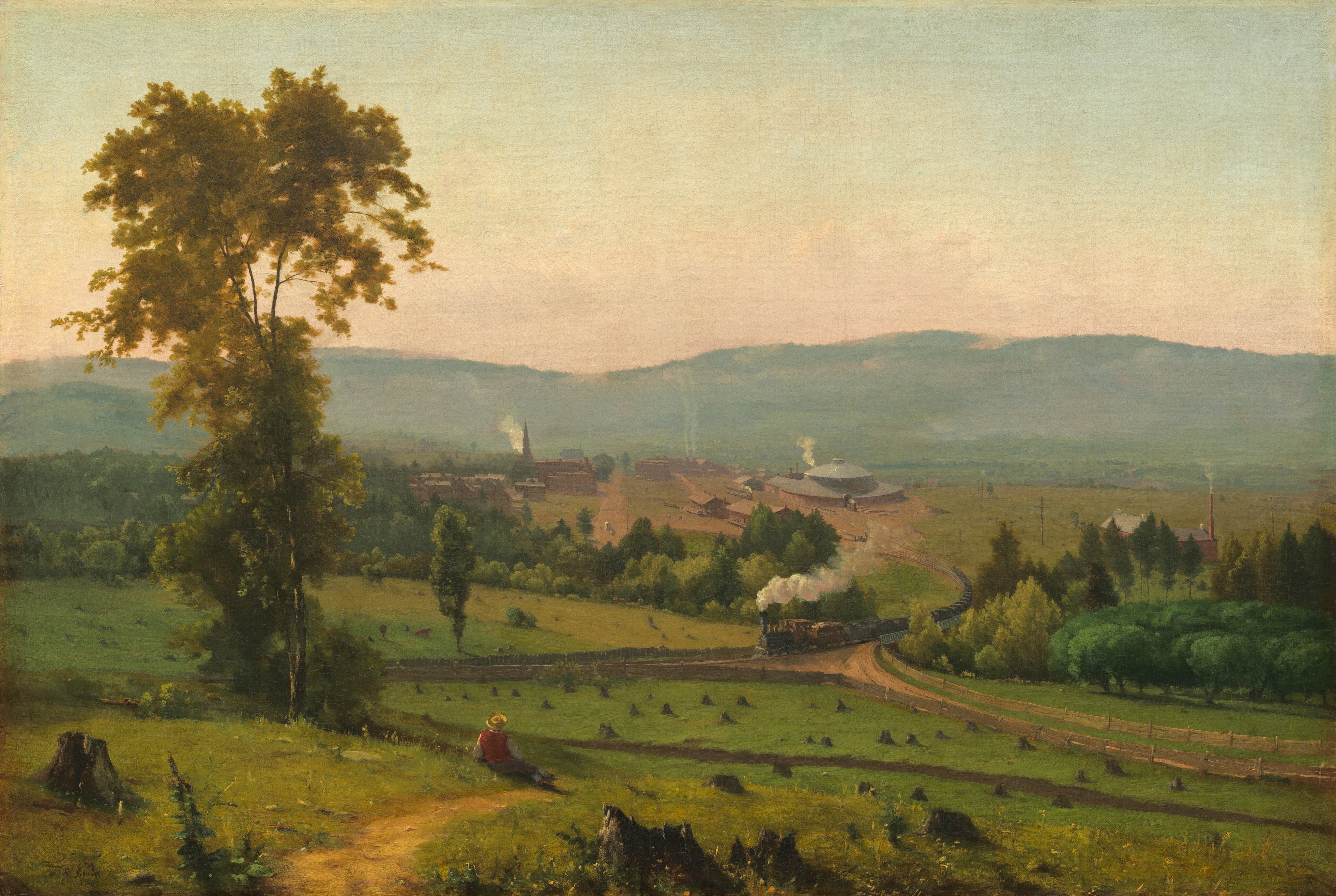
A figure reclines beneath a tree in a meadow scattered with stumps, looking out over a valley where a steam train puffs across a bridge, leaving behind a roundhouse, smoking chimneys and a church steeple. More about this work
About this work
A figure reclines beneath a tree in a meadow scattered with stumps, looking out over a valley where a steam train puffs across a bridge, leaving behind a roundhouse, smoking chimneys and a church steeple. George Inness painted the scene around 1856 for the Delaware, Lackawanna and Western Railroad, which wanted a picture of its line near Scranton, Pennsylvania. He made it far more than an advertisement: the cut stumps and the drifting smoke quietly register what is lost as the old landscape gives way to industry, even as the soft light presents progress as harmonious.
Written by Ochre Editions.
What you’re looking at
We look across and down into a valley with a person sitting near a tall tree and a train puffing smoke beyond, all enclosed by a band of mountains in the distance in this horizontal landscape painting. Closest to us, several broken, jagged tree stumps are spaced across the painting’s width. A little distance away and to our left, the person wears a yellow, broad-brimmed hat, red vest, and gray pants. He reclines propped on his left elbow near a walking path beside a tall, slender tree with golden leaves. The green meadow stretching in front of him is dotted with tree stumps cut close to the ground. Beyond the meadow, puffs of white smoke trail behind a long steam locomotive that crosses a bridge spanning a tree-filled ravine, headed to our left. The ravine creates a diagonal line across the canvas, moving subtly away from us to our left. The train has climbed out of the valley, away from a cluster of brick-red buildings. The most prominent structure is a train roundhouse, a large building with a high, domed roof to the right of the tracks. Smoke rises from chimneys on long, warehouse-like buildings, and a steeple and smaller structures suggest a church and homes to our left. Hazy in the distance, a row of mountains lines the horizon, which comes about halfway up the composition. The sky above deepens from pale, shell pink over the mountains to watery, pale blue above. The artist signed the work in tiny letters in the lower left corner: “G. Inness.”
Description from the National Gallery of Art.
How it was made
- Oil paint
- Pigment ground in a drying oil, usually linseed. It dries slowly, so painters could blend on the canvas, build up thin translucent glazes, and rework a picture over weeks. Canvas replaced wooden panels in the 1500s because it is lighter and can be rolled.
George Inness
American, 1825–1894 · Born in Newburgh, New York; died in Bridge of Allan, Scotland.
Inness was largely self-taught and began in the manner of the Hudson River School, but journeys to Italy and France, where he admired the Barbizon painters, led him towards broader, more atmospheric landscapes. In later life, influenced by the religious thought of Emanuel Swedenborg, he painted veiled, glowing scenes, many around his home at Montclair, New Jersey, in which form dissolves into light and mood. He died while travelling in Scotland.
Written by Ochre Editions.
Rights and the museum’s record
Public domain. The National Gallery of Art has dedicated this image to the public domain under CC0, so anyone may copy, adapt and use it, for any purpose, without asking. Our prints and files are reproductions made from the museum’s image; the museum doesn’t endorse them.
- Object number
- 1945.4.1
- Credit
- Courtesy National Gallery of Art, Washington
- Type
- Painting
- Licence
- CC0 1.0 Universal
- Museum record
- See it on the museum’s site
Report this work
More by George Inness
All their works
Close in colour