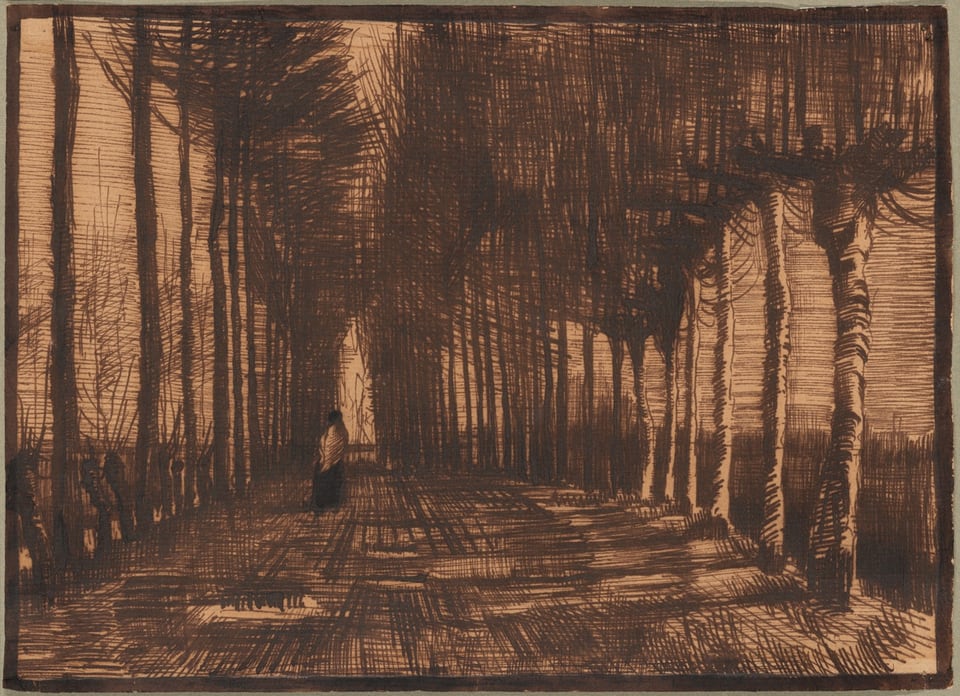
Avenue of Pollard Birches and PoplarsMarch 1884
A row of pollarded birches and poplars lines a country road near the village of Nuenen in the southern Netherlands, where Van Gogh lived with his parents from late 1883. More about this work
About this work
A row of pollarded birches and poplars lines a country road near the village of Nuenen in the southern Netherlands, where Van Gogh lived with his parents from late 1883. He drew it in March 1884 with a reed pen and iron-gall ink, building the stark, bare trees, the receding road and the wintry light from bold strokes and fine hatching. This early drawing, made before he discovered brilliant colour in Paris, shows his patient study of the Dutch countryside and his admiration for printmakers and illustrators.
Written by Ochre Editions.
What you’re looking at
A work made of reed pen and iron-gall ink on tan laid paper.
Description from the Art Institute of Chicago.
How it was made
- Pen and ink
- Drawn with a quill or reed pen, often with wash added by brush to model light and shadow.
- Laid paper
- Handmade on a mould of close-set wires, which leave fine parallel lines you can see when the sheet is held to the light.
Vincent van Gogh
Dutch, 1853–1890 · Born in Zundert; died in Auvers-sur-Oise.
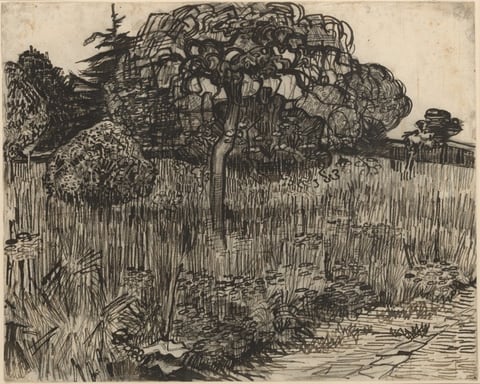
Van Gogh worked as an art dealer, teacher and lay preacher before he turned to art in 1880, at twenty-seven. His early pictures of Dutch peasants are dark and heavy; in Paris from 1886 he met the Impressionists and Neo-Impressionists, and his palette brightened. In Arles in 1888–89 he painted with intense colour and thick, directional strokes, and he worked on at the asylum in Saint-Rémy and finally at Auvers-sur-Oise. The Poet’s Garden belongs to a group made to decorate Gauguin’s room in the Yellow House.
Written by Ochre Editions.
Post-Impressionism
Artists who kept Impressionism's colour but pushed towards structure, symbol and feeling.
Rights and the museum’s record
Public domain. The Art Institute of Chicago has dedicated this image to the public domain under CC0, so anyone may copy, adapt and use it, for any purpose, without asking. Our prints and files are reproductions made from the museum’s image; the museum doesn’t endorse them.
- Object number
- 2022.74
- Credit
- Courtesy of the Art Institute of Chicago
- Type
- Drawing and Watercolor
- Department
- Prints and Drawings
- Licence
- CC0 1.0 Universal
- Museum record
- See it on the museum’s site
Report this work
More by Vincent van Gogh
All their works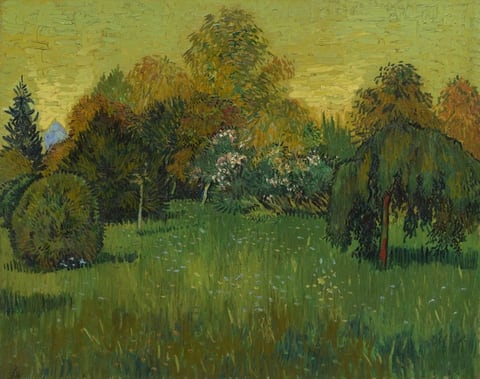
Close in colour