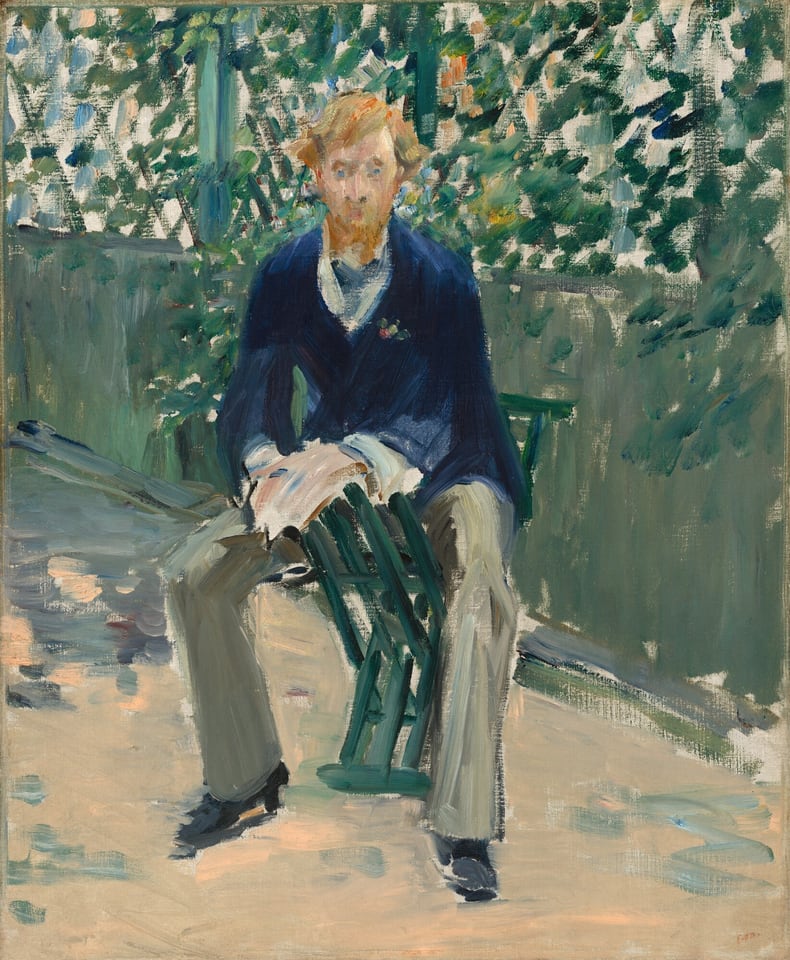
George Moore in the Artist's Gardenc. 1879
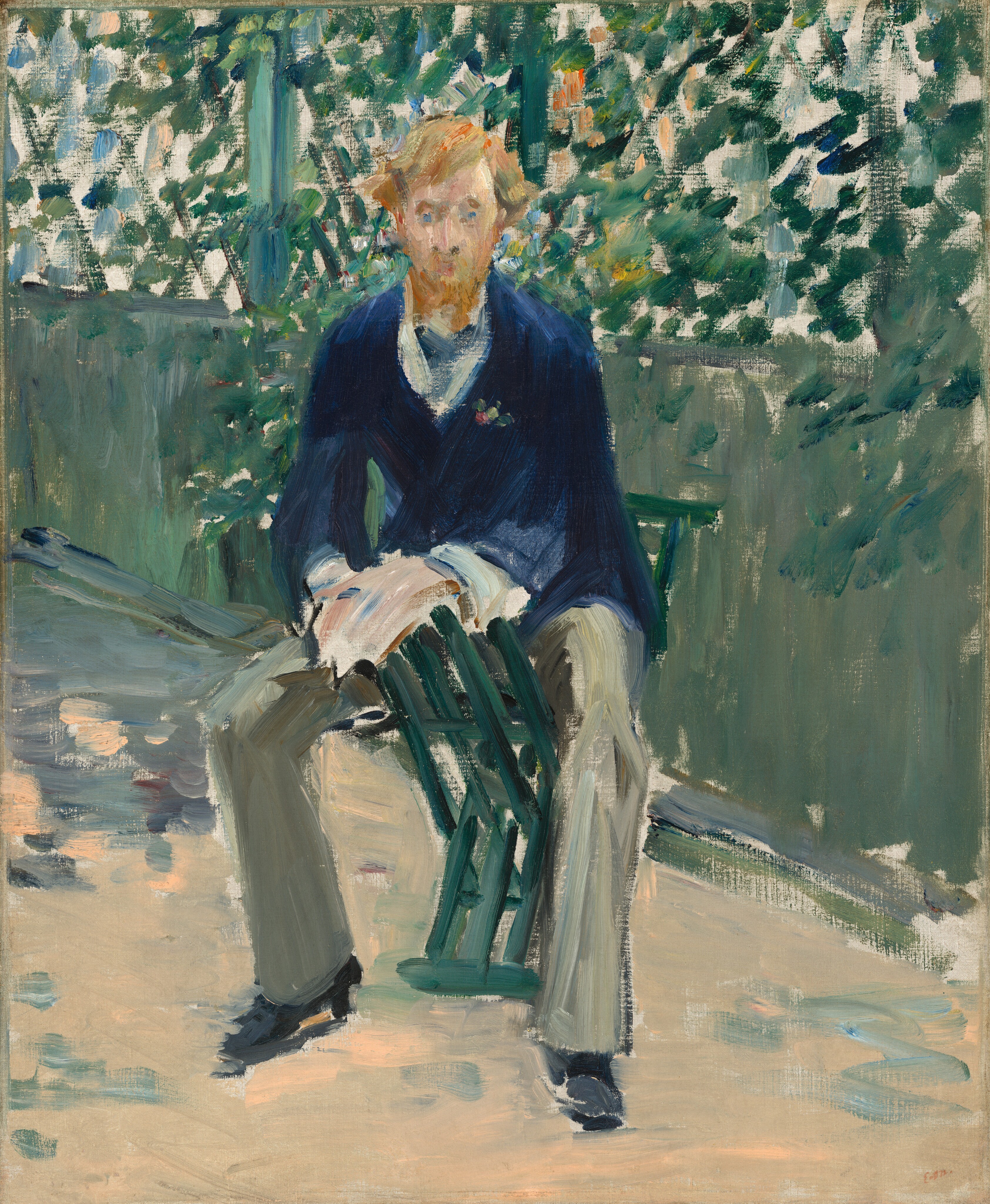
The young Irish writer George Moore sits astride a green folding chair in a sunlit garden, leaning forward with his hands on its frame, his red hair and beard and blue jacket set against a trellis tangled with vines and flecks of flowers. More about this work
About this work
The young Irish writer George Moore sits astride a green folding chair in a sunlit garden, leaning forward with his hands on its frame, his red hair and beard and blue jacket set against a trellis tangled with vines and flecks of flowers. Moore, who had come to Paris to train as a painter, became a friend of Manet and later one of the liveliest chroniclers of the Impressionist circle in English. Manet’s loose, rapid handling leaves the portrait close to a sketch, which gives it the immediacy of a conversation caught in passing.
Written by Ochre Editions.
What you’re looking at
A pale-skinned young man with a carrot-red beard and hair faces us, straddling a green chair in a sunny outdoor setting in this vertical painting. The scene is loosely painted so his features are indistinct. His eyes are painted as pale blue dots, and he looks out at us. His chair unfolds into an X shape, with interlacing slats to make the seat. He leans forward to rest his hands on one side of the chair, and his legs are spread wide. He wears a marine-blue jacket over a white shirt, sage-green trousers streaked with gray, and black shoes. A soft blue V-shape at the neck suggests a neckerchief. Behind him, a half wall is topped by a trellis. The wall is painted in muted tones of pale laurel green while the trellis is painted with crisscrossed strokes of pine green. Daubs of emerald, pine, and forest green suggest vines and leaves, and flicks of orange, gold, and blue could be flowers. The ground beneath the man is pale peach scattered with thin scribbles and patches of fog blue. The painting is inscribed with “E 72.” in the lower right.
Description from the National Gallery of Art.
How it was made
- Oil paint
- Pigment ground in a drying oil, usually linseed. It dries slowly, so painters could blend on the canvas, build up thin translucent glazes, and rework a picture over weeks. Canvas replaced wooden panels in the 1500s because it is lighter and can be rolled.
Édouard Manet
French, 1832–1883 · Born and died in Paris.
Manet came from a prosperous Parisian family, trained under Thomas Couture and studied the old masters, Velázquez above all. In the 1860s he provoked critics with Le Déjeuner sur l’herbe and Olympia, modern subjects painted in flat, frank colour with little modelling. Though he never showed with the Impressionists, younger painters looked to him as a leader, and in his last years he painted Parisian café life and A Bar at the Folies-Bergère.
Written by Ochre Editions.
Rights and the museum’s record
Public domain. The National Gallery of Art has dedicated this image to the public domain under CC0, so anyone may copy, adapt and use it, for any purpose, without asking. Our prints and files are reproductions made from the museum’s image; the museum doesn’t endorse them.
- Object number
- 2006.128.24
- Credit
- Courtesy National Gallery of Art, Washington
- Type
- Painting
- Licence
- CC0 1.0 Universal
- Museum record
- See it on the museum’s site
Report this work
More by Édouard Manet
All their works