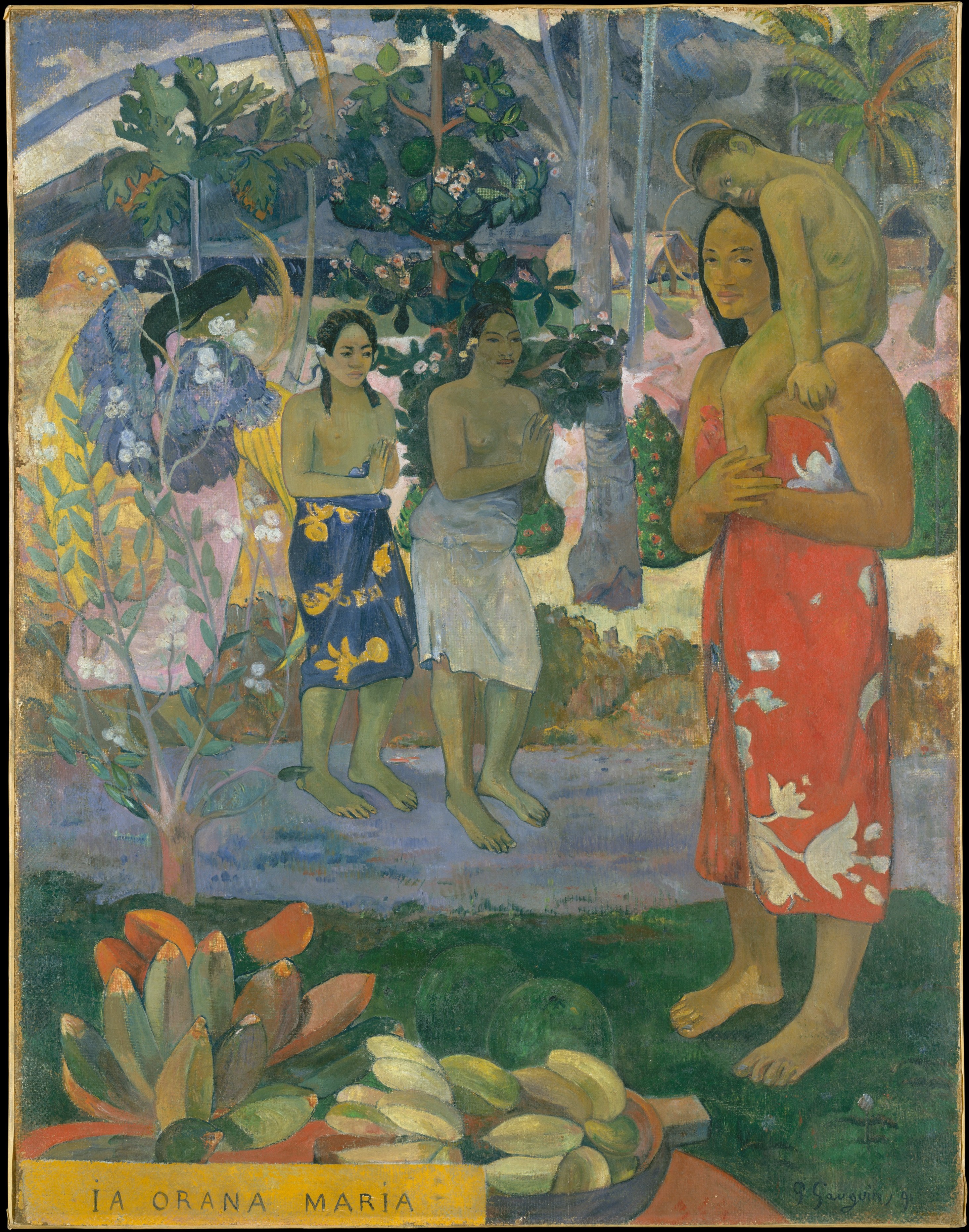
Ia Orana Maria (Hail Mary)1891
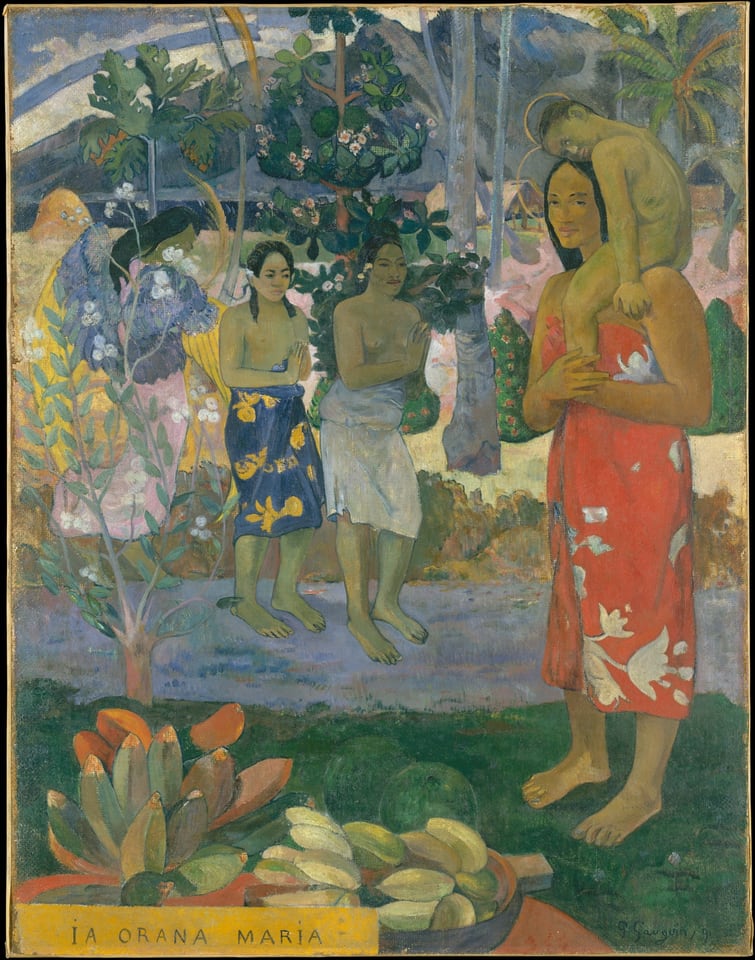
A Tahitian woman in a red pareo carries a child on her shoulder, both crowned with halos, while two women approach with hands joined in prayer, guided by an angel with yellow wings half hidden among flowering shrubs. More about this work
About this work
A Tahitian woman in a red pareo carries a child on her shoulder, both crowned with halos, while two women approach with hands joined in prayer, guided by an angel with yellow wings half hidden among flowering shrubs. The title, painted at lower left, means ‘Hail Mary’ in Tahitian, the first words of the angel’s greeting to the Virgin. Gauguin painted it in 1891, his first year in Tahiti, transposing a Christian subject into a lush island setting; the pose of the praying women came from a photograph of a relief at the Buddhist temple of Borobudur in Java.
Written by Ochre Editions.
How it was made
- Oil paint
- Pigment ground in a drying oil, usually linseed. It dries slowly, so painters could blend on the canvas, build up thin translucent glazes, and rework a picture over weeks. Canvas replaced wooden panels in the 1500s because it is lighter and can be rolled.
Paul Gauguin
French, 1848–1903 · Born in Paris; died in Atuona, Hiva Oa, Marquesas Islands.
Gauguin worked as a Paris stockbroker and collected the Impressionists before taking up painting full time in the 1880s, showing in the last five Impressionist exhibitions. At Pont-Aven in Brittany he developed a style of flat colour and bold outline, and in 1888 he spent nine turbulent weeks with Van Gogh in Arles. Seeking a simpler world, he sailed for Tahiti in 1891 and spent most of his remaining years in French Polynesia, dying in the Marquesas.
Written by Ochre Editions.
Post-Impressionism
Artists who kept Impressionism's colour but pushed towards structure, symbol and feeling.
Rights and the museum’s record
Public domain. The Met has dedicated this image to the public domain under CC0, so anyone may copy, adapt and use it, for any purpose, without asking. Our prints and files are reproductions made from the museum’s image; the museum doesn’t endorse them.
- Object number
- 51.112.2
- Credit
- Courtesy of The Metropolitan Museum of Art
- Type
- Paintings
- Department
- European Paintings
- Licence
- CC0 1.0 Universal
- Museum record
- See it on the museum’s site