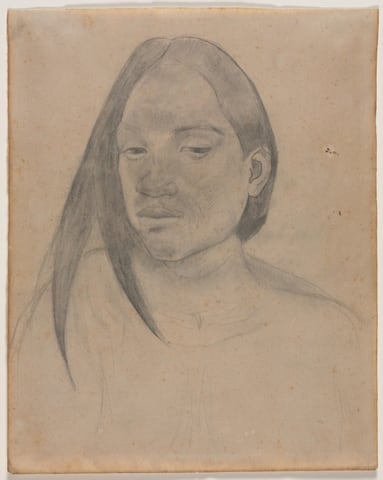
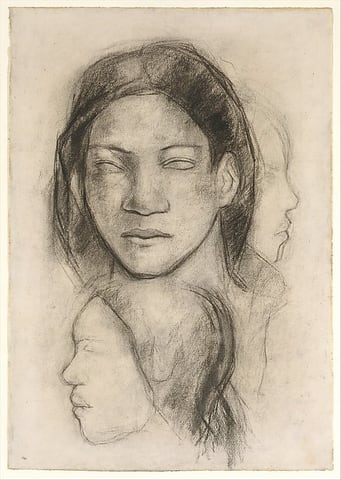
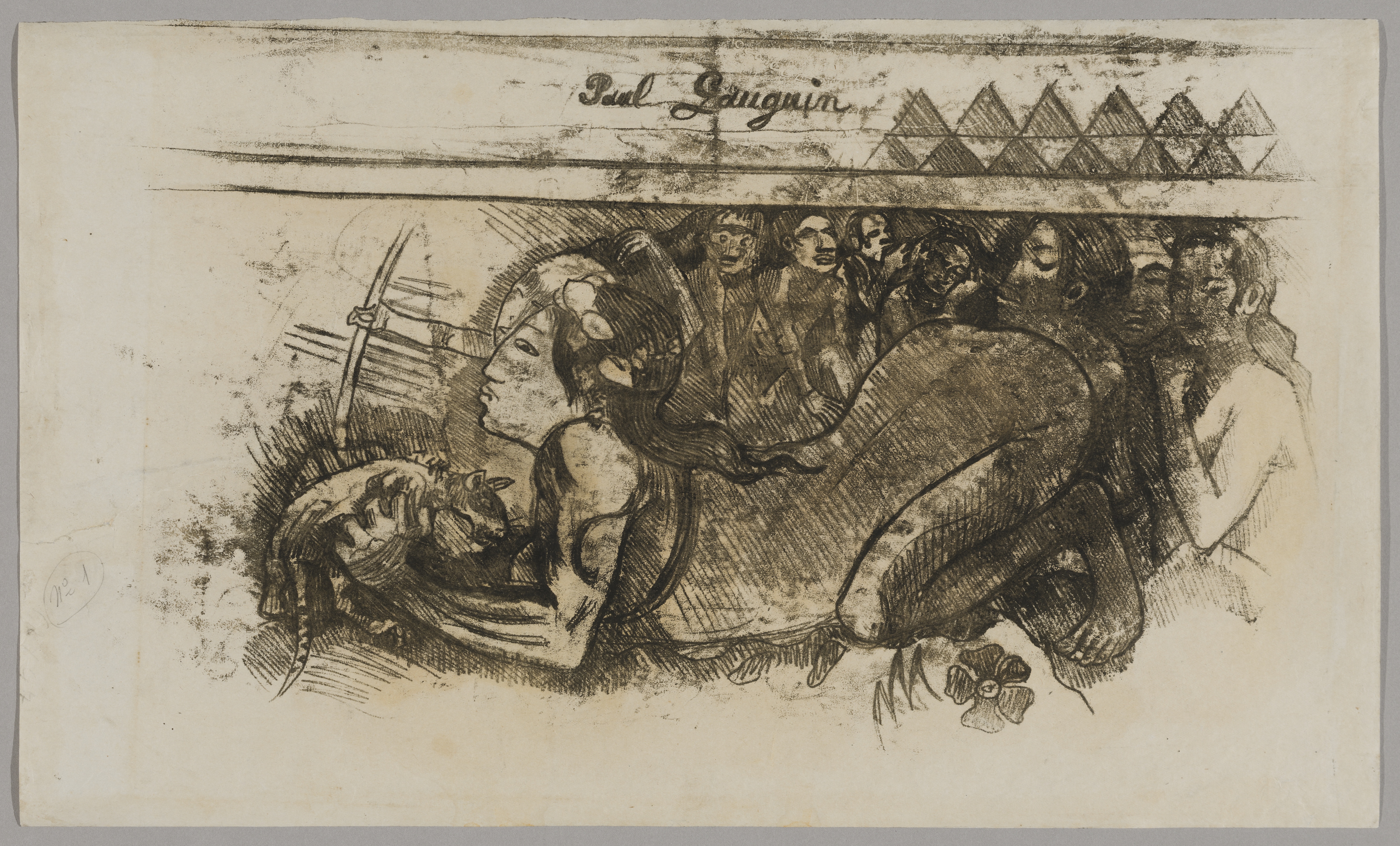
Woman with a Catc. 1900
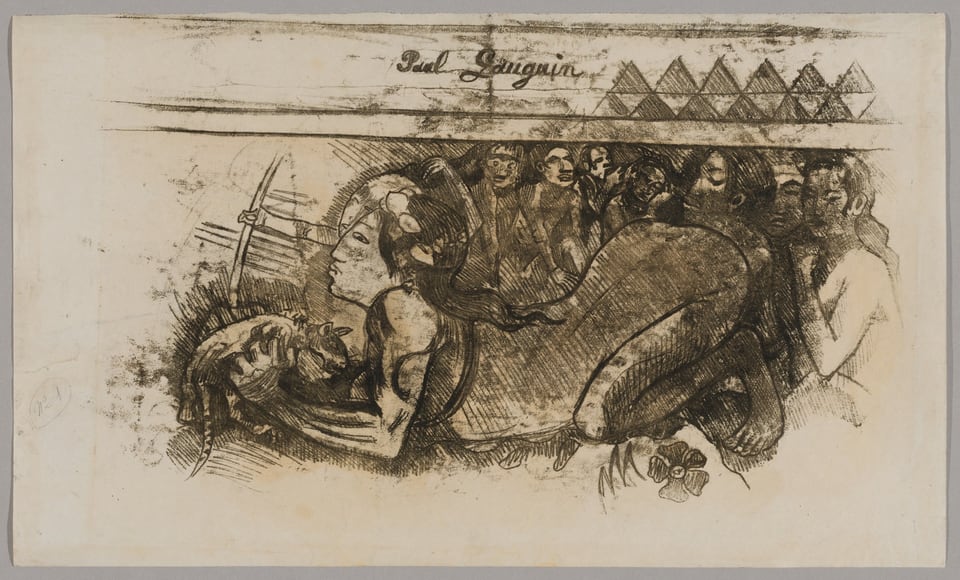
Gauguin developed this unusual technique in Tahiti around 1899: he inked a sheet, laid paper over it and drew on the back with pencil, so that the pressure transferred a soft, grainy line onto the underside, which became the finished image. More about this work
About this work
Gauguin developed this unusual technique in Tahiti around 1899: he inked a sheet, laid paper over it and drew on the back with pencil, so that the pressure transferred a soft, grainy line onto the underside, which became the finished image. The method gave his drawings a mysterious, smudged quality halfway between printmaking and drawing. Here a woman with a cat is evoked in brownish-black ink, with ochre washes on the other side of the sheet.
Written by Ochre Editions.
What you’re looking at
A work made of transfer drawing in brownish-black ink (recto); graphite and blue crayon pencil with brush and solvent washes in ocher on cream wove paper.
Description from the Art Institute of Chicago.
How it was made
- Graphite
- Pencil. Graphite has been used for drawing since the 1500s; in 1795 Nicolas-Jacques Conté mixed it with clay, so its hardness could be graded.
Paul Gauguin
French, 1848–1903 · Born in Paris; died in Atuona, Hiva Oa, Marquesas Islands.
Gauguin worked as a Paris stockbroker and collected the Impressionists before taking up painting full time in the 1880s, showing in the last five Impressionist exhibitions. At Pont-Aven in Brittany he developed a style of flat colour and bold outline, and in 1888 he spent nine turbulent weeks with Van Gogh in Arles. Seeking a simpler world, he sailed for Tahiti in 1891 and spent most of his remaining years in French Polynesia, dying in the Marquesas.
Written by Ochre Editions.
Post-Impressionism
Artists who kept Impressionism's colour but pushed towards structure, symbol and feeling.
Rights and the museum’s record
Public domain. The Art Institute of Chicago has dedicated this image to the public domain under CC0, so anyone may copy, adapt and use it, for any purpose, without asking. Our prints and files are reproductions made from the museum’s image; the museum doesn’t endorse them.
- Object number
- 1991.217
- Credit
- Courtesy of the Art Institute of Chicago
- Type
- Drawing and Watercolor
- Department
- Prints and Drawings
- Licence
- CC0 1.0 Universal
- Museum record
- See it on the museum’s site
Report this work
More by Paul Gauguin
All their works
Close in colour