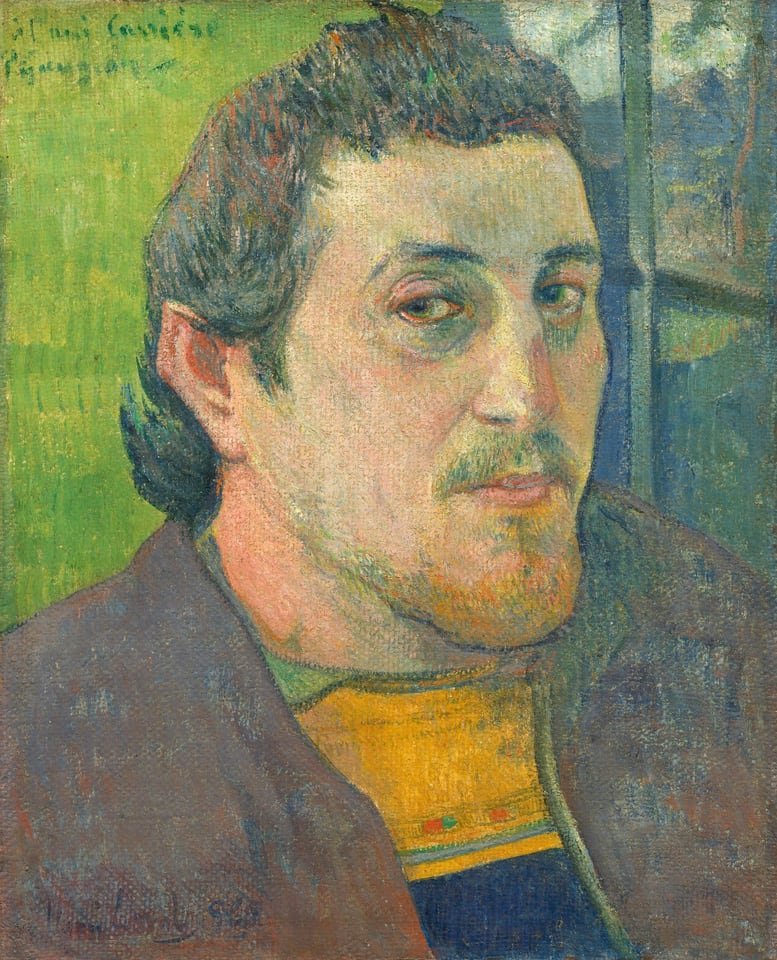
Self-Portrait Dedicated to Carrière1888 or 1889
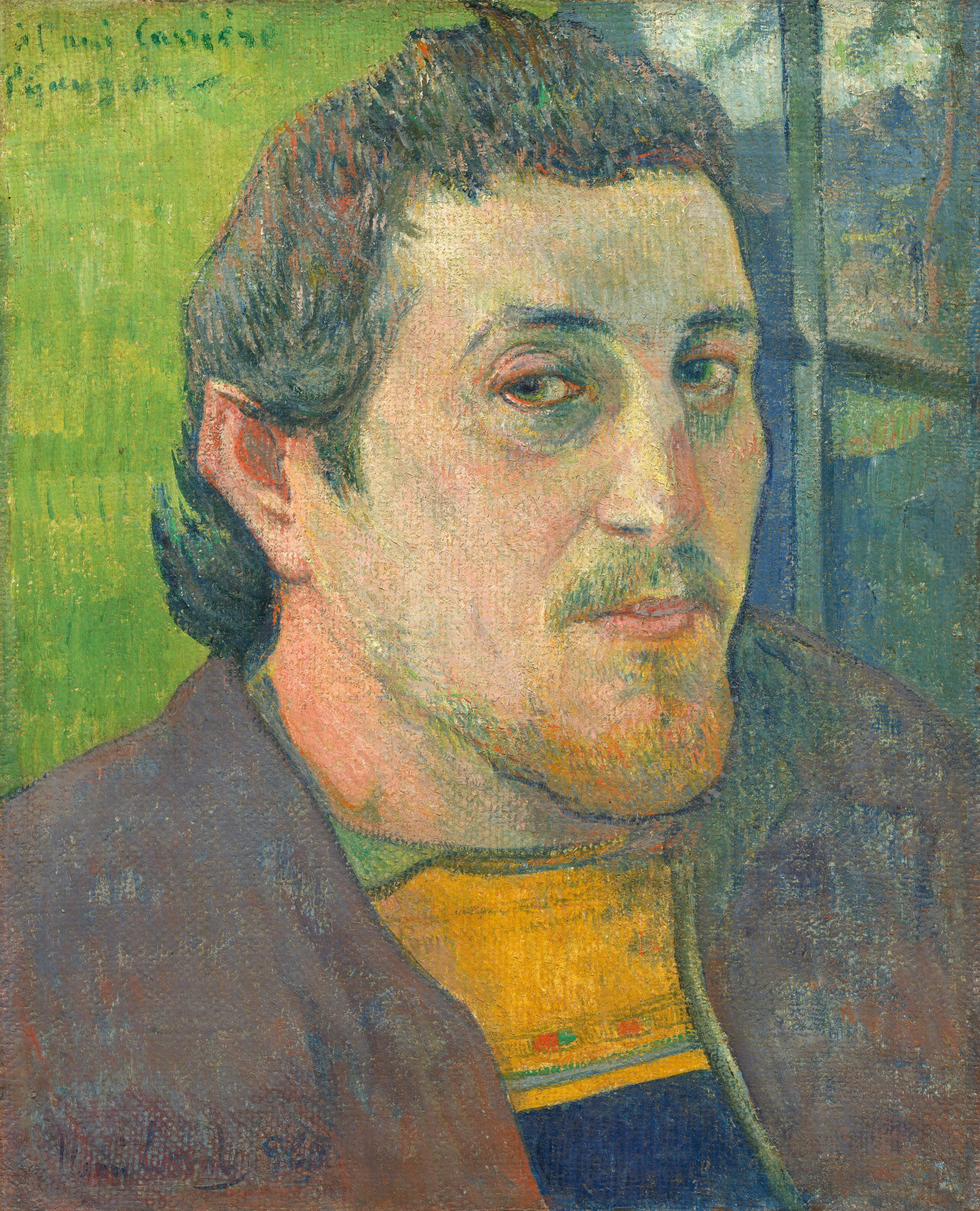
Gauguin portrays himself half-turned, glancing at us sideways with green eyes and one cocked blue eyebrow, his face modelled in bold patches of lime, plum, yellow and blue against a vivid green wall and a window opening onto vegetation. More about this work
About this work
Gauguin portrays himself half-turned, glancing at us sideways with green eyes and one cocked blue eyebrow, his face modelled in bold patches of lime, plum, yellow and blue against a vivid green wall and a window opening onto vegetation. The inscription at upper left dedicates the painting to his friend, the painter Eugène Carrière; a second inscription, at lower left, names Charles Laval, his companion on his voyage to Martinique. Painted around 1888–89, it shows Gauguin, sly and self-mocking, at the moment he was forging his new, anti-naturalistic style.
Written by Ochre Editions.
What you’re looking at
Painted in muted lime green, plum purple, buttercup yellow, slate and royal blue, the head and shoulders of a man with peach-colored skin sitting in front of a window looks at us in this stylized, vertical portrait. His body and face are angled to our right but he looks at us from the corners of his eyes, which are grass-green with touches of yellow. One cobalt-blue eyebrow is cocked, and shading in denim blue, butter yellow, and fern green create hollows under both eyes. His flat nose has a broad bridge, and his pale pink lips are closed, the far corner pulled slightly up. His mustache is painted with visible strokes of forest green and his ginger-orange beard is trimmed along his prominent, jutting chin. His short, dark hair is brushed back from his temples and is painted with strokes of pine green, navy blue, and coral orange. His shirt has a wide, golden yellow stripe along the collar above indigo blue, under a grayish-violet purple jacket. The wall over his shoulder, in the upper left corner, is painted vivid lime green with long, vertical brushstrokes. The view through the window beyond his other shoulder is of vegetation and mountains. The portrait is painted with visible brushstrokes throughout, and is especially loose in the background, hair, and jacket. An inscription in dark green script in the upper left reads, “a l'ami Carriere PGauguin.” A second inscription in the lower left is written with dark brown paint: “l'ami Laval PGo.”
Description from the National Gallery of Art.
How it was made
- Oil paint
- Pigment ground in a drying oil, usually linseed. It dries slowly, so painters could blend on the canvas, build up thin translucent glazes, and rework a picture over weeks. Canvas replaced wooden panels in the 1500s because it is lighter and can be rolled.
Paul Gauguin
French, 1848–1903 · Born in Paris; died in Atuona, Hiva Oa, Marquesas Islands.
Gauguin worked as a Paris stockbroker and collected the Impressionists before taking up painting full time in the 1880s, showing in the last five Impressionist exhibitions. At Pont-Aven in Brittany he developed a style of flat colour and bold outline, and in 1888 he spent nine turbulent weeks with Van Gogh in Arles. Seeking a simpler world, he sailed for Tahiti in 1891 and spent most of his remaining years in French Polynesia, dying in the Marquesas.
Written by Ochre Editions.
Post-Impressionism
Artists who kept Impressionism's colour but pushed towards structure, symbol and feeling.
Rights and the museum’s record
Public domain. The National Gallery of Art has dedicated this image to the public domain under CC0, so anyone may copy, adapt and use it, for any purpose, without asking. Our prints and files are reproductions made from the museum’s image; the museum doesn’t endorse them.
- Object number
- 1985.64.20
- Credit
- Courtesy National Gallery of Art, Washington
- Type
- Painting
- Licence
- CC0 1.0 Universal
- Museum record
- See it on the museum’s site