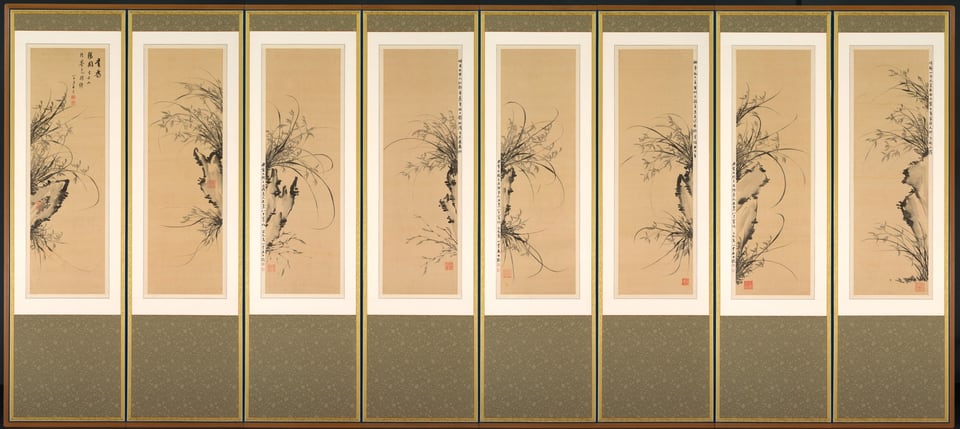
Orchids and Rocks1897–98
Yi Ha-eung (1820−1898), the artist of this eight-panel folding screen, was one of the most influential men in late 19th-century Korea. More about this work
About this work
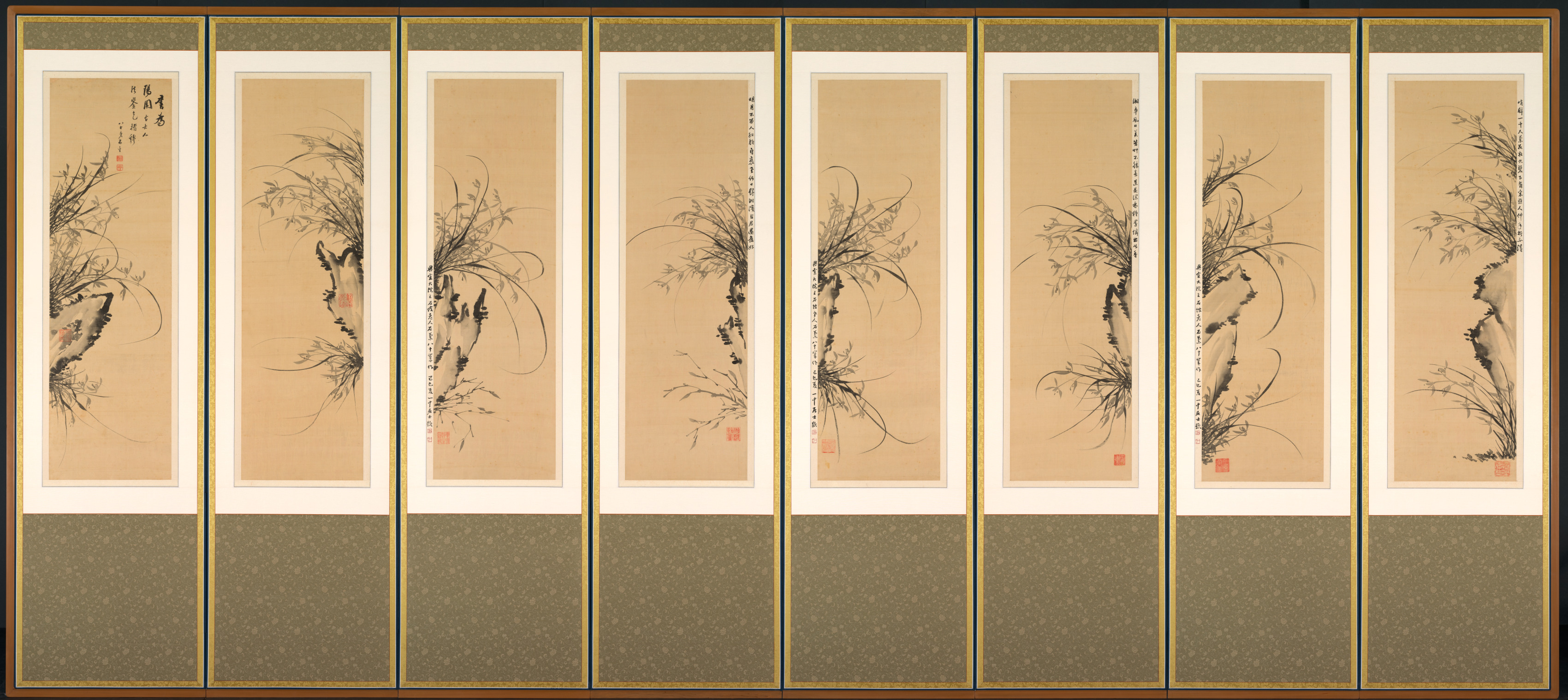
Yi Ha-eung (1820−1898), the artist of this eight-panel folding screen, was one of the most influential men in late 19th-century Korea. Acting as the regent for his son, King Gojong (1852−1919), who ascended the throne at the age of thirteen, Yi ruled Korea from 1866 to 1873. In addition to his illustrious political career, Yi was also recognized as one of the most celebrated artists who led the revival of literati art in late 19th-century Korean art. In particular, he was recognized as the master of orchids, one of the “Four Gentlemen” (plum, orchid, chrysanthemum, and bamboo) themes. Solely relying on monochrome ink, Yi depicted the curvilinear silhouettes of cymbidium orchid leaves dramatically hanging down from cliffs. Growing in wilderness and redolent with fragrance, orchids were often associated with the perseverance of principled gentlemen, and thus became one of the most popular subjects of scholar-artists' paintings.On the upper right corner of the far left panel, Yi wrote a short inscription stating that he painted the work at the age of 80.
Text from the Cleveland Museum of Art.
How it was made
- Folding screen
- Panels joined by paper hinges, so the screen stands by itself in a zigzag. The picture runs across every panel, and screens were often made in pairs.
- Ink and colour on silk
- Silk was sized with glue and alum so it would hold a crisp brushline, and mineral colours were built up in thin layers. The sheen of the weave still shows through.
Yi Ha-eung
Korean, 1820–1898
Rights and the museum’s record
Public domain. The Cleveland Museum of Art has dedicated this image to the public domain under CC0, so anyone may copy, adapt and use it, for any purpose, without asking. Our prints and files are reproductions made from the museum’s image; the museum doesn’t endorse them.
- Object number
- 2015.138
- Credit
- Courtesy of the Cleveland Museum of Art
- Type
- Painting
- Department
- Korean Art
- Licence
- CC0 1.0 Universal
- Museum record
- See it on the museum’s site
Report this work
Close in colour