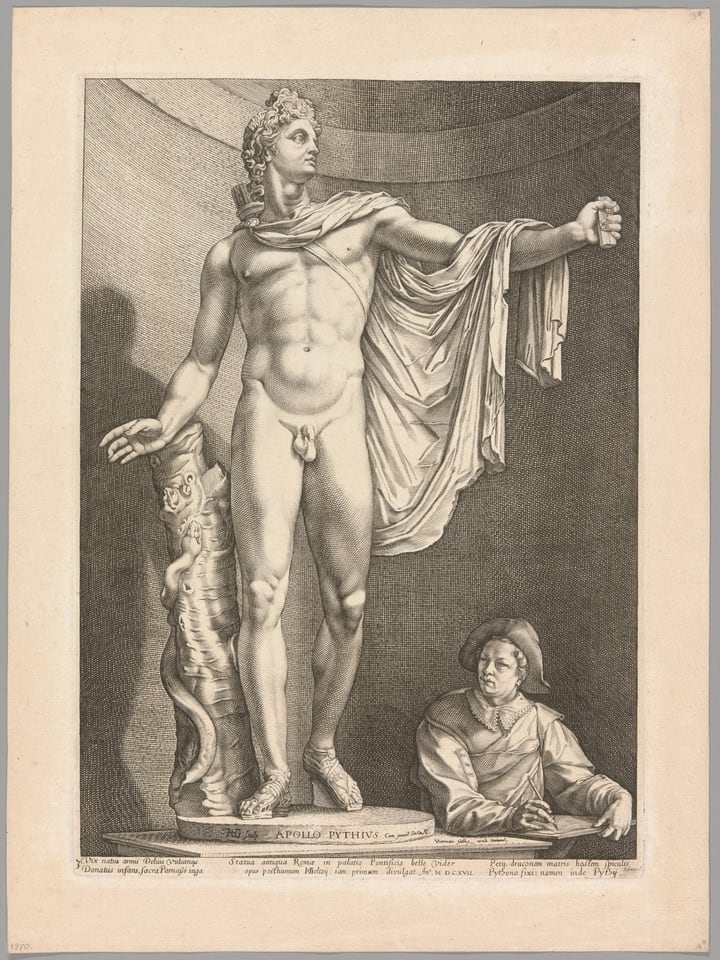
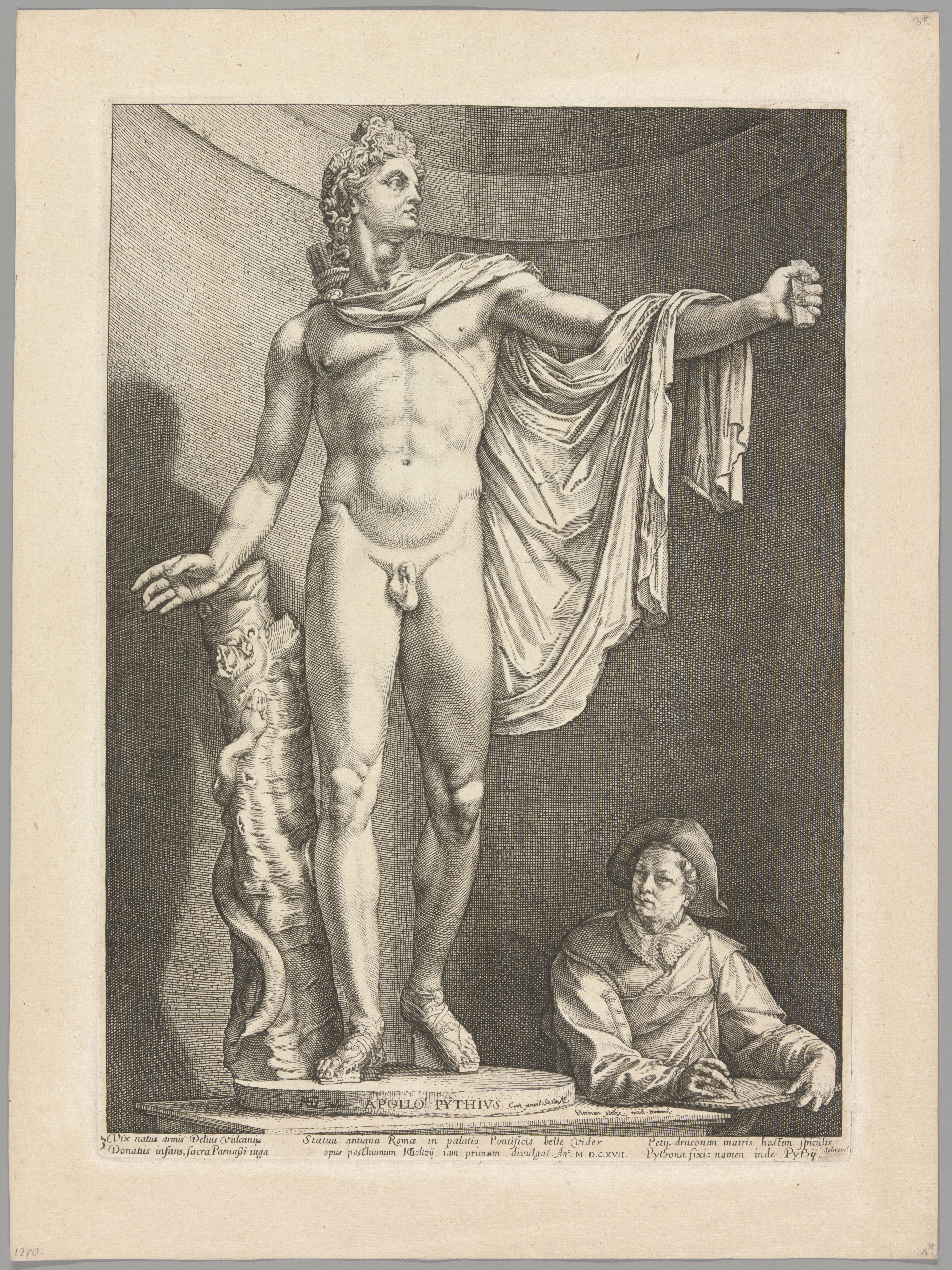
The Apollo Belvedere, plate 3 from Three Famous Antique Sculpturesc. 1592, printed c. 1617
The Apollo Belvedere, the ancient marble god in the Vatican that Renaissance artists regarded as the perfect male figure, is shown here as Hendrick Goltzius drew it during his stay in Rome in 1590–91. More about this work
About this work
The Apollo Belvedere, the ancient marble god in the Vatican that Renaissance artists regarded as the perfect male figure, is shown here as Hendrick Goltzius drew it during his stay in Rome in 1590–91. Back in Haarlem he engraved it as one of three plates of celebrated antique sculptures, though they were printed only around 1617, the year of his death. The swelling and tapering lines of the engraving model the marble with extraordinary virtuosity, turning carved stone into something close to living flesh.
Written by Ochre Editions.
What you’re looking at
A work made of engraving in black on cream laid paper.
Description from the Art Institute of Chicago.
How it was made
- Engraving
- Lines cut directly into a metal plate with a steel burin, which makes them swell and taper. It took years to master, and for centuries it was how paintings travelled as pictures.
- Laid paper
- Handmade on a mould of close-set wires, which leave fine parallel lines you can see when the sheet is held to the light.
Hendrick Goltzius
Dutch, 1558–1617 · Born in Mühlbracht; died in Haarlem.
Goltzius was the outstanding Dutch engraver of his generation, despite a childhood injury that crippled his right hand. In Haarlem he joined Karel van Mander and Cornelis van Haarlem in promoting the muscular Mannerist style of Bartholomeus Spranger, engraving swelling, tapering lines of great virtuosity. A journey to Italy in 1590–91 turned him towards classical sculpture, as in his engravings of the Apollo Belvedere, and around 1600 he gave up engraving for painting.
Written by Ochre Editions.
Dutch Golden Age
Seventeenth-century painting from the Dutch Republic: still lifes, interiors, portraits and flat, wide skies.
Rights and the museum’s record
Public domain. The Art Institute of Chicago has dedicated this image to the public domain under CC0, so anyone may copy, adapt and use it, for any purpose, without asking. Our prints and files are reproductions made from the museum’s image; the museum doesn’t endorse them.
- Object number
- 1990.498
- Credit
- Courtesy of the Art Institute of Chicago
- Type
- Department
- Prints and Drawings
- Licence
- CC0 1.0 Universal
- Museum record
- See it on the museum’s site
Report this work
More by Hendrick Goltzius
All their works
Close in colour