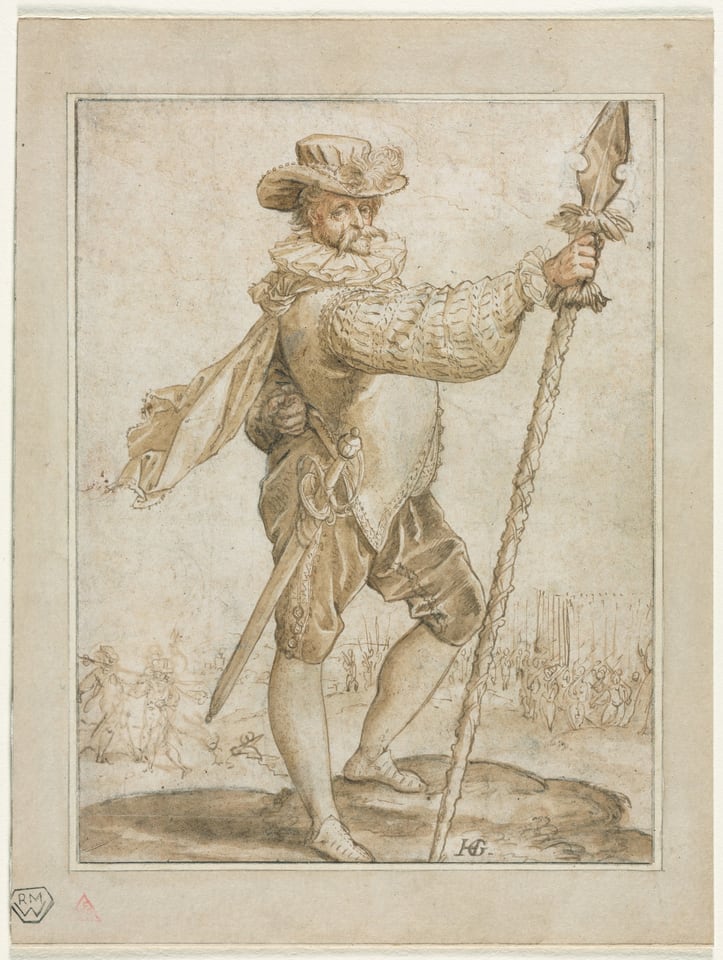
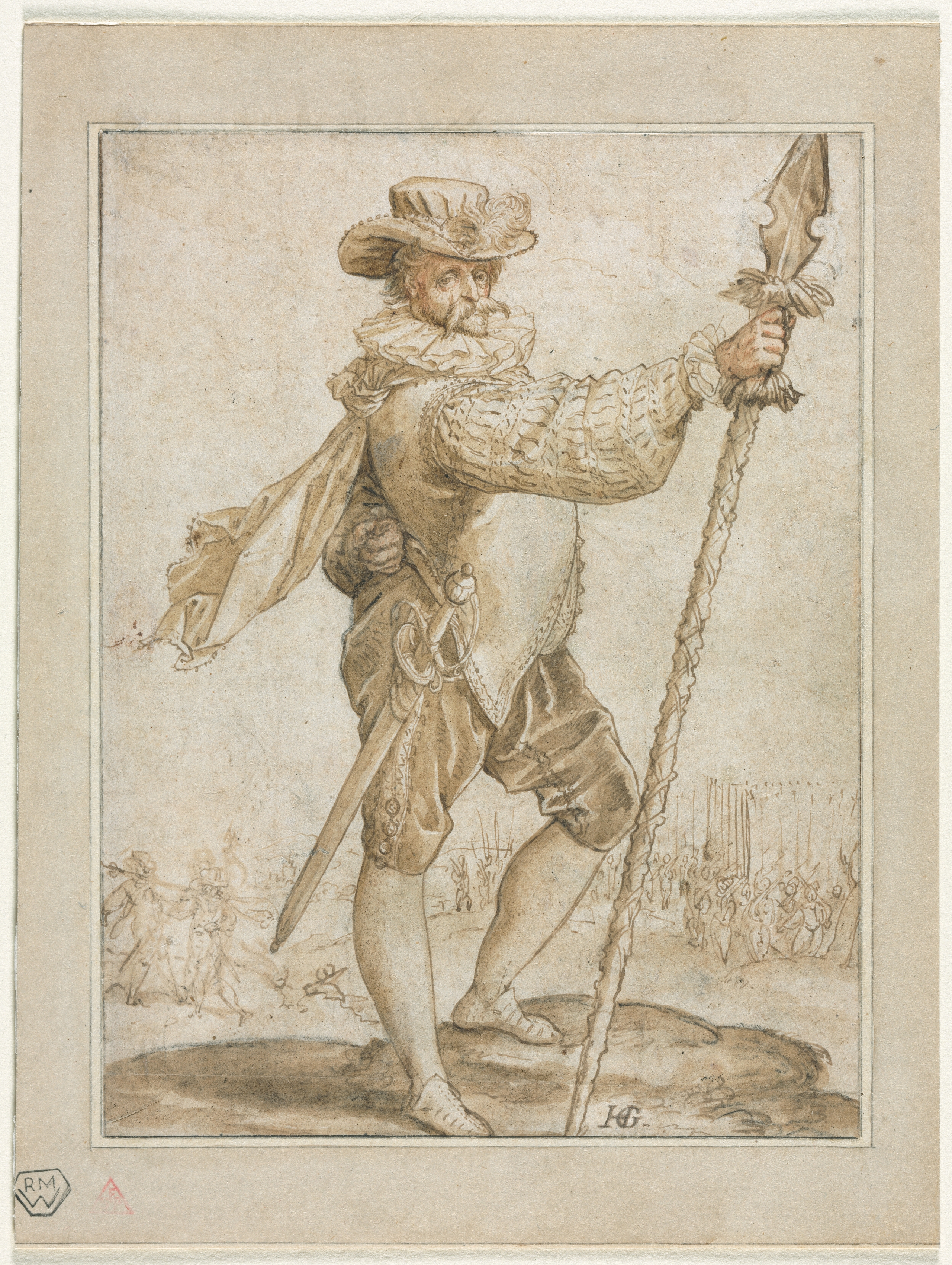
Standing Officer Holding a Boar's Spear1586
This sheet is the only known preparatory drawing for an important group of engravings depicting military figures designed by Hendrick Goltzius between 1582 and 1600. More about this work
About this work
This sheet is the only known preparatory drawing for an important group of engravings depicting military figures designed by Hendrick Goltzius between 1582 and 1600. Here Goltzius depicted a military officer with a confident stance and direct gaze as he staunchly holds a spear in his right hand and carries his sword on his hip. Details such as the fluttering scarf and the feather-trimmed hat enliven the image. The background portrays the deeds of the protagonist, including a scene with troops on the right, and two other officers, perhaps shown training with spears, on the left. Such imagery usually promoted militaristic values such as bravery in the period, as the Netherlands underwent continuous warfare with Spain. Goltzius's technique includes fine pen strokes and delicate brown washes combined with red chalk additions on the face and hands, which add a degree of naturalism and finish to the drawing.
Text from the Cleveland Museum of Art.
How it was made
- Opaque watercolour
- Watercolour made opaque with white or chalk and laid in flat, even layers. Persian and Indian painters ground their colours from minerals, applied them with the finest brushes and burnished the finished page.
- Chalk
- Natural black, red and white chalks. Used together on toned paper they could give the warmth of flesh with very little effort, and they were favourites for studies from life.
- Watercolour
- Pigment in gum arabic, thinned with water and laid in transparent washes. Nothing white is painted: the light is the paper showing through.
Hendrick Goltzius
Dutch, 1558–1617 · Born in Mühlbracht; died in Haarlem.
Goltzius was the outstanding Dutch engraver of his generation, despite a childhood injury that crippled his right hand. In Haarlem he joined Karel van Mander and Cornelis van Haarlem in promoting the muscular Mannerist style of Bartholomeus Spranger, engraving swelling, tapering lines of great virtuosity. A journey to Italy in 1590–91 turned him towards classical sculpture, as in his engravings of the Apollo Belvedere, and around 1600 he gave up engraving for painting.
Written by Ochre Editions.
Dutch Golden Age
Seventeenth-century painting from the Dutch Republic: still lifes, interiors, portraits and flat, wide skies.
Rights and the museum’s record
Public domain. The Cleveland Museum of Art has dedicated this image to the public domain under CC0, so anyone may copy, adapt and use it, for any purpose, without asking. Our prints and files are reproductions made from the museum’s image; the museum doesn’t endorse them.
- Object number
- 1994.195
- Credit
- Courtesy of the Cleveland Museum of Art
- Type
- Drawing
- Department
- Drawings
- Licence
- CC0 1.0 Universal
- Museum record
- See it on the museum’s site
Report this work
More by Hendrick Goltzius
All their works
Close in colour