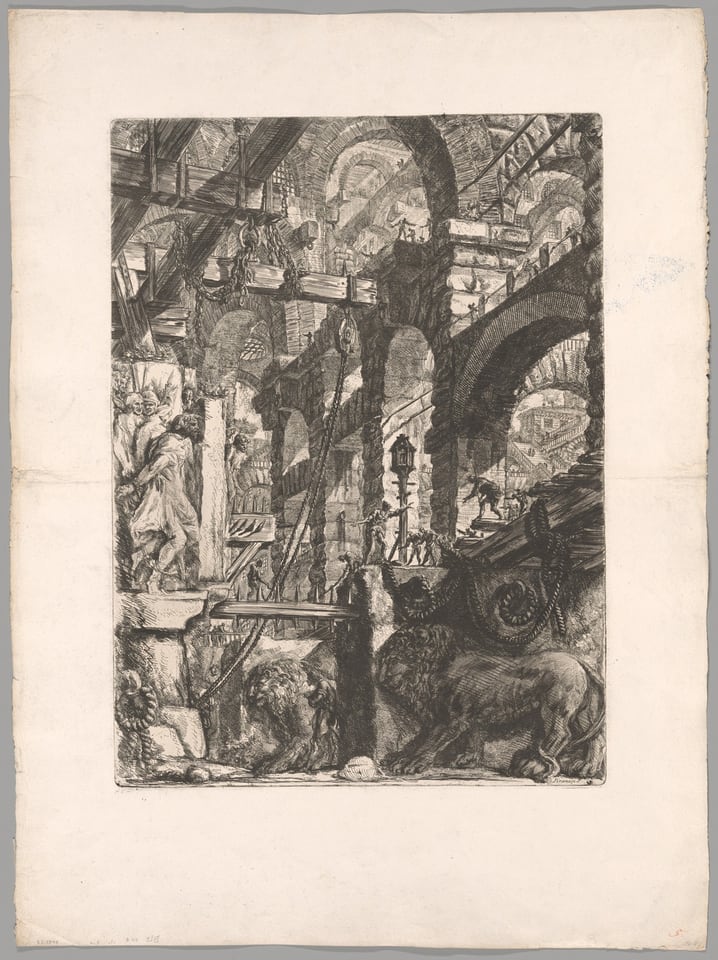
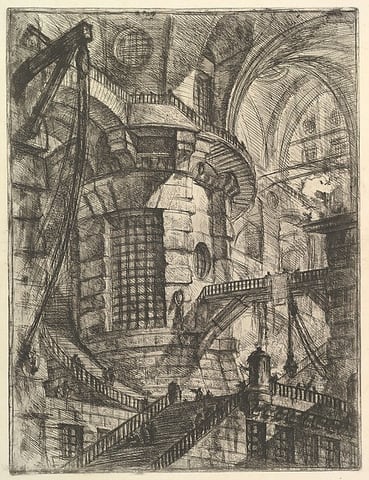
The Lion Bas-Reliefs, plate 5 from Imaginary Prisons1761
Vast stairways, arches and bridges recede into the gloom of an imaginary prison, while in the foreground stand massive relief panels carved with lions. More about this work
About this work
Vast stairways, arches and bridges recede into the gloom of an imaginary prison, while in the foreground stand massive relief panels carved with lions. The plate belongs to Piranesi’s Carceri d’invenzione, or Imaginary Prisons, first etched around 1750 and dramatically reworked for a second edition in 1761, when he darkened the plates and added new architectural detail and inscriptions. These fantasies, more vision than plan, have fascinated writers, architects and filmmakers ever since.
Written by Ochre Editions.
What you’re looking at
A work made of etching and engraving on heavy ivory laid paper.
Description from the Art Institute of Chicago.
How it was made
- Etching
- The artist draws with a needle through a waxy coating on a copper plate, and acid bites the exposed lines. The plate is then inked, wiped and printed under pressure, so the line keeps the freedom of drawing.
- Engraving
- Lines cut directly into a metal plate with a steel burin, which makes them swell and taper. It took years to master, and for centuries it was how paintings travelled as pictures.
- Laid paper
- Handmade on a mould of close-set wires, which leave fine parallel lines you can see when the sheet is held to the light.
Giovanni Battista Piranesi
Italian, 1720–1778 · Born in Mogliano Veneto; died in Rome.
Piranesi trained in Venice as an architect and stage designer before moving to Rome in 1740, where he spent the rest of his life. He is known above all for his etchings: the Views of Rome, more than a hundred large plates of ancient ruins and modern buildings, and the Imaginary Prisons, vast fantastical interiors of stairs, arches and machinery. A passionate champion of Roman architecture, he also published archaeological studies and designed the church of Santa Maria del Priorato.
Written by Ochre Editions.
Rights and the museum’s record
Public domain. The Art Institute of Chicago has dedicated this image to the public domain under CC0, so anyone may copy, adapt and use it, for any purpose, without asking. Our prints and files are reproductions made from the museum’s image; the museum doesn’t endorse them.
- Object number
- 1922.5595
- Credit
- Courtesy of the Art Institute of Chicago
- Type
- Department
- Prints and Drawings
- Licence
- CC0 1.0 Universal
- Museum record
- See it on the museum’s site
Report this work
More by Giovanni Battista Piranesi
All their works

Close in colour