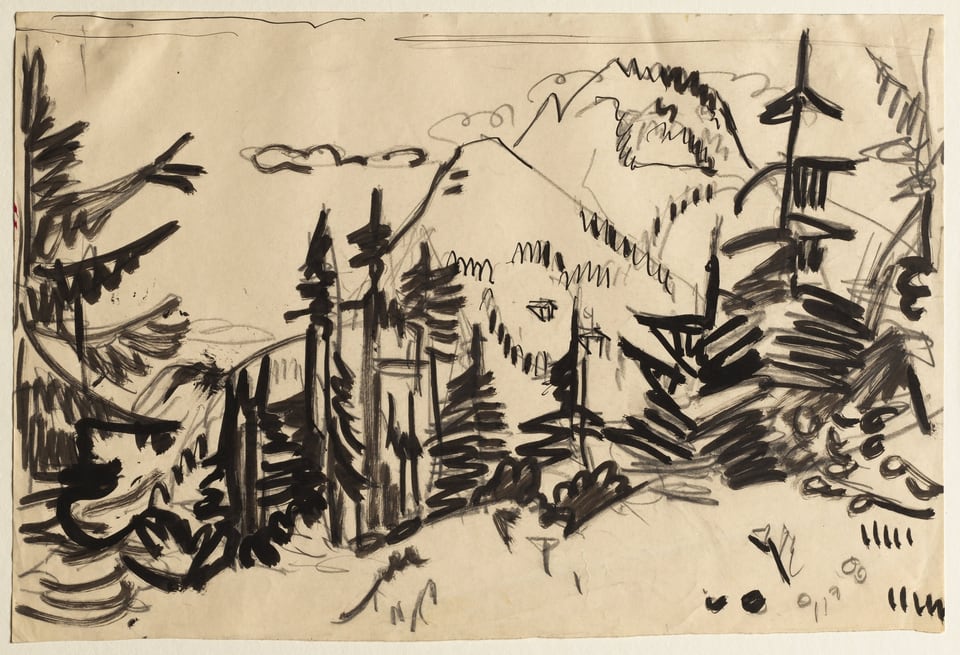
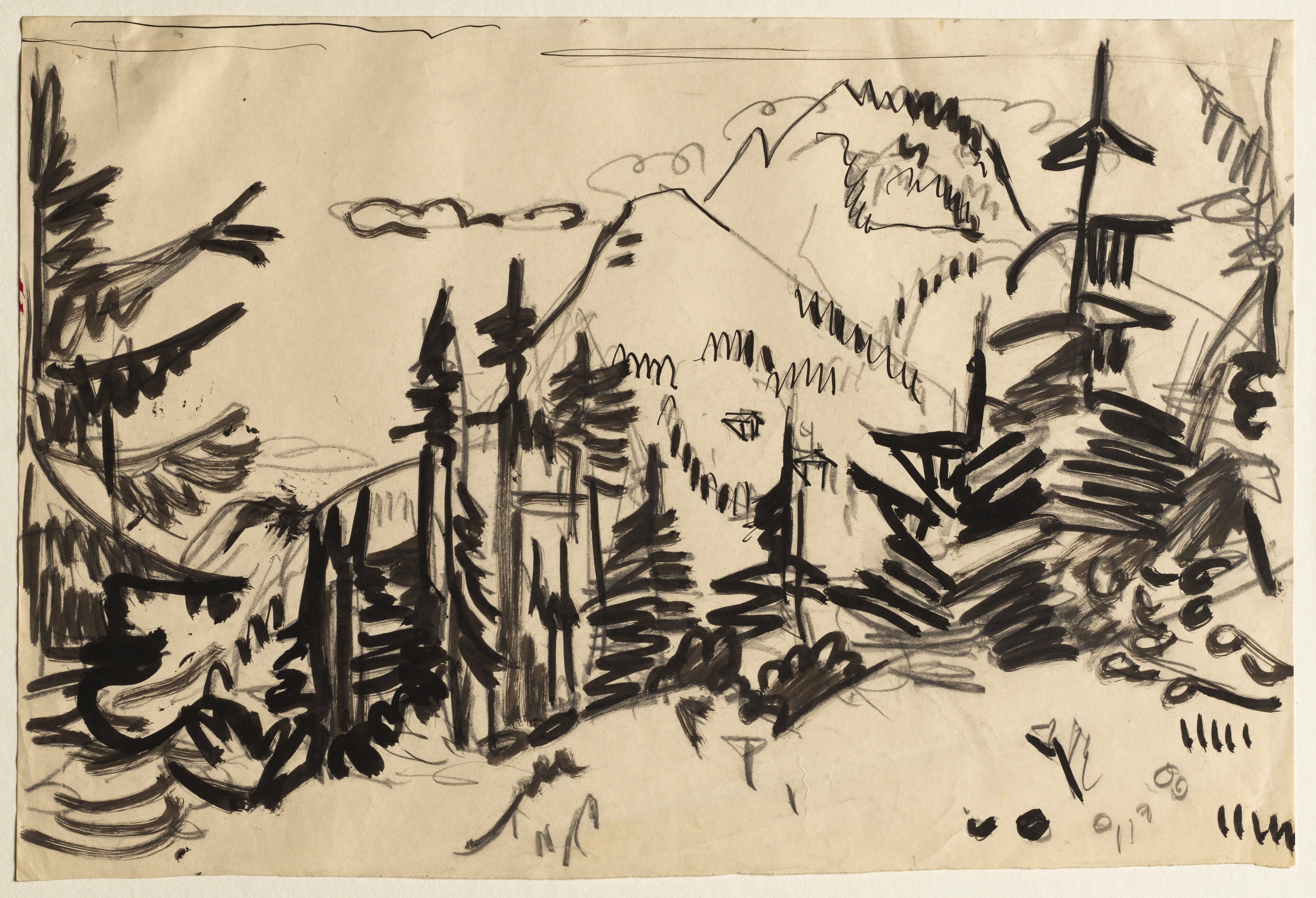
Mountain Landscape with Fir Trees1918/19
Following his discharge from the military after a mental and physical breakdown in 1915, Ernst Ludwig Kirchner took refuge at a sanitarium near Davos, Switzerland. More about this work
About this work
Following his discharge from the military after a mental and physical breakdown in 1915, Ernst Ludwig Kirchner took refuge at a sanitarium near Davos, Switzerland. The alpine landscape provided a new focus for his work and became a metaphor for his spiritual regeneration. Kirchner sketched this scene with black ink swept over graphite. His viewpoint is one of self-absorption, from within the mountain range rather than from above, a subjective view with vigorous marks that imbue the scene with energy.
Text from the Cleveland Museum of Art.
How it was made
- Graphite
- Pencil. Graphite has been used for drawing since the 1500s; in 1795 Nicolas-Jacques Conté mixed it with clay, so its hardness could be graded.
Ernst Ludwig Kirchner
German, 1880–1938
Kirchner studied architecture in Dresden, where in 1905 he co-founded Die Brücke with fellow students, seeking a raw, direct art of bright, unmixed colour and angular forms. After moving to Berlin in 1911 he painted the city’s streets and nightlife with nervous intensity. Military service in the First World War led to a breakdown, and from 1917 he lived in the Swiss mountains near Davos, painting the Alpine landscape. In 1937 the Nazis condemned his work as degenerate.
Written by Ochre Editions.
Rights and the museum’s record
Public domain. The Cleveland Museum of Art has dedicated this image to the public domain under CC0, so anyone may copy, adapt and use it, for any purpose, without asking. Our prints and files are reproductions made from the museum’s image; the museum doesn’t endorse them.
- Object number
- 1963.86
- Credit
- Courtesy of the Cleveland Museum of Art
- Type
- Drawing
- Department
- Drawings
- Licence
- CC0 1.0 Universal
- Museum record
- See it on the museum’s site
Report this work
More by Ernst Ludwig Kirchner
All their works
Close in colour