Charles Amédée Philippe Van Loo
Soap Bubbles1764
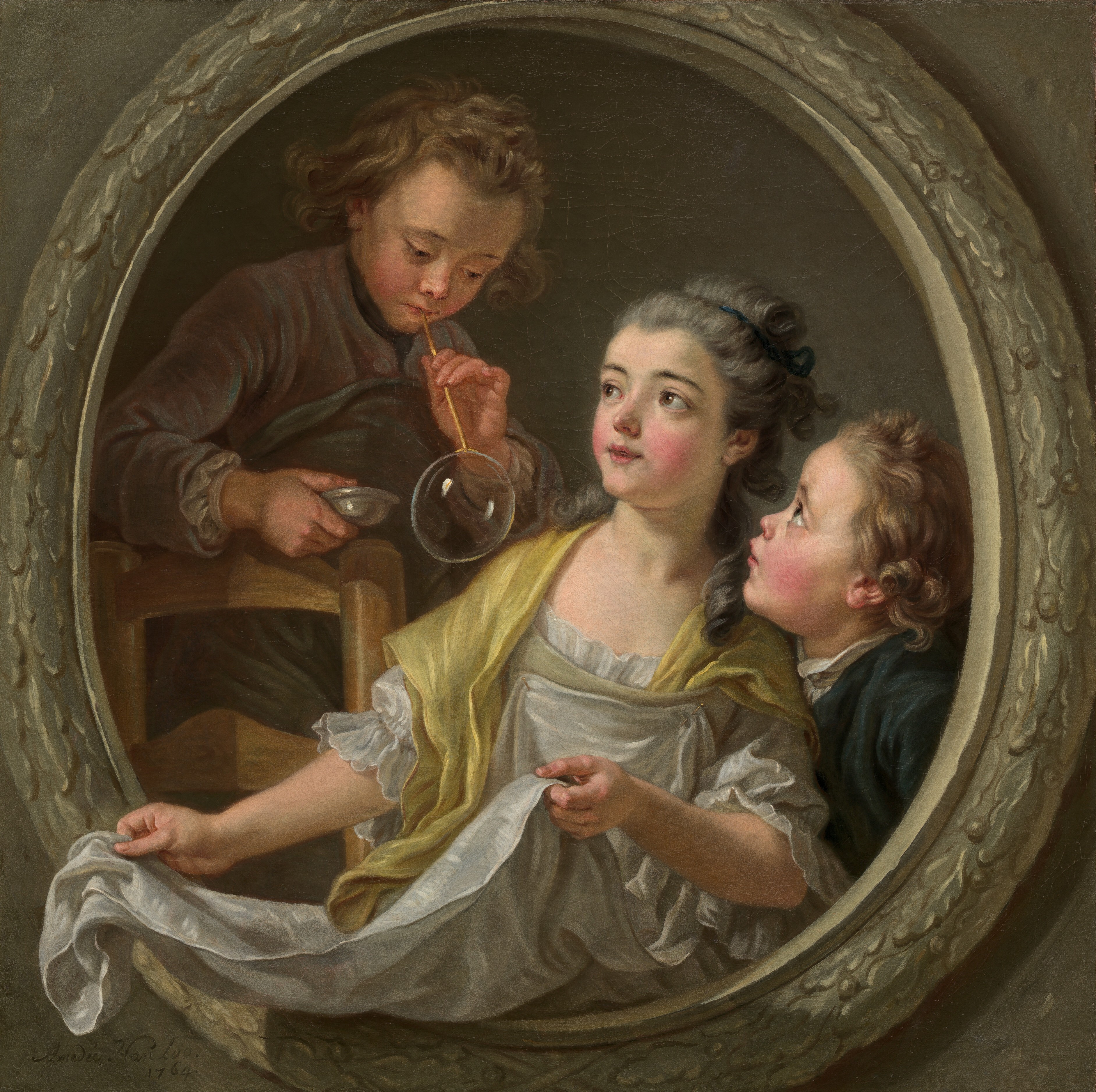
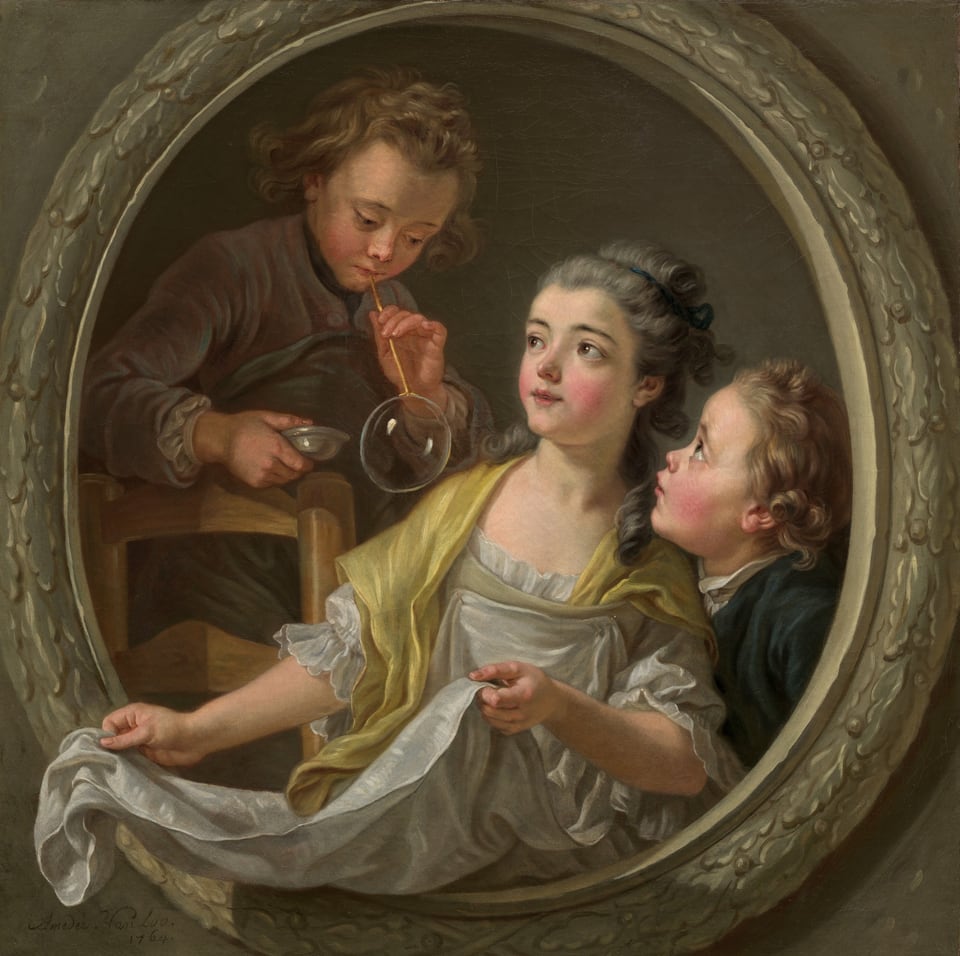
Three children lean out of a carved stone oval: a boy standing on a chair blows a large bubble through a long straw, a girl in a yellow shawl holds out a white cloth to catch it, and a second boy leans on her shoulder to watch. More about this work
About this work
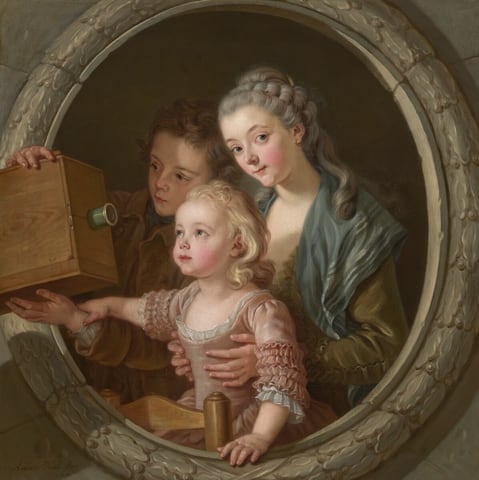
Three children lean out of a carved stone oval: a boy standing on a chair blows a large bubble through a long straw, a girl in a yellow shawl holds out a white cloth to catch it, and a second boy leans on her shoulder to watch. The girl’s arms and the cloth push forward past the frame, as if into our space. Soap bubbles were a traditional emblem of the brevity of life, though here the mood is light and affectionate. Van Loo painted it in 1764, the same year as The Camera Obscura, which uses the same carved oval window.
Written by Ochre Editions.
What you’re looking at
The painting depicts three children within an oval frame, their upper bodies visible. The central child, a young girl, is positioned with her body facing forward and her head turned slightly to the left. She has a fair complexion, with rosy cheeks, pink lips, and wide brown eyes. Her hair is gray and partially pulled back by a blue ribbon. She is dressed in a white garment with a yellow shawl draped over her shoulders. Her arms are outstretched, holding the ends of a cloth that has been pinned on her dress. Her arms and the cloth extend forward beyond the oval frame that encircles the trio, as if the frame is a window or porthole that she is reaching out of. On the right, a boy leans on the girl's shoulder, also facing to the left, seen in profile. He has light brown, curly hair and a fair complexion. He wears a dark blue-green jacket over a white collar, and he is looking upward towards the third child. On the left, another boy, who also has light skin and light brown curly hair, appears to stand on a chair above the other two children. He is holding a long yellow straw up to his lips. At the other end of the straw, a large bubble hangs over the white cloth that the girl holds out. In his other hand is a small white dish. He wears a muted brown outfit with a dark cloth wrapped around him. The background within the frame is plain gray, and the frame that surrounds the children is light gray and appears to be carved with leaf designs. Beyond the oval frame is gray.
Description from the National Gallery of Art.
How it was made
- Oil paint
- Pigment ground in a drying oil, usually linseed. It dries slowly, so painters could blend on the canvas, build up thin translucent glazes, and rework a picture over weeks. Canvas replaced wooden panels in the 1500s because it is lighter and can be rolled.
Charles Amédée Philippe Van Loo
French, 1719–1795
Charles-Amédée-Philippe van Loo belonged to a celebrated family of painters: he was the son of Jean-Baptiste van Loo and nephew of Carle van Loo. After training with his father, he spent many years as court painter to Frederick the Great of Prussia, decorating palaces at Potsdam and Berlin. Back in Paris he exhibited allegories and genre scenes, such as a pair showing children amusing themselves with soap bubbles and a camera obscura.
Written by Ochre Editions.
Rights and the museum’s record
Public domain. The National Gallery of Art has dedicated this image to the public domain under CC0, so anyone may copy, adapt and use it, for any purpose, without asking. Our prints and files are reproductions made from the museum’s image; the museum doesn’t endorse them.
- Object number
- 1945.10.2
- Credit
- Courtesy National Gallery of Art, Washington
- Type
- Painting
- Licence
- CC0 1.0 Universal
- Museum record
- See it on the museum’s site