The Artist's Studio1740s–50s
Johann Georg Platzer specialized in small, highly detailed paintings scaled for a connoisseur’s cabinet. More about this work
About this work
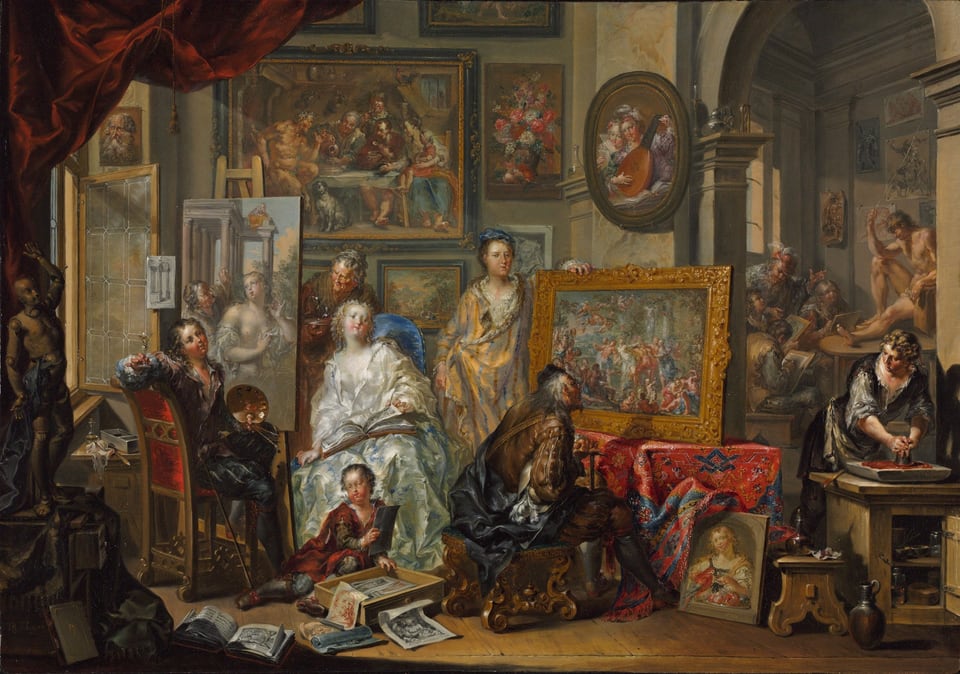
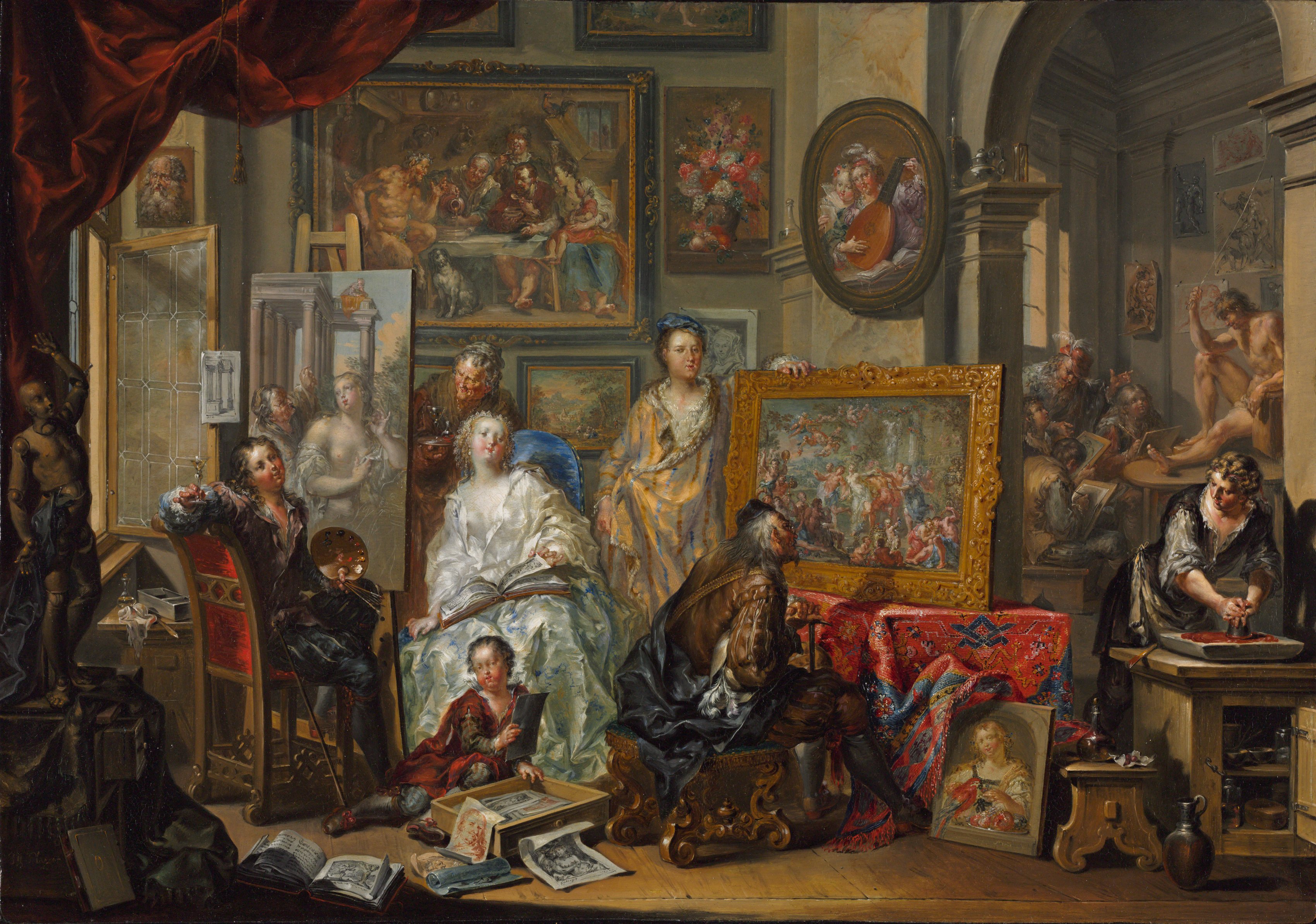
Johann Georg Platzer specialized in small, highly detailed paintings scaled for a connoisseur’s cabinet. At the center of this composition is an idealized portrait of the artist himself, clad in a fur-lined robe and holding a painting for the inspection of a visiting connoisseur. This work makes a statement about painting as a noble and intellectual pursuit, and the importance of rigorous training and practice: the artist at the easel is surrounded by a studio teeming with live models, pupils, assistants, and inspiring examples of art from earlier eras. The paintings on the wall, easel, and floor not only reference great artists of the past, but together present an allegory of the five senses.
Text from the Cleveland Museum of Art.
How it was made
- Oil on copper
- A sheet of copper gives oil paint a hard, glass-smooth surface, ideal for small pictures with jewel-like detail.
- Oil paint
- Pigment ground in a drying oil, usually linseed. It dries slowly, so painters could blend on the canvas, build up thin translucent glazes, and rework a picture over weeks. Canvas replaced wooden panels in the 1500s because it is lighter and can be rolled.
Johann Georg Platzer
Austrian, 1704–1761
Rights and the museum’s record
Public domain. The Cleveland Museum of Art has dedicated this image to the public domain under CC0, so anyone may copy, adapt and use it, for any purpose, without asking. Our prints and files are reproductions made from the museum’s image; the museum doesn’t endorse them.
- Object number
- 2012.41
- Credit
- Courtesy of the Cleveland Museum of Art
- Type
- Painting
- Department
- European Painting and Sculpture
- Licence
- CC0 1.0 Universal
- Museum record
- See it on the museum’s site
Report this work
Close in colour