Charles Amédée Philippe Van Loo
The Camera Obscura1764
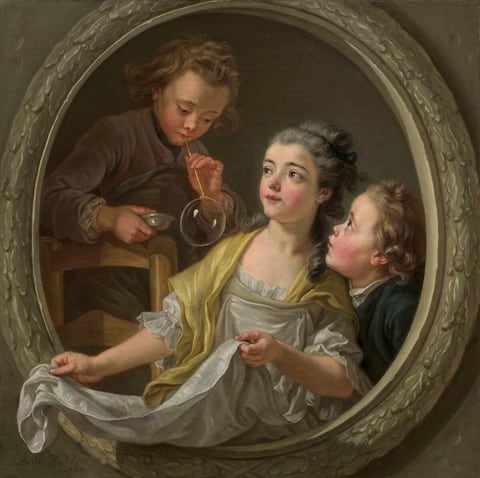
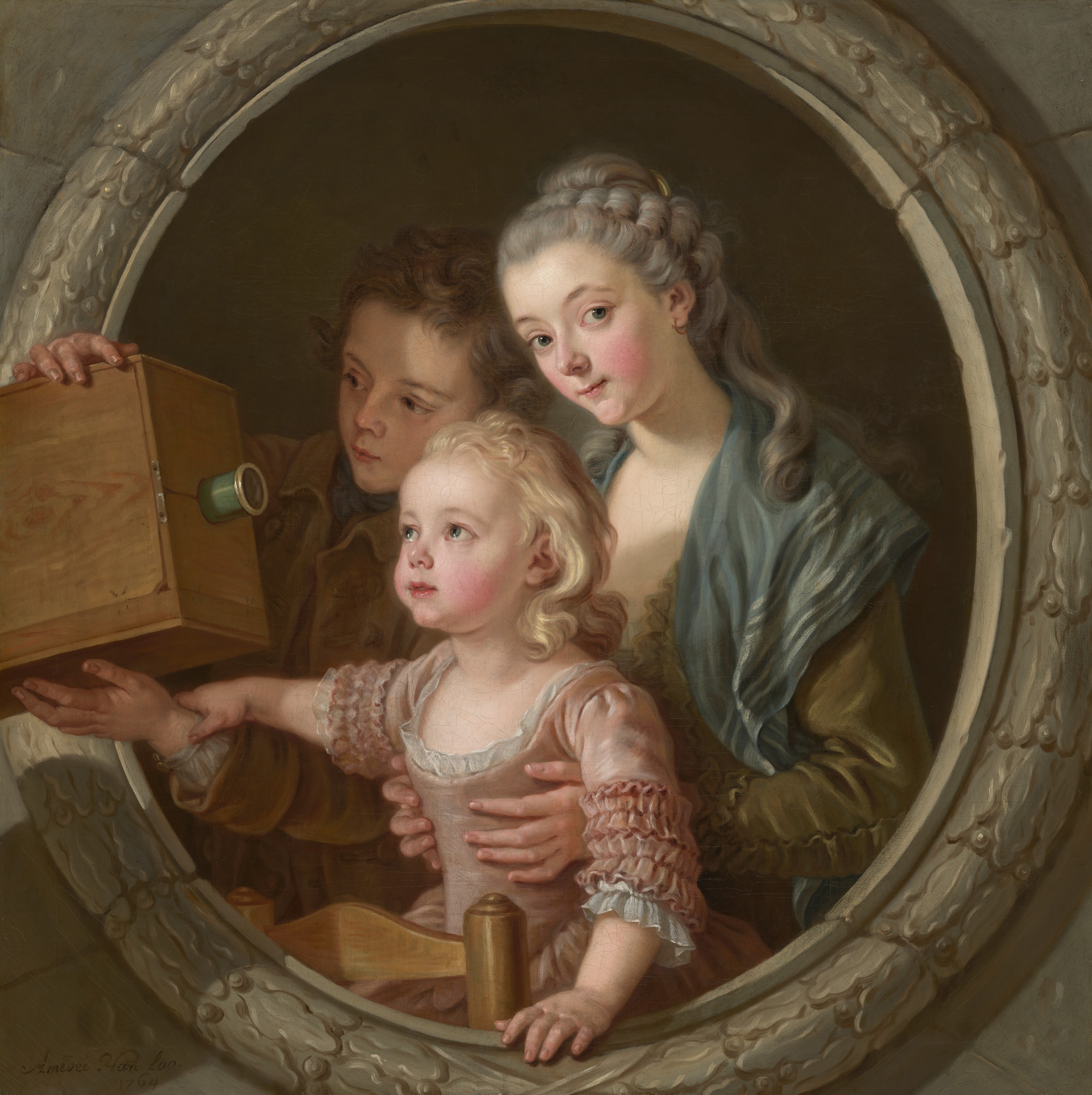
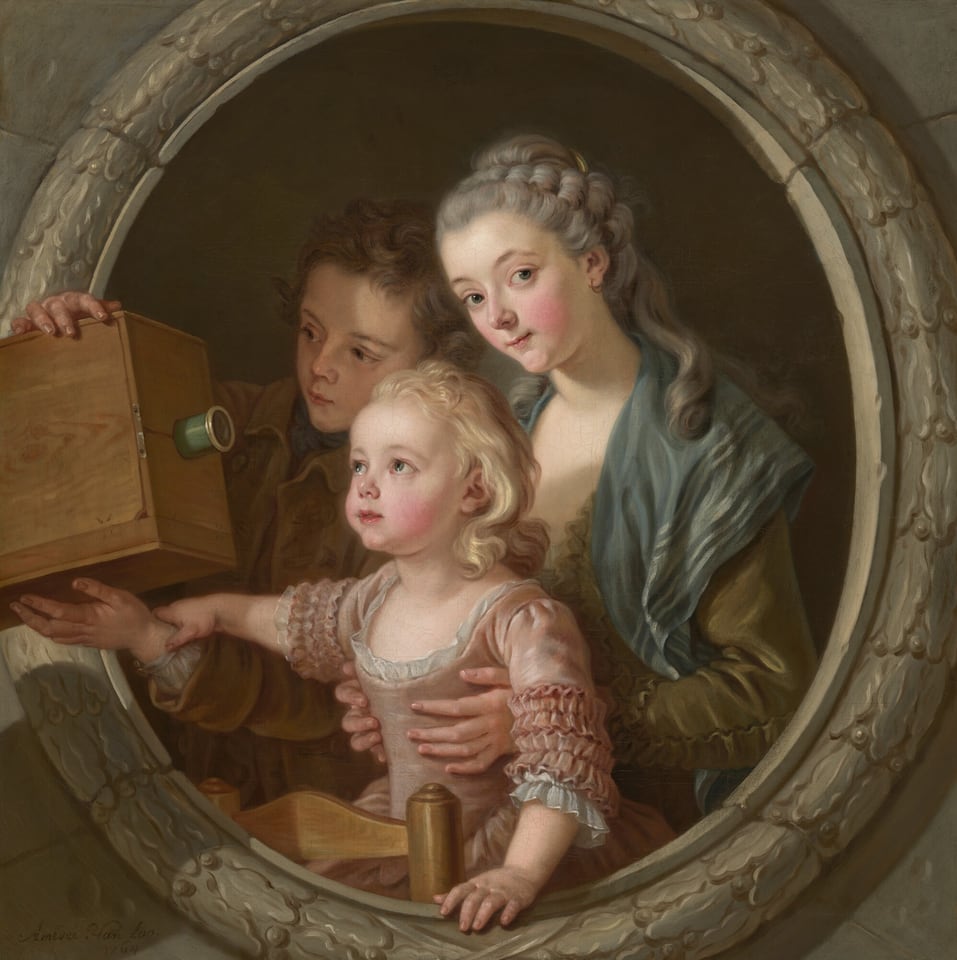
A young woman and two children lean into an oval stone window, absorbed in a wooden box with a brass-lined lens jutting from its side. More about this work
About this work
A young woman and two children lean into an oval stone window, absorbed in a wooden box with a brass-lined lens jutting from its side. The box is a camera obscura, an optical device that projects an image of whatever lies in front of it, and here it serves as a fashionable household amusement. Van Loo frames the trio like a carved cameo: the woman glances out at us with a half-smile while the children stare at the device, and the little girl and the box cast shadows across the sill. The painting is signed and dated 1764 at lower left.
Written by Ochre Editions.
What you’re looking at
A young woman and two children are shown from the waist up through an oval, stone opening, holding and looking at a wooden box with a lens protruding from one side in this square painting. All three people have pale skin with rosy cheeks. To our right, the young woman’s body is angled to our left as she braces the torso of a young girl. The young woman looks at us from the corners of her sage-green eyes, under lifted brows. Her small, pink mouth is pursed in a slight smile, and she has a faint dimple in her rounded chin. Her heather-gray hair is partially plaited over the crown of her head, and long curls fall over her shoulders. She wears a spruce-blue shawl over the shoulders of her low-cut, olive-green dress. The child she braces has chubby cheeks, and her wavy blond hair is brushed back from her forehead and falls loosely to her shoulders. She wears a blush-pink dress with ruffles on the half-length sleeves and gossamer-white trim around the neckline and cuffs. The top and side rails of a wooden, ladderback chair up against the inside of the opening suggests she stands or kneels on a backward-facing chair. She rests her left hand on the edge of the stone opening and her other hand on the wrist of the boy standing close behind her. Mostly in the shadow behind the others, the boy has small, pointed features and short, curly, sable-brown hair. He wears a tan coat, and a muted blue scarf is tied at his throat. The two children gaze at the wooden box the boy holds, which is about the size of a toaster. A short, cylindrical, brass-lined lens pokes out of the center of the side facing the trio. The oval opening through which we see them is carved on our side with stylized leaves and berries, and the wall around it is the same elephant gray as the carvings. The girl and the box cast a shadow across the opening. The artist signed and dated the painting in the lower left corner, “Amedee Can Loo./1764.”
Description from the National Gallery of Art.
How it was made
- Oil paint
- Pigment ground in a drying oil, usually linseed. It dries slowly, so painters could blend on the canvas, build up thin translucent glazes, and rework a picture over weeks. Canvas replaced wooden panels in the 1500s because it is lighter and can be rolled.
Charles Amédée Philippe Van Loo
French, 1719–1795
Charles-Amédée-Philippe van Loo belonged to a celebrated family of painters: he was the son of Jean-Baptiste van Loo and nephew of Carle van Loo. After training with his father, he spent many years as court painter to Frederick the Great of Prussia, decorating palaces at Potsdam and Berlin. Back in Paris he exhibited allegories and genre scenes, such as a pair showing children amusing themselves with soap bubbles and a camera obscura.
Written by Ochre Editions.
Rights and the museum’s record
Public domain. The National Gallery of Art has dedicated this image to the public domain under CC0, so anyone may copy, adapt and use it, for any purpose, without asking. Our prints and files are reproductions made from the museum’s image; the museum doesn’t endorse them.
- Object number
- 1945.10.1
- Credit
- Courtesy National Gallery of Art, Washington
- Type
- Painting
- Licence
- CC0 1.0 Universal
- Museum record
- See it on the museum’s site