Daniel in the Lions' Denc. 1614/1616
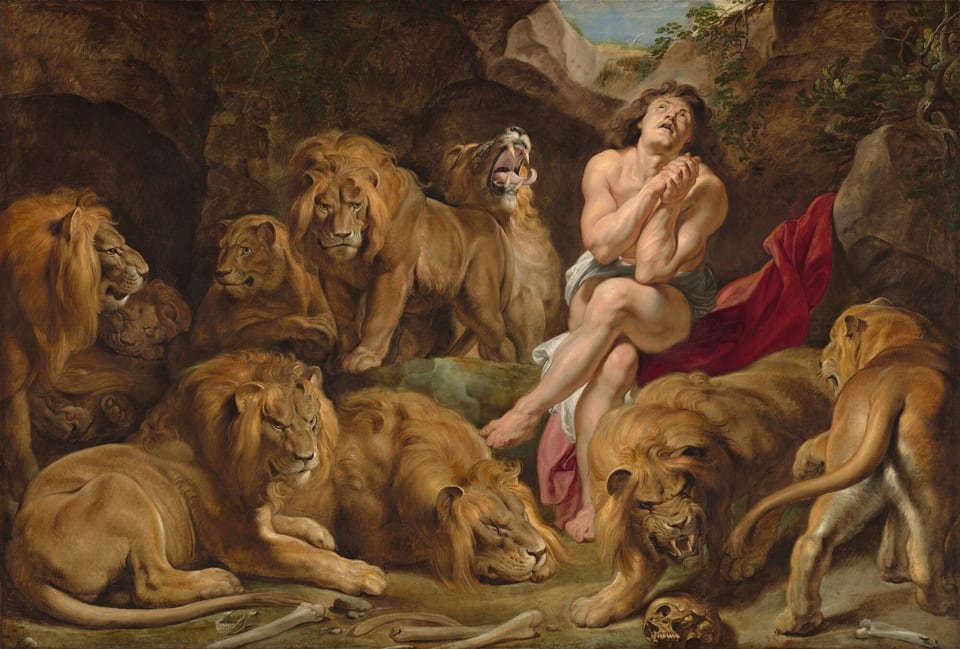
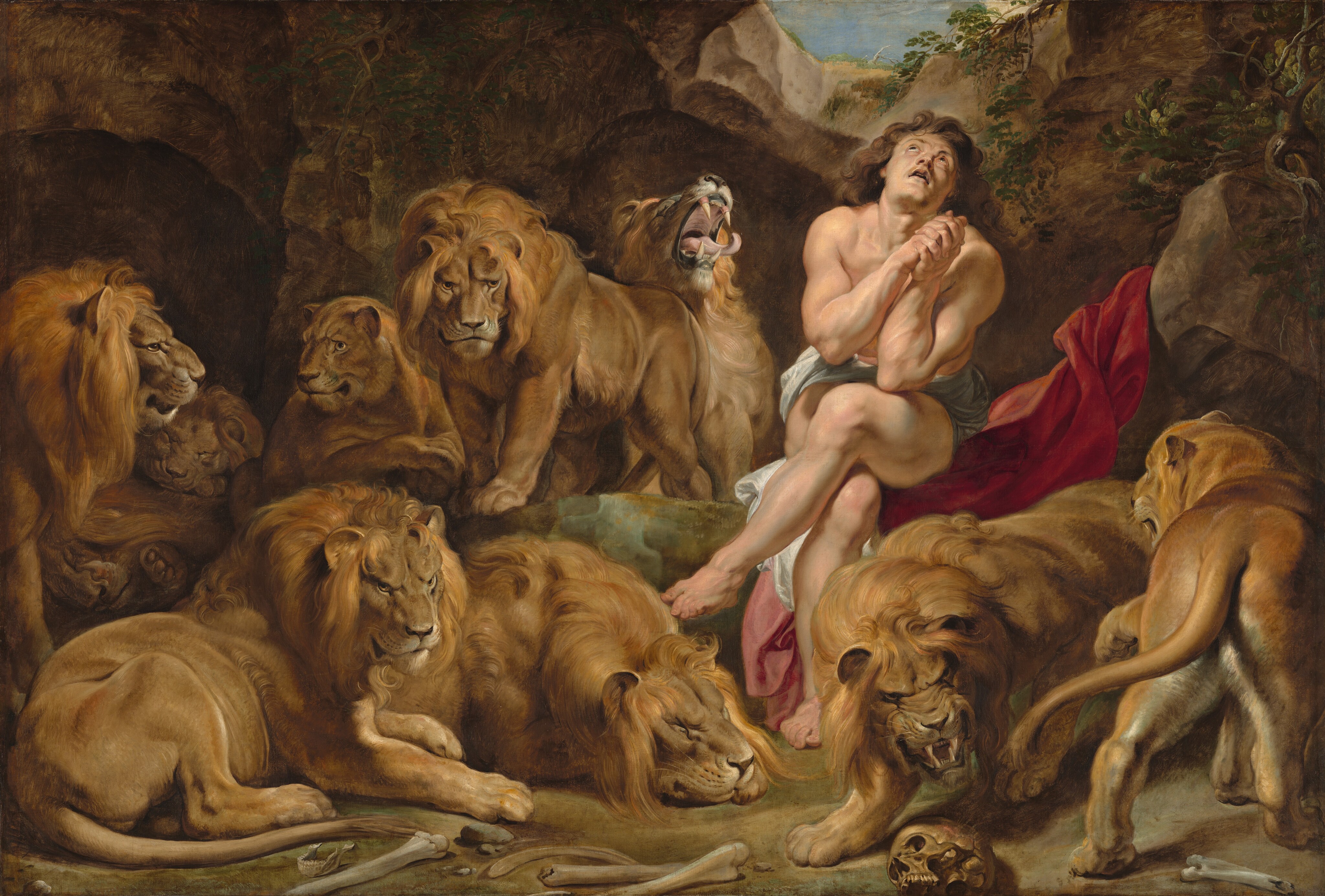
Daniel, nearly nude, sits with his hands clasped and his face turned up towards the small opening of light above the den, while nine lions prowl, yawn and stare around him, a human skull and bones at his feet. More about this work
About this work
Daniel, nearly nude, sits with his hands clasped and his face turned up towards the small opening of light above the den, while nine lions prowl, yawn and stare around him, a human skull and bones at his feet. Rubens painted the life-size beasts with astonishing realism, drawing on studies of real lions, and the painting shows his gift for combining physical drama with spiritual intensity. In 1618 he listed it among works offered to the English diplomat Sir Dudley Carleton, describing it as entirely by his own hand.
Written by Ochre Editions.
What you’re looking at
A nearly nude, muscular man with pale, peachy skin sits in an underground cave among seven male and two female lions in this horizontal painting. The man sits to our right of center with his legs crossed, elbows close to his body with hands clasped by his chest. His head tips back to look up through a small opening above. He has long, wavy, chestnut-brown hair and dark eyes. A white cloth wraps across his hips, and he sits on a scarlet-red swath of fabric draped up over a rock next to him. The nine lions stalk, sit, or lie down around the man. One male lion next to the man, to our left, opens his mouth with his head thrown back, curling tongue extended beyond long fangs. A human skull and other bones are strewn on the dirt ground close to us. The rocky cave curves up around the animals and man to a narrow, round opening showing blue sky above.
Description from the National Gallery of Art.
How it was made
- Oil paint
- Pigment ground in a drying oil, usually linseed. It dries slowly, so painters could blend on the canvas, build up thin translucent glazes, and rework a picture over weeks. Canvas replaced wooden panels in the 1500s because it is lighter and can be rolled.
Peter Paul Rubens
Flemish, 1577–1640 · Born in Siegen; died in Antwerp.
Rubens was born in Siegen, raised in Antwerp and spent eight formative years in Italy, mainly in the service of the Duke of Mantua. Settling in Antwerp in 1608, he ran a large, efficient studio that produced altarpieces, ceilings and tapestry designs for courts across Europe, from the Medici cycle in Paris to the Banqueting House ceiling in London. He also served as a diplomat. Isabella Brant and later Helena Fourment, his two wives, appear often in his work.
Written by Ochre Editions.
Rights and the museum’s record
Public domain. The National Gallery of Art has dedicated this image to the public domain under CC0, so anyone may copy, adapt and use it, for any purpose, without asking. Our prints and files are reproductions made from the museum’s image; the museum doesn’t endorse them.
- Object number
- 1965.13.1
- Credit
- Courtesy National Gallery of Art, Washington
- Type
- Painting
- Licence
- CC0 1.0 Universal
- Museum record
- See it on the museum’s site
Report this work
More by Peter Paul Rubens
All their works
Close in colour