Hans Roth [reverse]1527
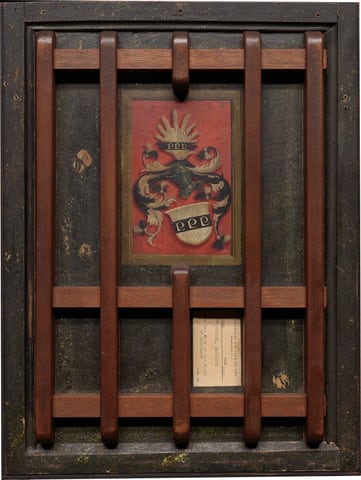
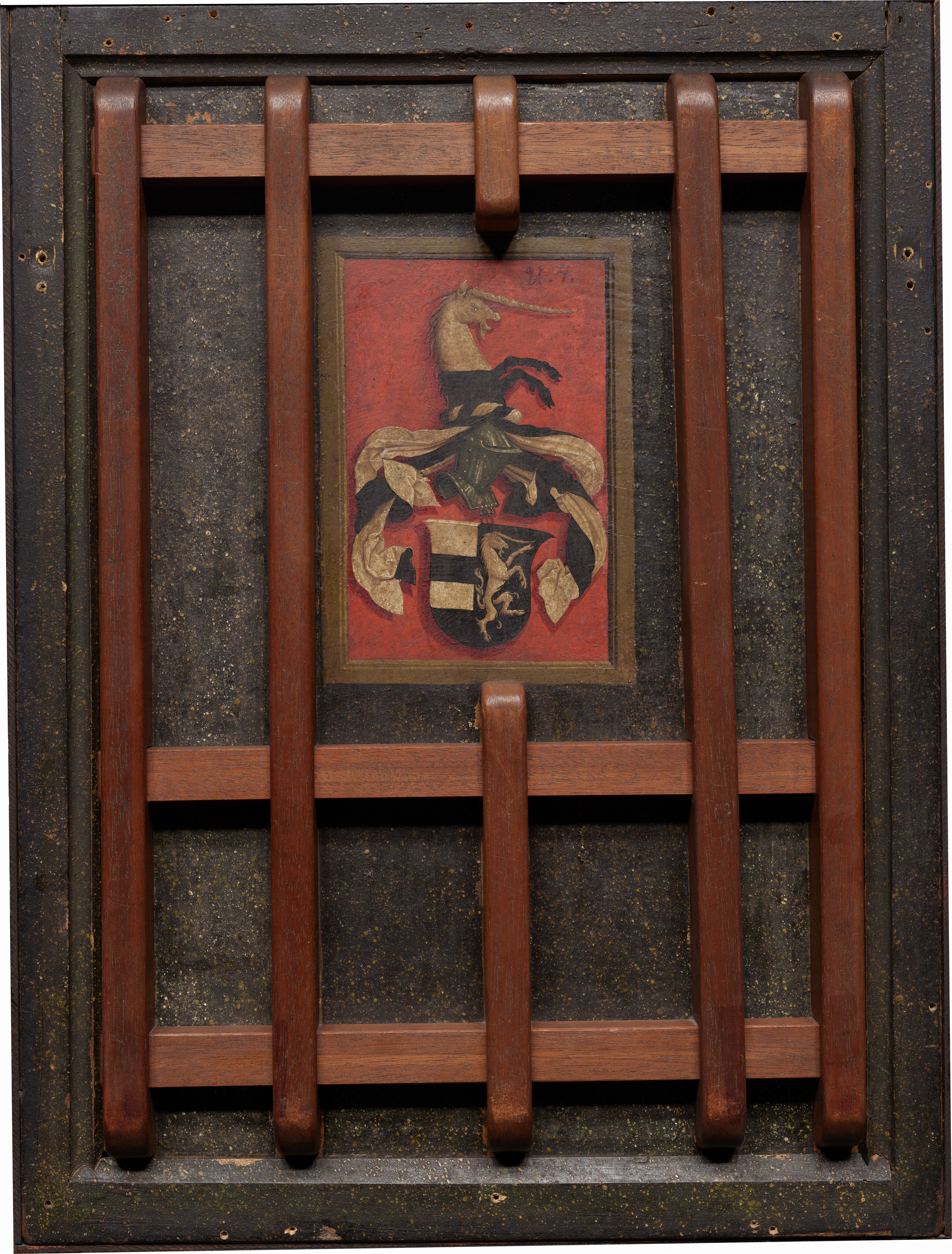
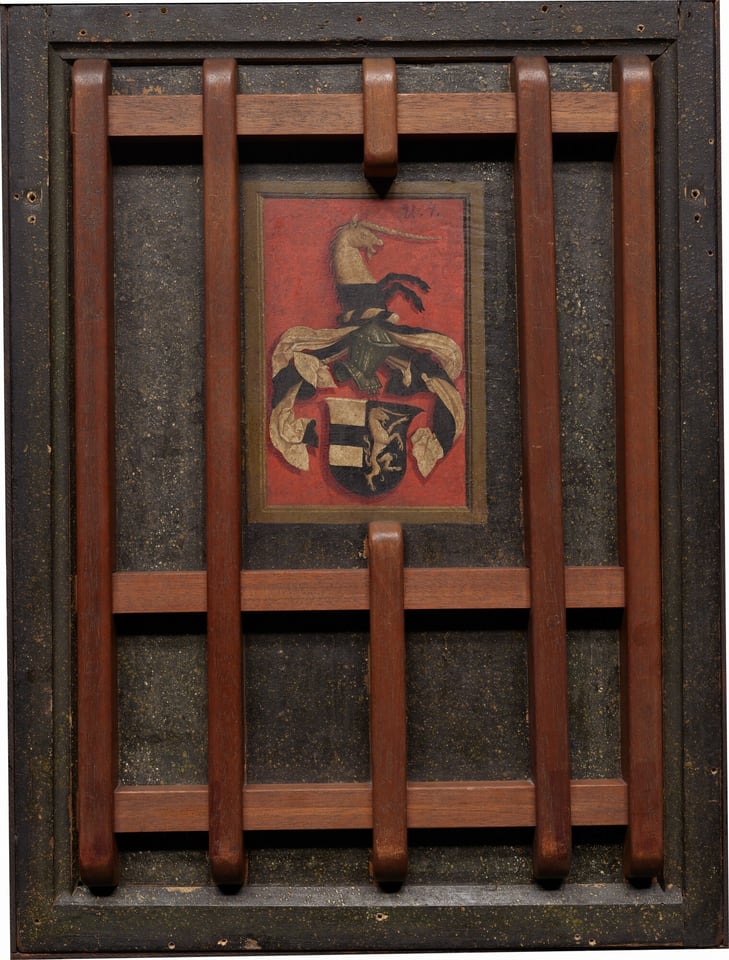
The back of Bernhard Strigel’s 1527 portrait of Hans Roth carries his coat of arms: a black and gold shield beneath a crest from which a unicorn-like creature emerges, all set on a deep red ground. More about this work
About this work
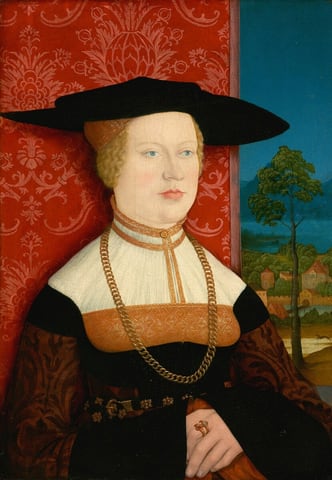
The back of Bernhard Strigel’s 1527 portrait of Hans Roth carries his coat of arms: a black and gold shield beneath a crest from which a unicorn-like creature emerges, all set on a deep red ground. Painted reverses like this turned a portrait into an object to be held and turned over, and they declared the sitter’s family and standing. Its companion, the portrait of Margarethe Vöhlin, has a matching heraldic reverse.
Written by Ochre Editions.
What you’re looking at
This is a painting depicting a heraldic coat of arms. The image features a detailed coat of arms with a central shield, adorned with black and gold sections, and additional decorative elements above it. There is a figure resembling a unicorn emerging from the crest. The background is a deep red hue. The artwork is displayed within a wooden frame with crossbars. This style is associated with displaying family crests and lineage.
Description from the National Gallery of Art.
How it was made
- Oil on panel
- Oil paint on prepared wooden boards, usually oak in the north and poplar in Italy. The rigid, smooth surface suits fine detail and thin, glowing glazes.
- Oil paint
- Pigment ground in a drying oil, usually linseed. It dries slowly, so painters could blend on the canvas, build up thin translucent glazes, and rework a picture over weeks. Canvas replaced wooden panels in the 1500s because it is lighter and can be rolled.
Bernhard Strigel
German, 1460/1461–1528
Strigel came from a family of painters in Memmingen in Swabia, where he worked for most of his life. He became a favoured portraitist of Emperor Maximilian I, painting the emperor and his family, including a well-known group portrait of Maximilian with his wife, son and grandsons. He also painted altarpieces in a late Gothic manner with lively colour. His late portraits of the couple Hans Roth and Margarethe Vöhlin show his attention to individual character.
Written by Ochre Editions.
Rights and the museum’s record
Public domain. The National Gallery of Art has dedicated this image to the public domain under CC0, so anyone may copy, adapt and use it, for any purpose, without asking. Our prints and files are reproductions made from the museum’s image; the museum doesn’t endorse them.
- Object number
- 1947.6.4.b
- Credit
- Courtesy National Gallery of Art, Washington
- Type
- Painting
- Licence
- CC0 1.0 Universal
- Museum record
- See it on the museum’s site