Margarethe Vöhlin [obverse]1527
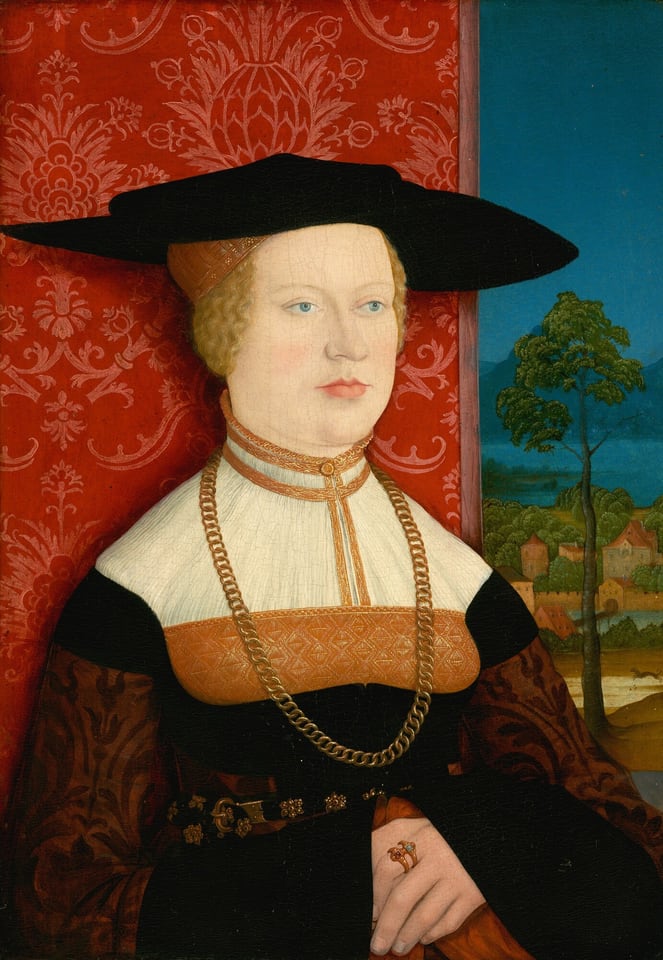
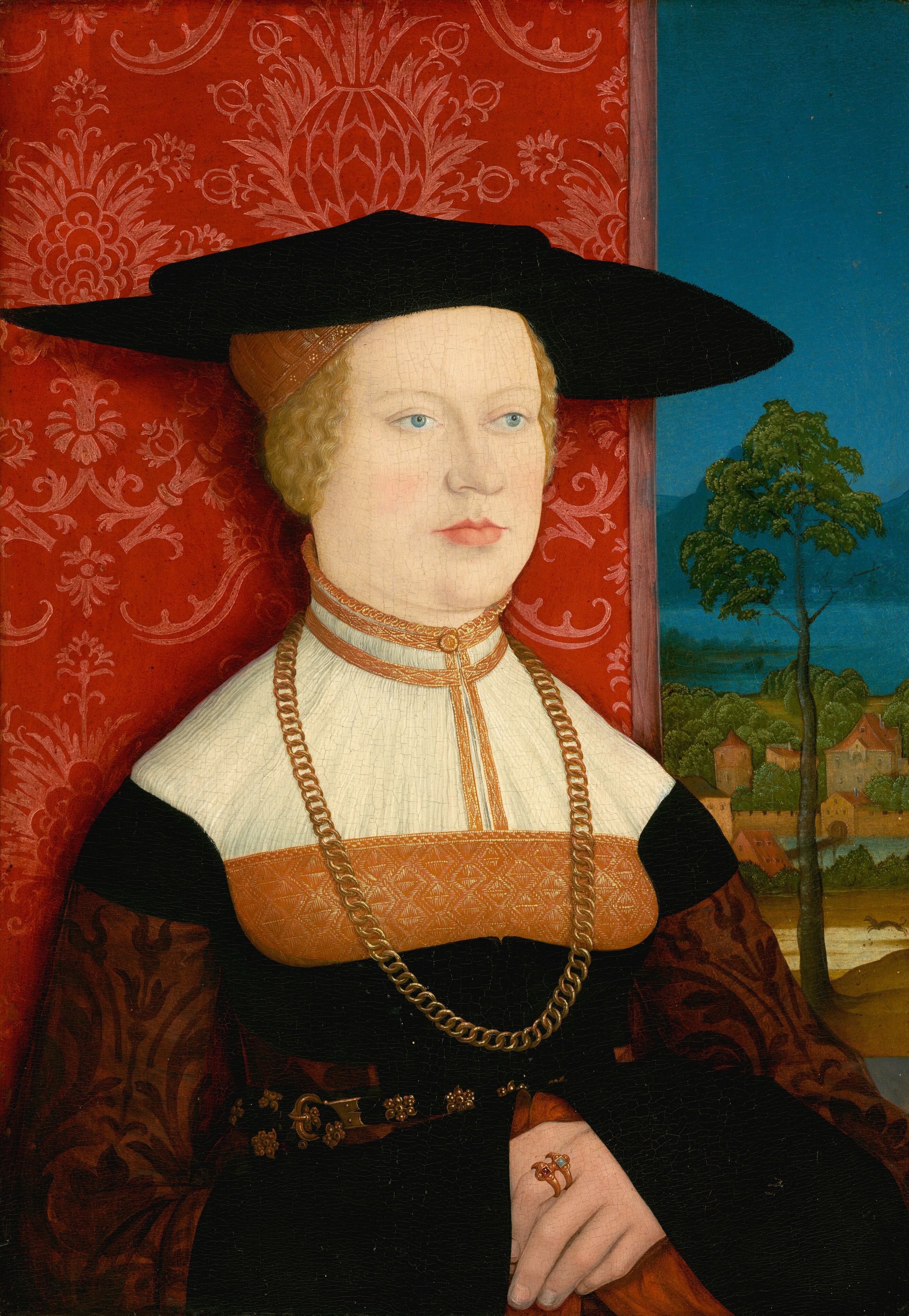
Margarethe Vöhlin sits half-length in a high-necked dress of white, black and gold, a long gold chain falling to her waist and two jewelled rings on one finger of her folded hands. More about this work
About this work
Margarethe Vöhlin sits half-length in a high-necked dress of white, black and gold, a long gold chain falling to her waist and two jewelled rings on one finger of her folded hands. Her blond hair is gathered into a gold cap beneath a broad black hat. Behind her, a red wall hanging patterned with pink flowers gives way at the right to a view of a bridge, a town, a leaping dog and blue mountains across a lake. Bernhard Strigel, a favoured portraitist of Emperor Maximilian I, painted her in 1527 as one of a pair with Hans Roth; the backs of both panels carry coats of arms.
Written by Ochre Editions.
What you’re looking at
Shown from the waist up, a light-skinned woman sits angled slightly to our right in this vertical portrait painting. The woman has blue eyes, faint brows, and a sloping nose ending in a small bulb. Her upper lip is thin and her lower lip full over a slight double chin. Her blond hair is pulled back under a gold, cap-like headdress and a black, wide-brimmed hat with a shallow crown. She wears a high-necked white, black, and gold dress with intricate detailing, a gold chain necklace that falls to her waist, and a black belt with a gold clasp and medallions. She wears two gold rings set with gems on the pointer finger of her left hand, which is folded across her belly over the other hand. A scarlet-red wallcovering with pink floral designs fills two-thirds of the space behind her. The rightmost third of the background opens onto a landscape with a tall, spindly tree, a leaping animal, presumably a dog, and a bridge across a body of water leading to a town. Across another body of water, perhaps a lake, mountains are marine blue in the distance under a clear, celestial-blue sky.
Description from the National Gallery of Art.
How it was made
- Oil on panel
- Oil paint on prepared wooden boards, usually oak in the north and poplar in Italy. The rigid, smooth surface suits fine detail and thin, glowing glazes.
- Oil paint
- Pigment ground in a drying oil, usually linseed. It dries slowly, so painters could blend on the canvas, build up thin translucent glazes, and rework a picture over weeks. Canvas replaced wooden panels in the 1500s because it is lighter and can be rolled.
Bernhard Strigel
German, 1460/1461–1528
Strigel came from a family of painters in Memmingen in Swabia, where he worked for most of his life. He became a favoured portraitist of Emperor Maximilian I, painting the emperor and his family, including a well-known group portrait of Maximilian with his wife, son and grandsons. He also painted altarpieces in a late Gothic manner with lively colour. His late portraits of the couple Hans Roth and Margarethe Vöhlin show his attention to individual character.
Written by Ochre Editions.
Rights and the museum’s record
Public domain. The National Gallery of Art has dedicated this image to the public domain under CC0, so anyone may copy, adapt and use it, for any purpose, without asking. Our prints and files are reproductions made from the museum’s image; the museum doesn’t endorse them.
- Object number
- 1947.6.5.a
- Credit
- Courtesy National Gallery of Art, Washington
- Type
- Painting
- Licence
- CC0 1.0 Universal
- Museum record
- See it on the museum’s site
Report this work
More by Bernhard Strigel
All their works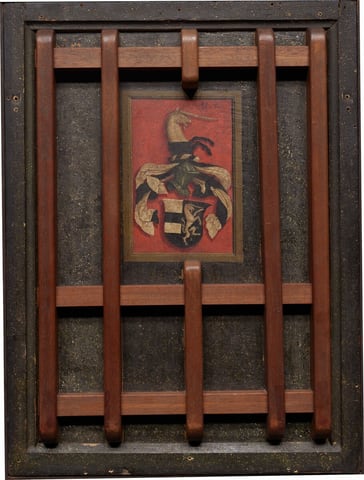
Close in colour