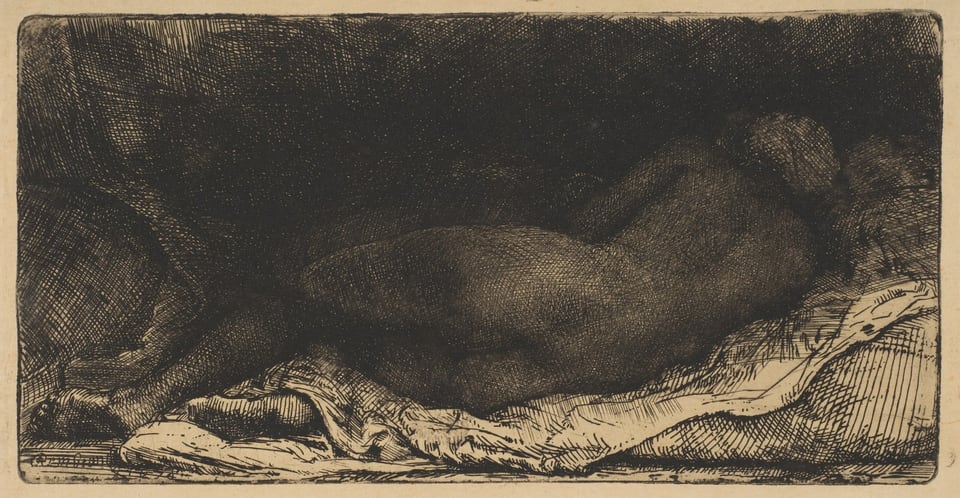
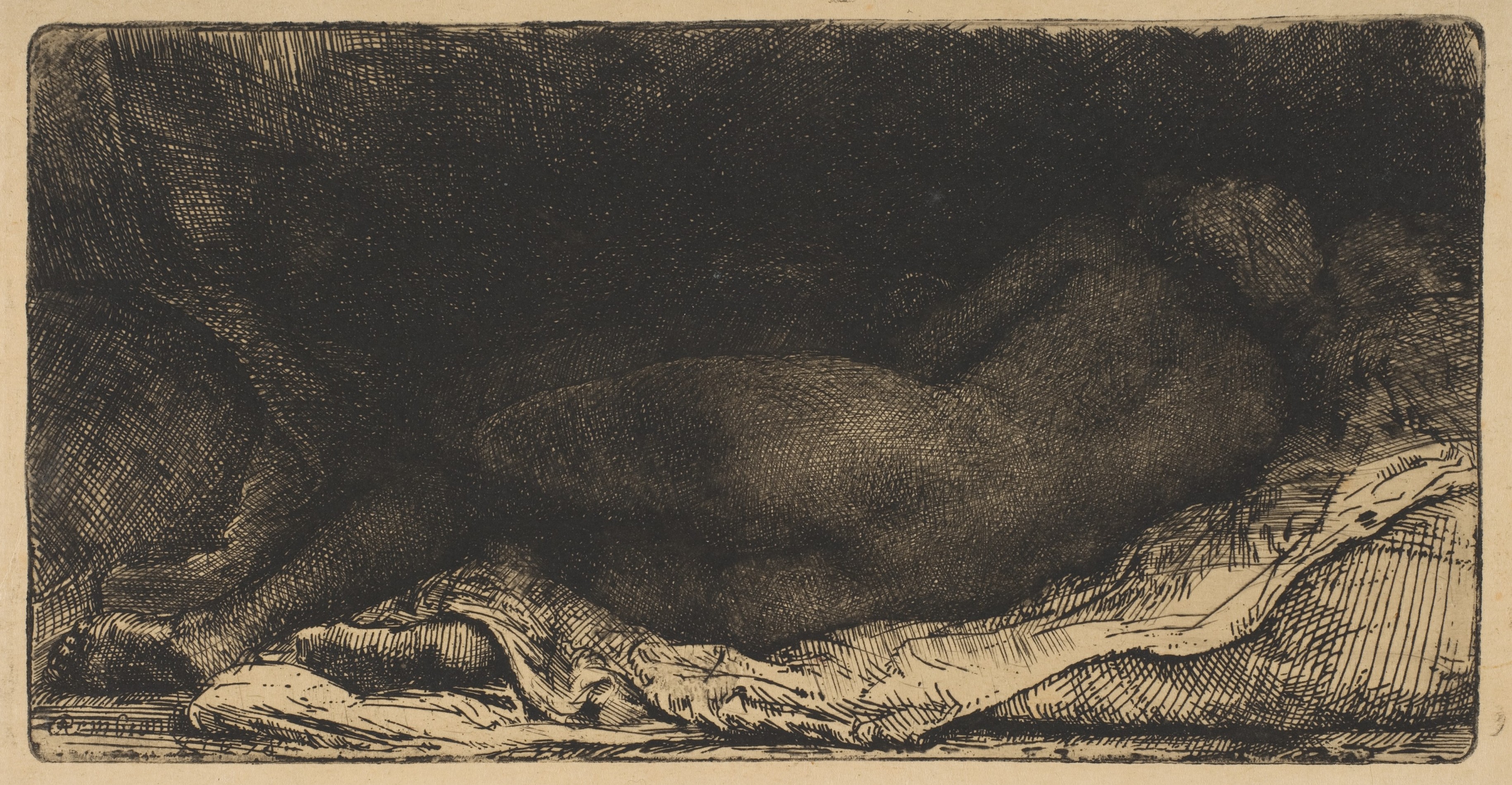
Reclining Female Nude1658
A nude woman reclines, her body emerging softly from deep shadow, in one of a group of etchings of the nude that Rembrandt made in 1658. More about this work
About this work
A nude woman reclines, her body emerging softly from deep shadow, in one of a group of etchings of the nude that Rembrandt made in 1658. He built up the darkness with dense etched hatching, drypoint and engraving, so that the figure glows against it. This impression, the second of six states, is printed on Japanese paper, whose smooth, warm surface Rembrandt favoured for its ability to hold rich, velvety tones.
Written by Ochre Editions.
How it was made
- Drypoint
- Lines scratched straight into the plate with a needle throw up a ridge of metal, the burr, which holds ink and prints a soft, furred line. The burr wears down, so early impressions are the richest.
- Etching
- The artist draws with a needle through a waxy coating on a copper plate, and acid bites the exposed lines. The plate is then inked, wiped and printed under pressure, so the line keeps the freedom of drawing.
- Engraving
- Lines cut directly into a metal plate with a steel burin, which makes them swell and taper. It took years to master, and for centuries it was how paintings travelled as pictures.
Rembrandt van Rijn
Dutch, 1606–1669 · Born in Leiden; died in Amsterdam.
Rembrandt trained in Leiden and Amsterdam, settled in Amsterdam in the early 1630s and became the city’s most sought-after portraitist. His later work grows rougher and more searching, with thick paint, deep shadow and faces that seem lost in thought, as in Aristotle with a Bust of Homer, painted for a Sicilian collector. He was also the leading etcher of his age, reworking plates through many states and making the medium as expressive as painting.
Written by Ochre Editions.
Rights and the museum’s record
Public domain. The Met has dedicated this image to the public domain under CC0, so anyone may copy, adapt and use it, for any purpose, without asking. Our prints and files are reproductions made from the museum’s image; the museum doesn’t endorse them.
- Object number
- 29.107.28
- Credit
- Courtesy of The Metropolitan Museum of Art
- Type
- Prints
- Department
- Drawings and Prints
- Licence
- CC0 1.0 Universal
- Museum record
- See it on the museum’s site
Report this work
More by Rembrandt van Rijn
All their works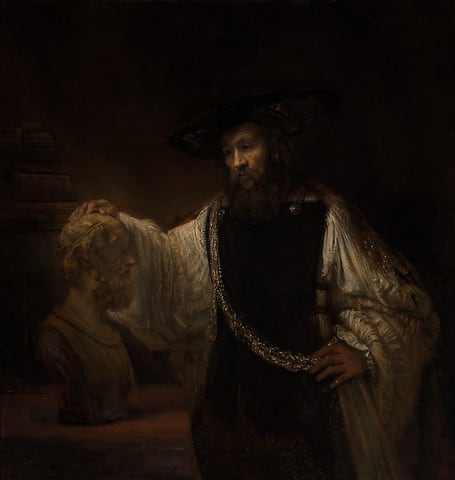
Close in colour