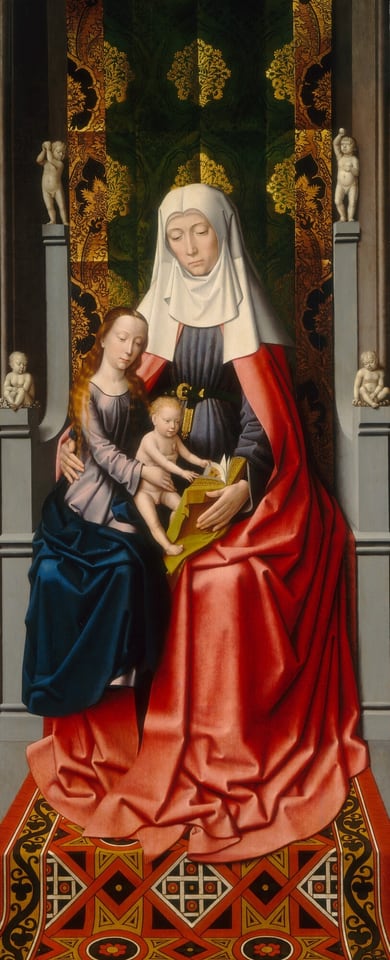
The Saint Anne Altarpiece: Saint Anne with the Virgin and Child [middle panel]c. 1500/1520
Gerard David painted this in about 1500/1520, aged about 45. It is now at the National Gallery of Art in Washington, DC. More about this work
About this work
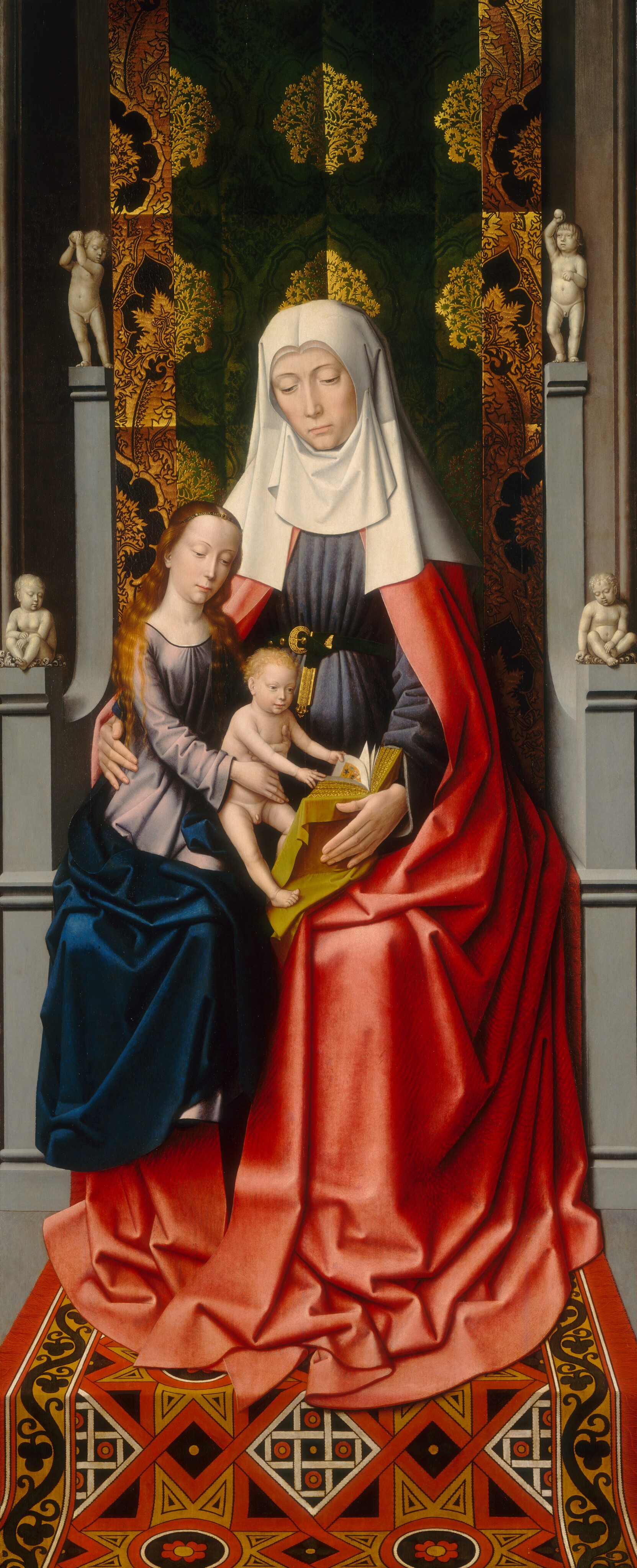
Two women and a baby, all with pale skin, sit together on a gray, stone throne with patterned fabric hanging behind them and a patterned rug below in this narrow, vertical painting. The woman sitting on the throne, Saint Anne, is the largest. A second woman, Mary, is smaller in scale, and she sits on Saint Anne’s lap. Mary, in turn, holds a nude baby boy on her lap. Both women have light brown eyes under faint, arched brows, smooth skin, long straight noses, and their shell-pink lips are closed. Saint Anne sits with her body facing us and she looks down with her head slightly tilted to our left. Her white head covering drapes over her shoulders and hangs down from her chin to cover her neck. She wears a marine-blue dress cinched at her waist with a black and gold belt, and a crimson-red robe that falls to and puddles around her feet. Her right arm, on our left, wraps around and holds Mary’s hip, and she supports a book with gold-edged pages with her other hand. Mary sits on Saint Anne’s right thigh, to our left, and leans toward the baby, who sits on her left knee, to our right. Her long, wavy, brown hair falls over her shoulders, and she wears a cobalt-blue robe over a lilac-purple dress. The baby has short, curly blond hair and reaches to turn the pages of the book. He has rounded cheeks and a pudgy torso. The stone throne is ornamented on the arms and at the top corners with ivory-white, nude children that are presumably also carved out of stone. The cloth hanging behind Saint Anne is decorated with glimmering gold, ornamental leaf designs against a pine-green background. The rug beneath her feet is a geometric pattern of red, tan, black, and white.
Description from the National Gallery of Art.
Gerard David painted this in about 1500/1520, aged about 45. It is now at the National Gallery of Art in Washington, DC.
How it was made
- Oil on panel
- Oil paint on prepared wooden boards, usually oak in the north and poplar in Italy. The rigid, smooth surface suits fine detail and thin, glowing glazes.
- Oil paint
- Pigment ground in a drying oil, usually linseed. It dries slowly, so painters could blend on the canvas, build up thin translucent glazes, and rework a picture over weeks. Canvas replaced wooden panels in the 1500s because it is lighter and can be rolled.
Gerard David
Netherlandish, 1455–1523 · Born in Oudewater; died in Bruges.
Rights and the museum’s record
Public domain. The National Gallery of Art has dedicated this image to the public domain under CC0, so anyone may copy, adapt and use it, for any purpose, without asking. Our prints and files are reproductions made from the museum’s image; the museum doesn’t endorse them.
- Object number
- 1942.9.17.b
- Credit
- Courtesy National Gallery of Art, Washington
- Type
- Painting
- Licence
- CC0 1.0 Universal
- Museum record
- See it on the museum’s site