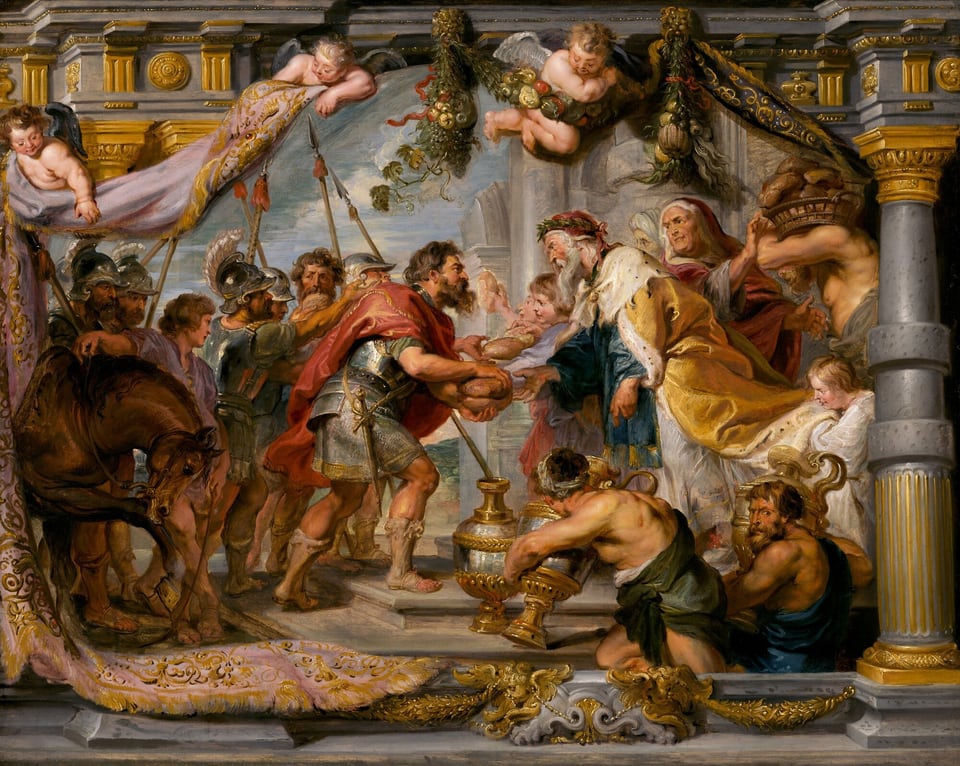
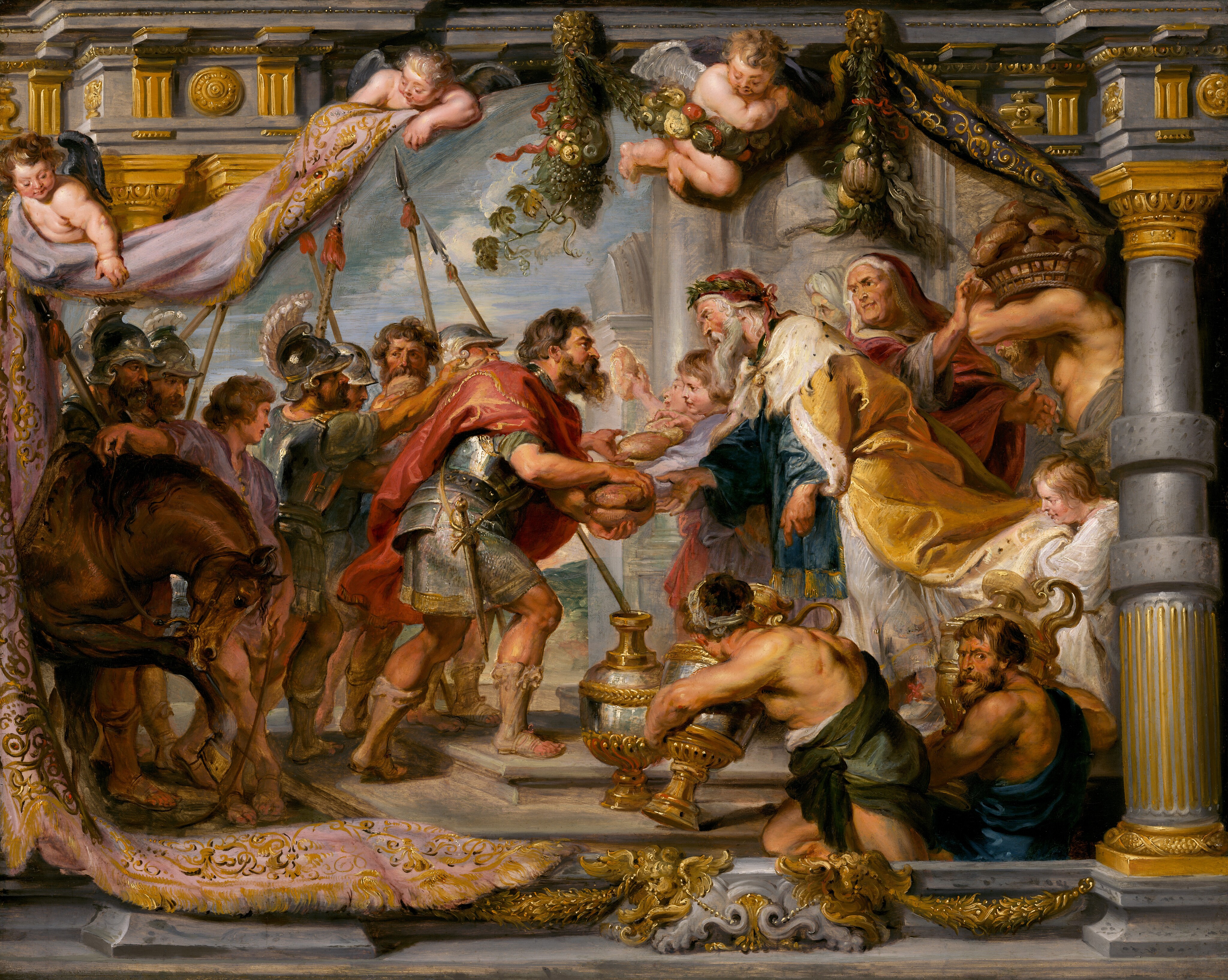
The Meeting of Abraham and Melchizedekc. 1626
The scene is painted as if it were a tapestry, unfurled by winged putti between grey and gold columns: within it, the armoured Abraham, returning from battle, meets the white-bearded priest-king… More about this work
About this work
The scene is painted as if it were a tapestry, unfurled by winged putti between grey and gold columns: within it, the armoured Abraham, returning from battle, meets the white-bearded priest-king Melchizedek, who brings bread and wine, while attendants carry loaves and huge silver and gold vessels. Rubens made this oil sketch around 1626 for the Triumph of the Eucharist, a series of tapestries commissioned by the Infanta Isabella, governor of the Spanish Netherlands, for the convent of the Descalzas Reales in Madrid. The Old Testament meeting was understood as a foreshadowing of the Christian Eucharist.
Written by Ochre Editions.
What you’re looking at
This horizontal painting shows a tapestry being unfurled and held up by winged, baby-like putti against a structure with gray and gold columns, seen at the edges of the composition. Taking up most of the composition, the tapestry shows two ranks of men, women, and children gathered behind two central men, who meet at the center. All the people have light or tanned skin, and the bodies we can see are muscular. In the central pair of men, the one to our left, Abraham, faces our right in profile as he holds two loaves of bread. He has a brown beard and short, wavy hair, and dark brows over a prominent nose. He looks at the other man with dark eyes and leans toward him, to our right. Abraham wears an armored breastplate over silver chainmail edged with gold, which falls to mid-thigh. A crimson-red cape wraps around his shoulders and swirls around his back. A sword hangs by his hip, and tan sandals cover his heels and shins. Behind him are seven men and one brown horse, who gnaws at its foreleg. Most of the men are bearded and five wear armored helmets. A cleanshaven man wearing a lavender-purple tunic stands with his arm slung over the horse’s neck, holding the rein between thumb and forefinger. The man to our right, Melchizedek has a long white beard and short white hair. His red cap is encircled with a wreath of dark green leaves. He wears a long-sleeved, waist-length, aquamarine-blue garment over a white skirt. A heavy, golden-yellow cape with a broad, white fur collar and lining drapes over his shoulders, and is supported by at least one attendant. Behind and around Melchizedek are eight men, women, and children, standing near stone, gray ruins. Behind Melchizedek, one portly person wearing a dark pink mantle reaches into a basket of bread held across the shoulders of a blond, bearded, bare-chested man. Closer to us, in the lower right corner of the tapestry, one man wearing a green toga and another wearing blue kneel and sit, holding oversized silver and gold urns, the size of their torsos. The man in blue, to our right, turns to look at us over his shoulder. A third large urn sits near the other man. A view into the landscape with a low, green hill and a pale blue sky is glimpsed between the groups. The tapestry showing this scene curls over at the edges where the pudgy angels lift the top edge. The top right corner of the tapestry wraps around the edge of an unseen feature of the building, next to a gray column that rises the height of the painting up along the right edge. The border of the tapestry is rose pink with stylized gold designs. One putto with brown hair holds up the left corner, and one with light gray hair holds up the middle one arm slung over the front of the tapestry. The third putto, with blond hair, hooks an arm over a leafy garland with fruit that hangs from the cornice near the top center of the composition.
Description from the National Gallery of Art.
How it was made
- Oil on panel
- Oil paint on prepared wooden boards, usually oak in the north and poplar in Italy. The rigid, smooth surface suits fine detail and thin, glowing glazes.
- Oil paint
- Pigment ground in a drying oil, usually linseed. It dries slowly, so painters could blend on the canvas, build up thin translucent glazes, and rework a picture over weeks. Canvas replaced wooden panels in the 1500s because it is lighter and can be rolled.
Peter Paul Rubens
Flemish, 1577–1640 · Born in Siegen; died in Antwerp.
Rubens was born in Siegen, raised in Antwerp and spent eight formative years in Italy, mainly in the service of the Duke of Mantua. Settling in Antwerp in 1608, he ran a large, efficient studio that produced altarpieces, ceilings and tapestry designs for courts across Europe, from the Medici cycle in Paris to the Banqueting House ceiling in London. He also served as a diplomat. Isabella Brant and later Helena Fourment, his two wives, appear often in his work.
Written by Ochre Editions.
Rights and the museum’s record
Public domain. The National Gallery of Art has dedicated this image to the public domain under CC0, so anyone may copy, adapt and use it, for any purpose, without asking. Our prints and files are reproductions made from the museum’s image; the museum doesn’t endorse them.
- Object number
- 1958.4.1
- Credit
- Courtesy National Gallery of Art, Washington
- Type
- Painting
- Licence
- CC0 1.0 Universal
- Museum record
- See it on the museum’s site
Report this work
More by Peter Paul Rubens
All their works
Close in colour