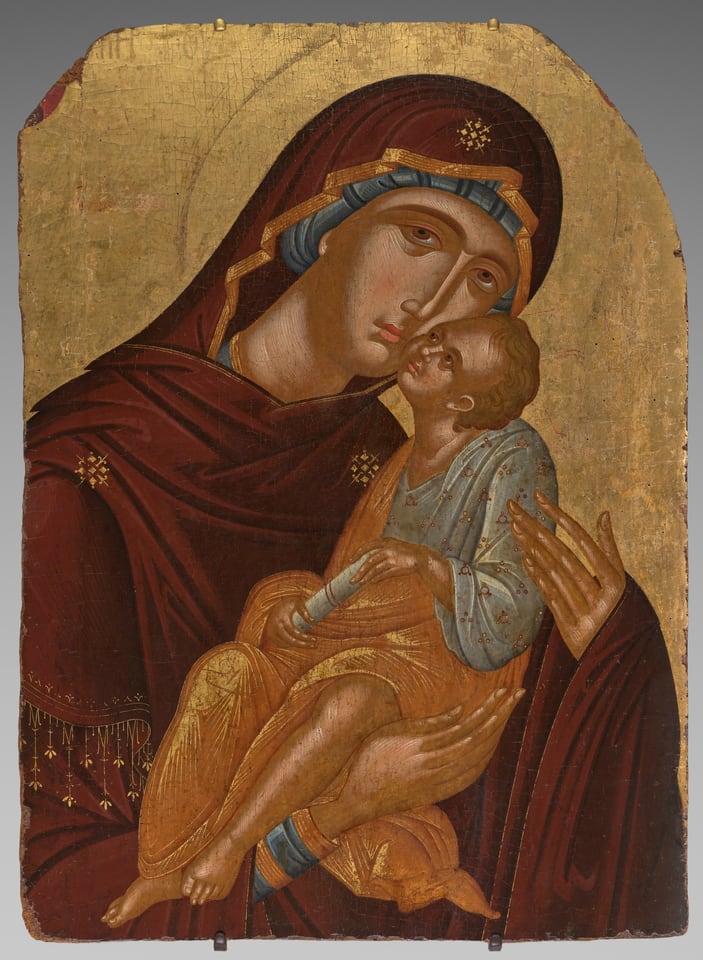
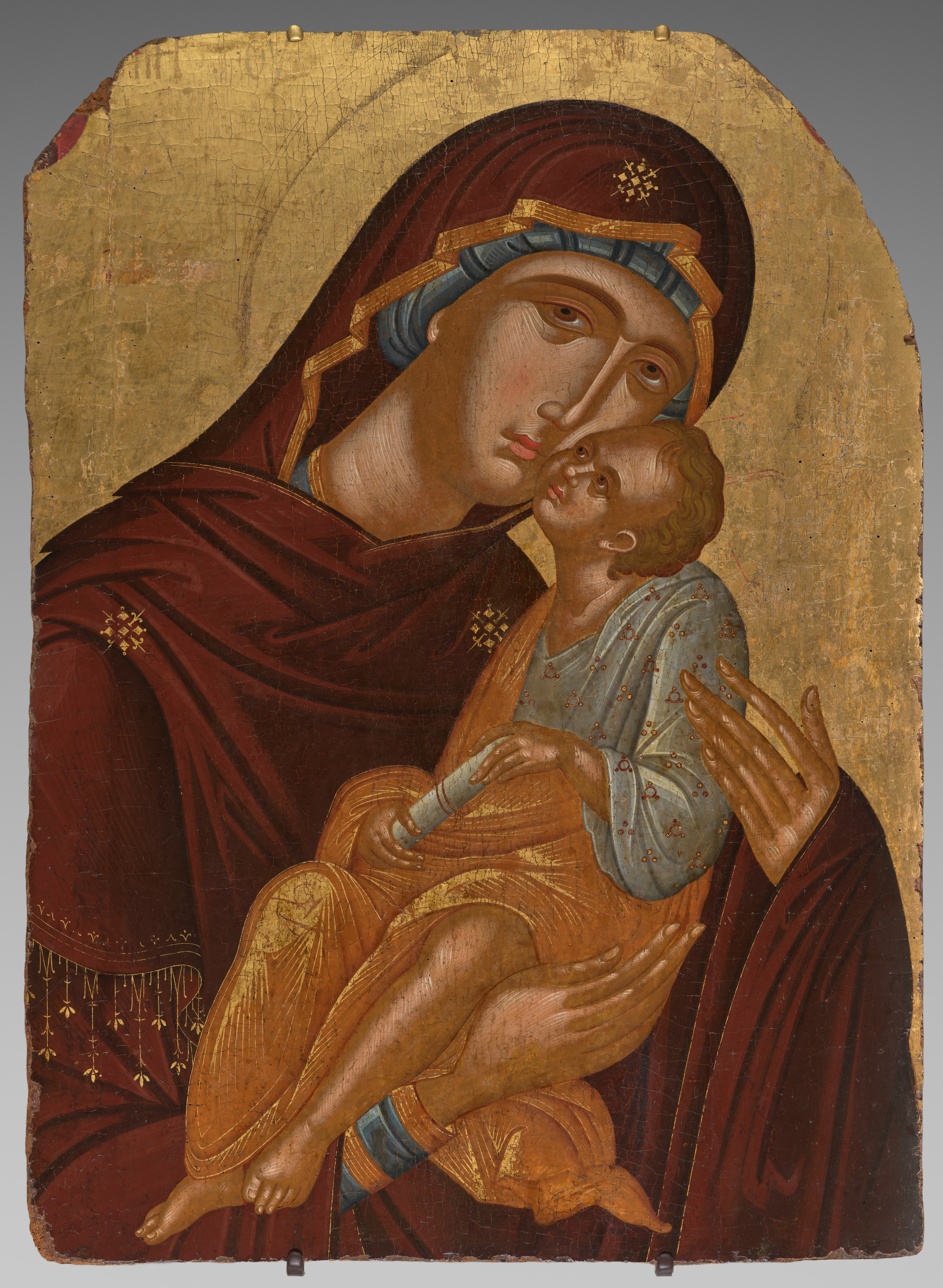
Icon of the Mother of God and Infant Christ (Virgin Eleousa)c. 1425–50
This large icon of a tender embrace between the Virgin Mary and Christ likely hung on a Greek Orthodox church’s iconostasis, a screen separating the congregation from the altar-containing sanctuary, which only clergy could enter. More about this work
About this work
This large icon of a tender embrace between the Virgin Mary and Christ likely hung on a Greek Orthodox church’s iconostasis, a screen separating the congregation from the altar-containing sanctuary, which only clergy could enter. A skilled painter of faces and draperies, Angelos Akotantos was among Crete’s most sought-after artists. Based in Byzantium’s artistic center in his hometown of Candia, he painted for imperial clients and beyond. Despite theological differences, Cretan icons of Mary were popular in Ethiopia. In the early 1500s, Emperor Lebna Dengel sent monks Zekre and Pawli to acquire Cretan icons for him. Twenty-nine Cretan icons are still venerated (honored) in Ethiopian churches.
Text from the Cleveland Museum of Art.
How it was made
- Gold ground
- Gold leaf laid over a red clay and burnished to a mirror shine, often tooled with punches so it flickers in candlelight. Behind sacred figures it stands for heavenly light.
- Tempera
- Pigment bound with egg yolk. It dries in minutes and can’t be blended wet, so painters built up form with fine, hatched strokes. It was Europe’s main panel technique before oil.
Angelos Akotantos
Cretan, died 1450
Rights and the museum’s record
Public domain. The Cleveland Museum of Art has dedicated this image to the public domain under CC0, so anyone may copy, adapt and use it, for any purpose, without asking. Our prints and files are reproductions made from the museum’s image; the museum doesn’t endorse them.
- Object number
- 2010.154
- Credit
- Courtesy of the Cleveland Museum of Art
- Type
- Painting
- Department
- Medieval Art
- Licence
- CC0 1.0 Universal
- Museum record
- See it on the museum’s site
Report this work
Close in colour