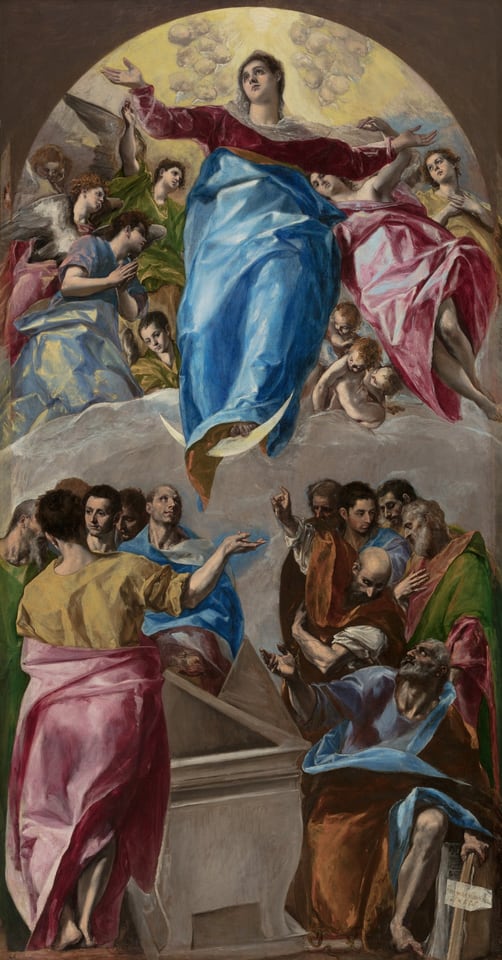
The Assumption of the Virgin1577–79
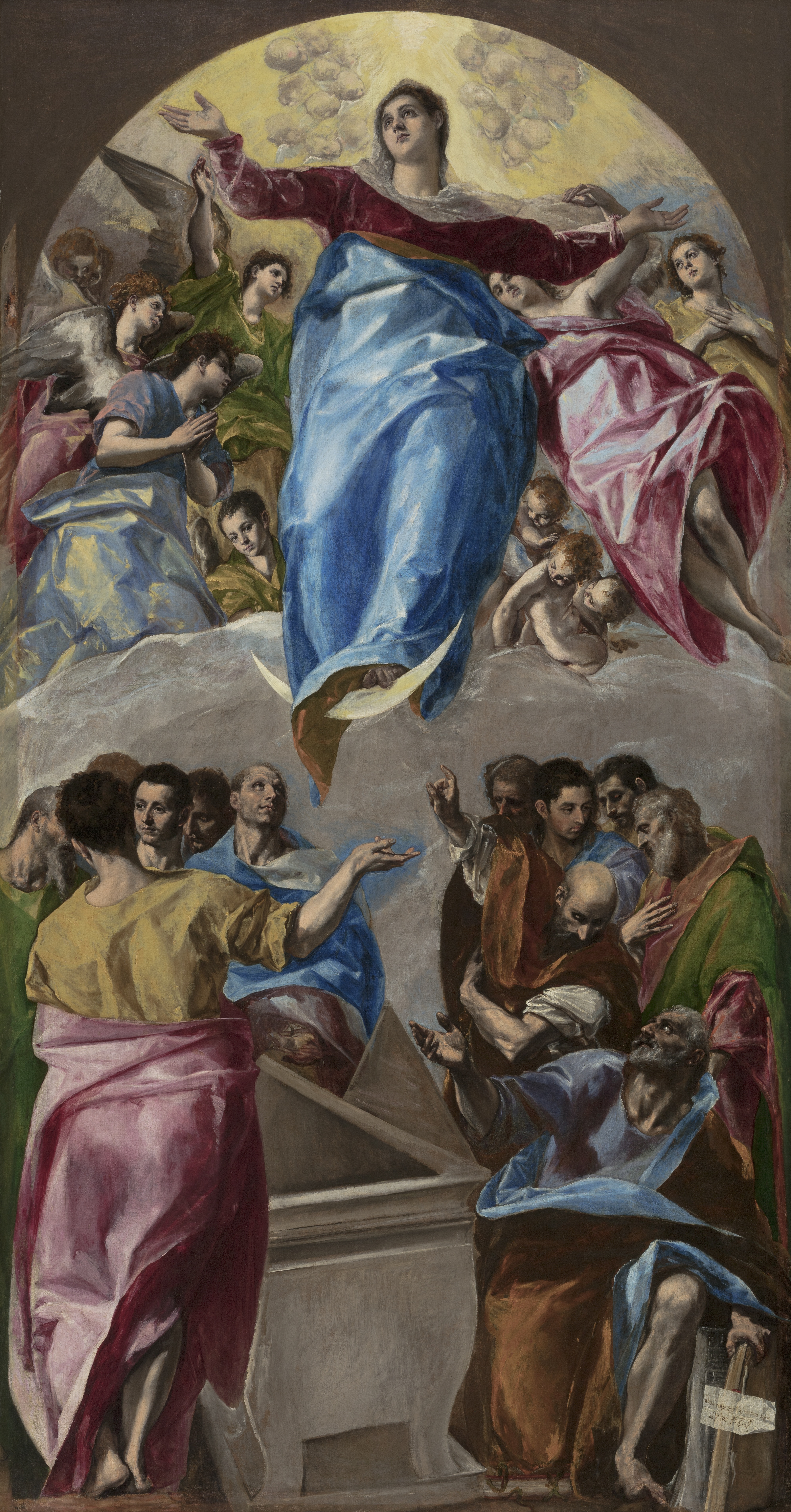
This painting was the central element of an altarpiece that was El Greco’s first major Spanish commission and large public work. More about this work
About this work
This painting was the central element of an altarpiece that was El Greco’s first major Spanish commission and large public work. The Virgin floats upward on the crescent moon, a symbol of her purity, while the apostles express amazement and concern. El Greco’s broad brushstrokes and bold color made this painting a favorite of modern artists such as Pablo Picasso and Mary Cassatt.
Text from the Art Institute of Chicago.
What you’re looking at
Painting of the Virgin Mary ascending to heaven amongst multitude of angels.
Description from the Art Institute of Chicago.
How it was made
- Oil paint
- Pigment ground in a drying oil, usually linseed. It dries slowly, so painters could blend on the canvas, build up thin translucent glazes, and rework a picture over weeks. Canvas replaced wooden panels in the 1500s because it is lighter and can be rolled.
El Greco
Spanish, 1541–1614 · Born in Iráklion (Candia); died in Toledo.
El Greco, “the Greek”, was born in Crete and trained in the Byzantine icon tradition before studying Venetian painting and working in Rome. From 1577 he lived in Toledo, where his first major commission was the high altarpiece of Santo Domingo el Antiguo, to which The Assumption of the Virgin belongs. His mature style, with elongated figures, flickering light and acid colour, found few imitators in his time but was rediscovered with enthusiasm by modern painters.
Written by Ochre Editions.
Rights and the museum’s record
Public domain. The Art Institute of Chicago has dedicated this image to the public domain under CC0, so anyone may copy, adapt and use it, for any purpose, without asking. Our prints and files are reproductions made from the museum’s image; the museum doesn’t endorse them.
- Object number
- 1906.99
- Credit
- Courtesy of the Art Institute of Chicago
- Type
- Painting
- Department
- Painting and Sculpture of Europe
- Licence
- CC0 1.0 Universal
- Museum record
- See it on the museum’s site
Report this work
More by El Greco
All their works
Close in colour