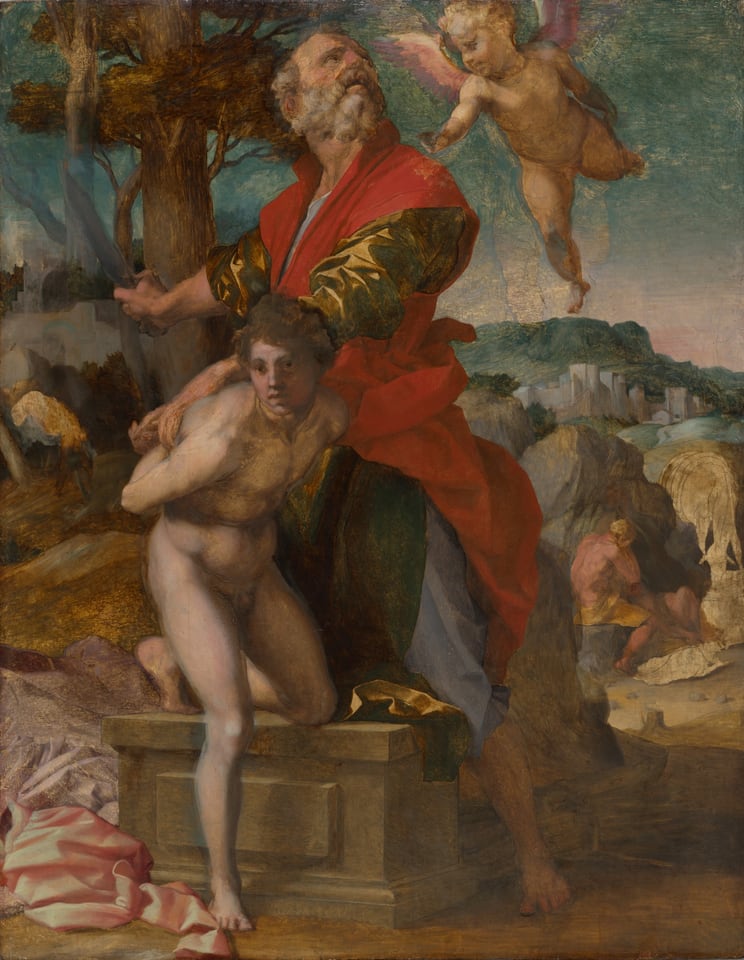
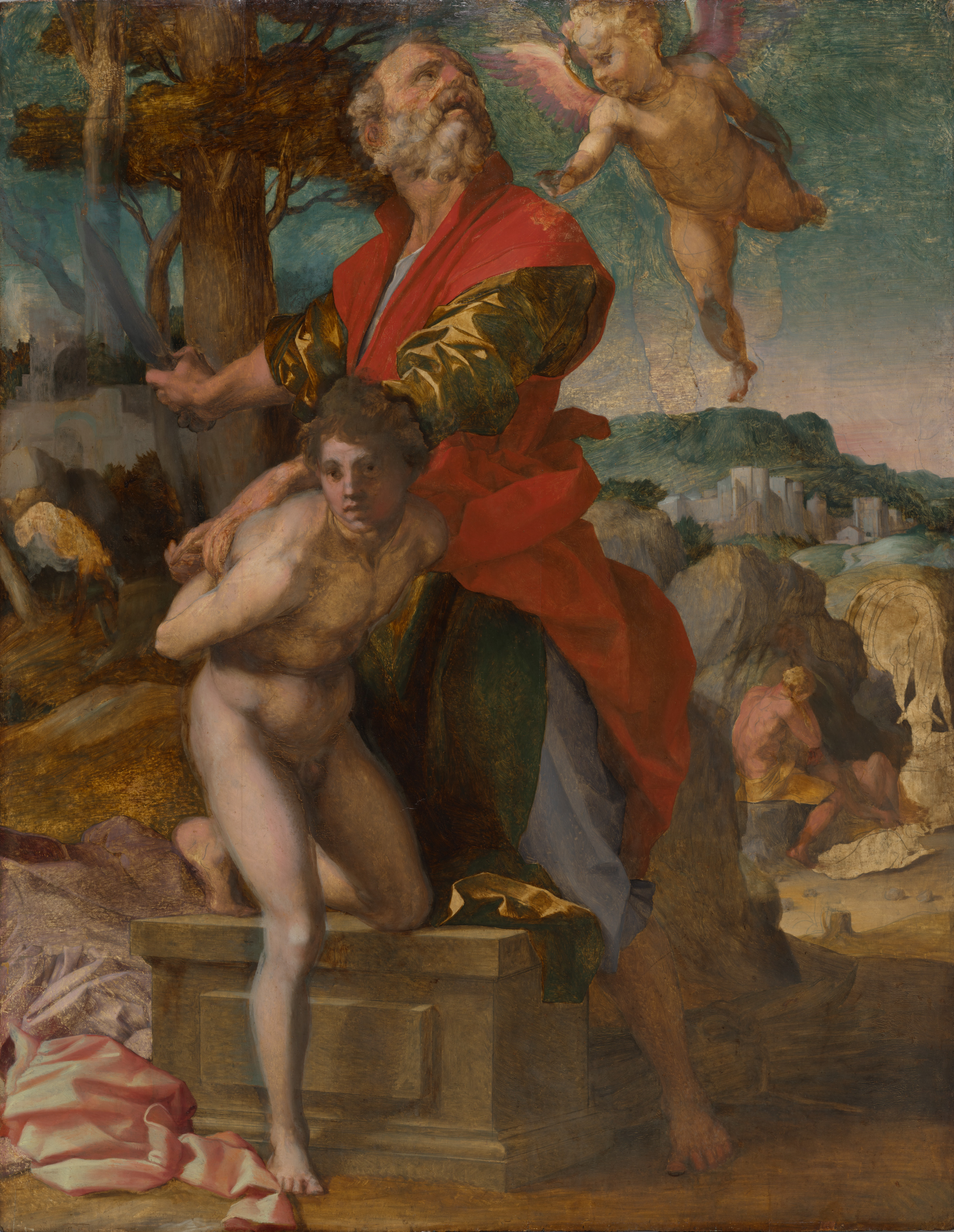
The Sacrifice of Isaacc. 1527
In this dramatic test of faith from the Old Testament book of Genesis, Abraham agrees to slay his son Isaac on God’s command. More about this work
About this work
In this dramatic test of faith from the Old Testament book of Genesis, Abraham agrees to slay his son Isaac on God’s command. As Abraham raises the knife, an angel suddenly appears to halt the sacrifice. This work gains its power from the complex expressions of father and son, combining grief, strength, resignation, fear, and realization in their faces and bodies, the latter inspired by ancient sculpture and Michelangelo. Andrea del Sarto never finished this painting, and it lays bare his working methods. He transferred the design to the panel from a drawing, reinforcing the chalk with painted lines—best seen in the donkey at the far right. He then worked over the whole panel at once with thin, brushy veils of color, letting him alter the composition while painting—especially evident in the angel, Isaac’s body, and Abraham’s head.
Text from the Cleveland Museum of Art.
How it was made
- Oil on panel
- Oil paint on prepared wooden boards, usually oak in the north and poplar in Italy. The rigid, smooth surface suits fine detail and thin, glowing glazes.
- Oil paint
- Pigment ground in a drying oil, usually linseed. It dries slowly, so painters could blend on the canvas, build up thin translucent glazes, and rework a picture over weeks. Canvas replaced wooden panels in the 1500s because it is lighter and can be rolled.
Andrea del Sarto
Italian, 1486–1530 · Born and died in Florence.
Andrea del Sarto, the son of a tailor, or sarto, spent almost his whole career in Florence and became its leading painter after Leonardo, Michelangelo and Raphael had left. His frescoes at the Santissima Annunziata and the grisaille cycle in the Chiostro dello Scalzo show his soft modelling and harmonious colour. He worked briefly for Francis I in France in 1518–19. Pontormo and Rosso Fiorentino trained with him, and Vasari, his pupil, wrote his life.
Written by Ochre Editions.
Renaissance
European art from about 1400 to 1600, when painters rediscovered perspective and the classical past.
Rights and the museum’s record
Public domain. The Cleveland Museum of Art has dedicated this image to the public domain under CC0, so anyone may copy, adapt and use it, for any purpose, without asking. Our prints and files are reproductions made from the museum’s image; the museum doesn’t endorse them.
- Object number
- 1937.577
- Credit
- Courtesy of the Cleveland Museum of Art
- Type
- Painting
- Department
- European Painting and Sculpture
- Licence
- CC0 1.0 Universal
- Museum record
- See it on the museum’s site
Report this work
More by Andrea del Sarto
All their works
Close in colour