Skip to content
Ochre Editions
ArtArtistsCollectionsGalleriesDrops
SearchSign inCart (0)
The galleries · Style galleries

The French eighteenth century

Fêtes, portraits and still lifes from the France of the Regency and Louis XV.

35 works · hang 7523 ·

Share The French eighteenth century, in the galleries

The rooms are imagined; every work on their walls is real.

Walk this roomRehang this room

First room, north wall

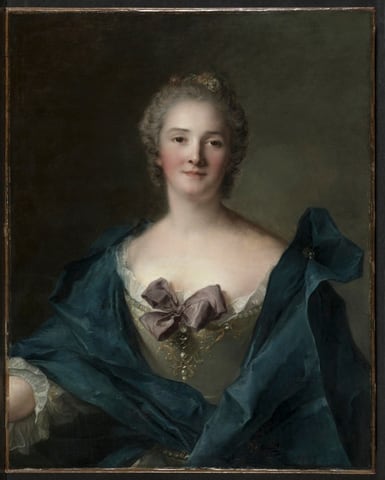
  1. Portrait of a Woman, by Jean-Marc Nattier, c. 1748
    Portrait of a WomanJean-Marc Nattier, c. 1748Courtesy of the Cleveland Museum of Art
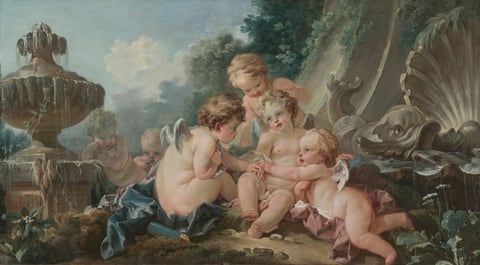
  2. Cupids in Conspiracy, by François Boucher, 1740s
    Cupids in ConspiracyFrançois Boucher, 1740sCourtesy of the Cleveland Museum of Art
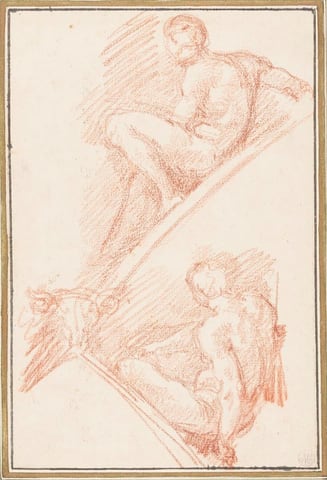
  3. FIGURES FROM SISTINE CHAPEL CEILING
    Figures from Sistine Chapel ceilingJean-Robert Ango, ca. 1759–70Courtesy of Cooper Hewitt, Smithsonian Design Museum

First room, south wall
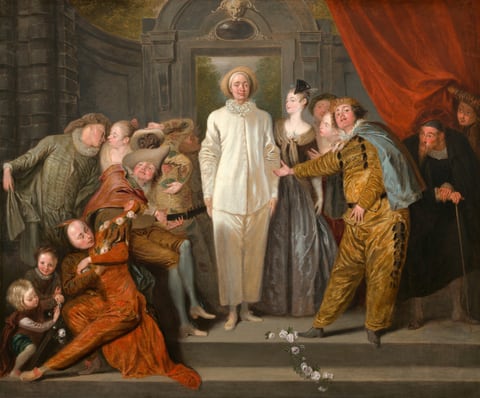
  1. A man wearing loose, ivory-white clothing stands flanked by two groups of people in this horizontal painting. All the people have pale or peachy skin except for one person, who may have a brown mask. The man in the center, representing the character Pierrot, stands facing us with his hands by his sides. He has slightly bulging eyes, a bulbous nose, ruddy cheeks, and his full pink lips slightly smile. He wears a straw hat pushed back on his high forehead and a narrow ruffled collar around his neck. His shirt has long, voluminous sleeves and a row of small white buttons down the front. The pants are baggy and end abruptly above his white-stockinged ankles over white slippers. The fabric seems to have a sheen. In the shallow space behind him, a stone wall curves toward us to either side of a doorway that leads to a park-like setting. A crimson-red curtain is pulled to our right. Pierrot stands on the top of two steps, and the people to either side are arranged along the stage or the step that runs close to the bottom edge of the canvas. A spray of white flowers drapes down the front of the steps to our right of center. The group to our left has eight men, women, and children. Closest to us and in the lower left corner, a young man wearing a tomato-red jester’s costume trimmed with bells sits on the steps as he twists and looks back at the scene behind him. He holds a scepter or puppet in the shape of a doll-like jester. Two children gather at his feet. One weaves stems of white flowers together, and the other looks at us, smiling. Just above them another cleanshaven young man sits holding a lute in his lap. He wears a brick-red coat, brown breeches, and slate-blue stockings over crossed legs. He leans back and looks up and to our left, his round cheeks flushed. At the back of this group, two people wear tan-colored costumes covered in muted green and pink diamond shapes, and one might wear a brown mask. That person’s pink lips, black mustache and eyebrows, and black dots for eyes appear painted onto a hard, molded surface. The group of six people to our right stand on the same level as Pierrot. At the front of that group, a heavyset young man wears a gold-colored costume trimmed with black and a waist-length, Wedgewood-blue cape. He faces us but looks to our right as he leans back with one arm extended toward Pierrot. Beyond him are two woman and another person shown only from the neck up. The woman closest to Pierrot wears a pewter-gray gown with a scooped neckline. To the right of the man in gold is an old man with a long beard, wearing a black skullcap and cloak. He leans on a short staff and turns his head to look at the group. The last person on the far right is shown from the neck up and stands before the red curtain hanging from the upper right.
    The Italian ComediansAntoine Watteau, probably 1720Courtesy National Gallery of Art, Washington
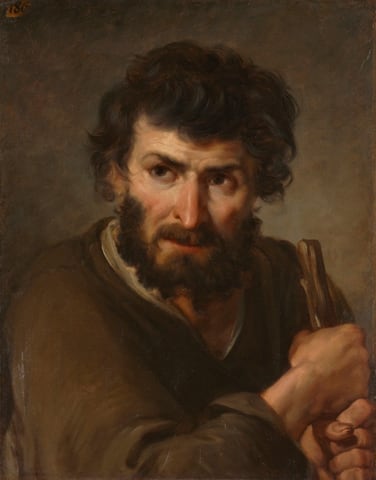
  2. Study of a Shepherd, 1700s
    Study of a ShepherdUnrecorded French maker, 1700sCourtesy of the Cleveland Museum of Art
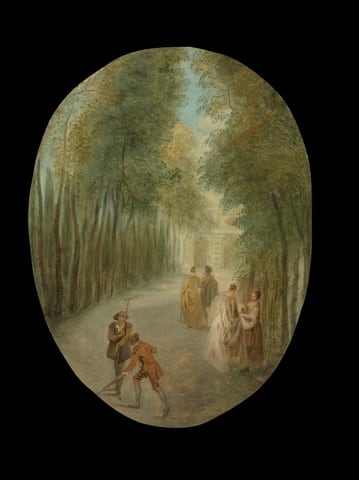
  3. Spring, by Jean-Baptiste Pater, c. 1720–36
    SpringJean-Baptiste Pater, c. 1720–36Courtesy of the Cleveland Museum of Art
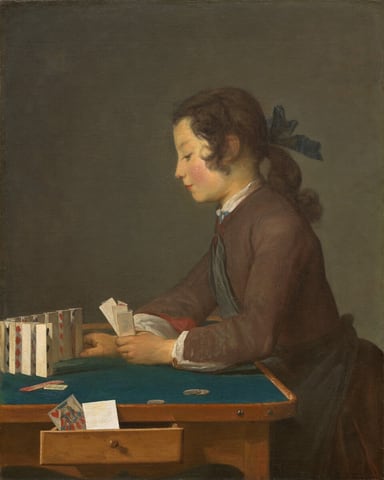
  4. Shown from about the lap up, a young person with brown hair and a peachy complexion faces our left in profile as he leans onto a table and sets folded playing cards up in a row in this vertical painting. Shown against a dark background, his long, brown hair curls by his ears and is pulled back with a navy-blue ribbon at the nape of his neck. He has a delicately sloping nose, his pink lips are closed, the cheek facing us is flushed, and he looks down at the tabletop under lowered lids. He wears a chestnut-brown, long-sleeved coat with a dark blue sash across his chest and tied around his waist. The white of his undershirt peeks out at the high neck and wrists, and the brick-red lining of the sleeve of his jacket rolls back at his right wrist. The wooden table is lined with teal-blue fabric on its surface, and three coins lie near his left hand, closer to us. In that hand he holds three nested, vertically folded playing cards. With his right hand he places the last in a line of ten cards, standing vertically but close together like dominoes, in a curving row in front of him. Scarlet-red diamonds and hearts and the edges of some black shapes are visible within the bent cards. A jack of hearts and a piece of paper or the back of another card sit in a drawer that opens toward us along the side of the table. The artist signed the work in dark brown paint in the lower right corner: “J. Chardin.”
    The House of CardsJean Siméon Chardin, probably 1737Courtesy National Gallery of Art, Washington

Second room, south wall
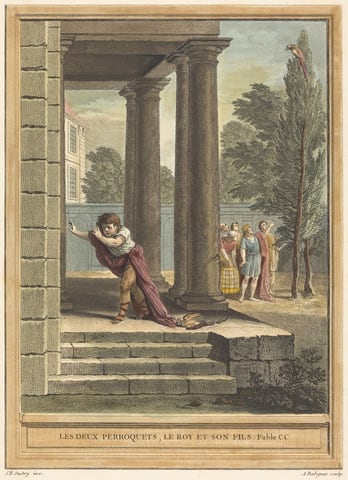
  1. This painting depicts a classical architectural scene with a bird and multiple individuals. It is done in the style of Jean-Baptiste Oudry. The image includes a large building with stone columns and stairs. A parrot is perched on a tree, catching attention with its colorful feathers. In the foreground, a person in classical clothing appears to be in motion. In the background, a group of people are gathered with varied expressions and gestures directed towards the person in the foreground. The architectural elements and foliage add depth and context to the scene.
    Les deux perroquets, le roi et son fils (Two Parrots, the King, and His Son)Antoine Radigues, published 1759Courtesy National Gallery of Art, Washington
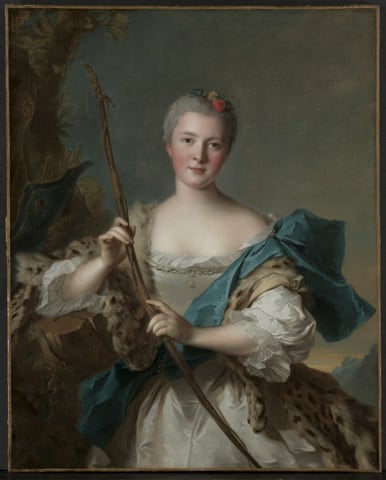
  2. Portrait of a Woman as Diana, by Jean-Marc Nattier, 1752
    Portrait of a Woman as DianaJean-Marc Nattier, 1752Courtesy of the Cleveland Museum of Art
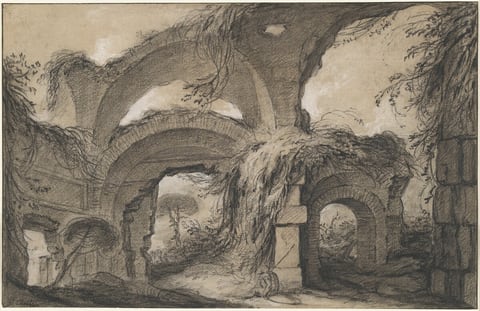
  3. The image shows an ancient ruin with arches and crumbling stonework surrounded by overgrown vegetation. The horizon is slightly elevated, emphasizing the towering remnants of the architecture. Expressive brushstrokes and textures are notable, especially in the vines and leaves on the stone. The color palette is subdued, mainly earthy tones and black, creating contrast and suggesting openings into the distance, enhancing the old, abandoned feel of the ruins.
    Arches of the Larger Baths at Hadrian's VillaCharles Michel-Ange Challe, c. 1748Courtesy National Gallery of Art, Washington
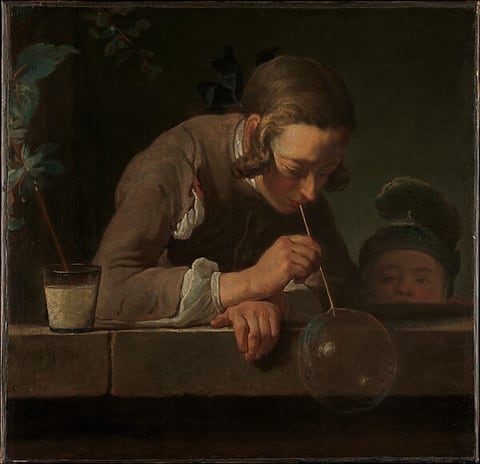
  4. Soap Bubbles, by Jean Siméon Chardin, ca. 1733–34
    Soap BubblesJean Siméon Chardin, ca. 1733–34Courtesy of The Metropolitan Museum of Art

Second room, north wall
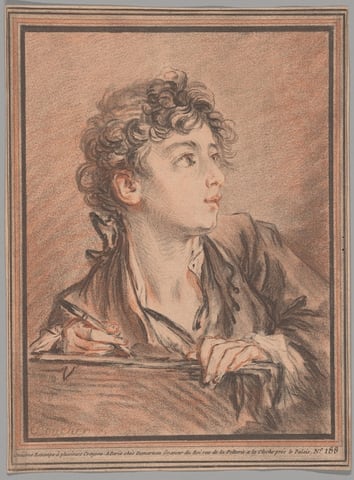
  1. A work made of crayon manner engraving in red and black on cream laid paper.
    The Young DraftsmanGilles Demarteau, 1750/70Courtesy of the Art Institute of Chicago
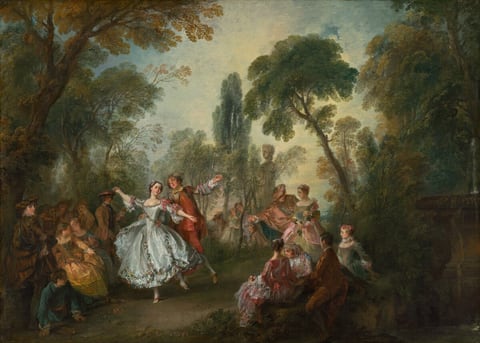
  2. Twenty-one men in long waistcoats and women in elegantly trimmed gowns gather and dance within a verdant landscape in this horizontal painting. The men wear jackets and breeches in ginger brown, pale pink, or spruce blue. The women’s gowns have full sleeves, tight-fitting bodices, and full skirts in shades of bronze, teal blue, butterscotch gold, or rich pink edged with ribbons and lace. Some of them wear floral wreaths or ribbons in their upswept hair. Groups gather around a woman and man who dance together to our left in the scene. Some in the group of onlookers to our left hold musical instruments, including a violin and a pipe. Another group is nestled among trees just beyond the dancers, at the center of the painting, and more sit and stand to our right. The dancing woman wears a gleaming, ice-blue gown with rows of flowers in muted pink, blue, and gold down the full skirt and around the bottom hem, which falls short of her thin ankles. More garlands cross her chest and shoulders, and flowers are tucked into her dark gray hair. She faces us with her head turned to our right as she looks off in that direction with dark eyes under curving brows. She has a delicate nose, rosy, round cheeks, and pink lips. She holds her arms spread wide with the thumb touching the index finger of each hand. The man with whom she dances wears a coral-red tunic and breeches with sleeves decorated with pale pink and blue ribbons. The brim of his brown hat is turned up. His body faces us but he turns his head to look at the woman, his lips parted. The man and woman each have one gracefully pointed foot raised. The dancers and groups are enclosed within a park-like setting with tall trees to either side, and a screen of trees across the back of the space. The trees have slender trunks and canopies in shades of pine, sage, and moss green. Near the back middle of the scene, a stone column topped by a human head wearing a wreath of laurel leaves rises above the central group. A fountain with a vertical jet of water is tucked into the shadows within a grove of trees along the right edge of the painting. The water falls into a pool in the lower right corner.
    La Camargo DancingNicolas Lancret, c. 1730Courtesy National Gallery of Art, Washington
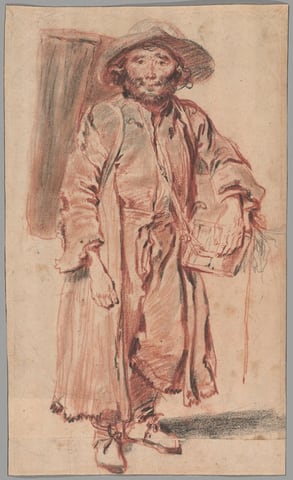
  3. Chalk drawing with red and black shading of man carrying crate and pack.
    The Old SavoyardAntoine Watteau, c. 1715Courtesy of the Art Institute of Chicago

Third room, north wall
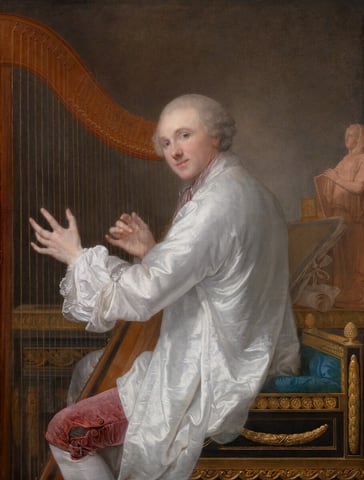
  1. A pale-skinned man sits facing our left as he plays a harp while turning his face to smile at us in this vertical portrait painting. He looks out the corners of his light blue eyes under arched, gray brows. He has a rounded nose, pale pink lips, and a round face. Gray hair is brushed back from his high forehead and curls around his ears. His long fingers rest on the strings of the harp, and the ends of strings curl like wind-loosened strands of hair along the top edge. The man wears a pale mauve-purple cravat, and his snow-white, long-sleeved chemise is untucked and loose around his thighs. The cuff we see is open and folded back over a bright white shirt edged with lace. His dusky rose-pink breeches are unbuttoned at the knee over white stockings. The square-seated chair on which he sits is carved with garlands and floral patterns, which are gilded gold. The seat itself is topaz blue, and it has a low back. A similarly ornamented and gilded table along the back of the room holds a portfolio and roll of papers, the tooled and gilded spines of books, and a statuette to the right. The pale pinkish-orange statuette shows a woman holding a tablet and wearing a long, loose robe and head covering. Her body angles to our left and she looks off in that direction. The wall behind the table is mottled with smoky shades of gray and tan.
    Ange Laurent de La Live de JullyJean Baptiste Greuze, probably 1759Courtesy National Gallery of Art, Washington
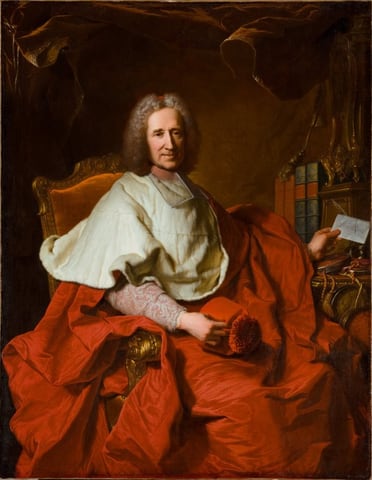
  2. Portrait of Cardinal Guillaume Dubois, by Hyacinthe Rigaud, 1723
    Portrait of Cardinal Guillaume DuboisHyacinthe Rigaud, 1723Courtesy of the Cleveland Museum of Art

Walk on

  • The French eighteenth century, room 2
  • Hyacinthe Rigaud's contemporaries 8 works
  • 18th-century France 75 works
Ochre Editions

The world's museums, on your wall. Every work here is a reproduction of a public-domain original, credited to the museum that holds it.

Shop

All artCollectionsLimited dropsPrints and framing

Help

Find an orderShippingReturnsVerify a certificate

About

About Ochre EditionsMuseum creditsFor agentsDevelopers

Legal

Terms of UseTerms of SaleLimited Editions and CertificatesPrivacy PolicyCookie PolicyAcceptable Use PolicyAgent & API TermsCopyright and DMCA PolicyPrinting Your Own PhotoVulnerability Disclosure PolicyAccessibility StatementOpen-Access Credits
© 2026 Ochre EditionsPrices in US dollars. Prints ship within the United States.