Skip to content
Ochre Editions
ArtArtistsCollectionsGalleriesDrops
SearchSign inCart (0)
The galleries · Style galleries

The American Gilded Age

Painting and design in the United States from the Civil War to 1910.

67 works · hang 7789 ·

Share The American Gilded Age, in the galleries

The rooms are imagined; every work on their walls is real.

Walk this roomRehang this room

First room, north wall

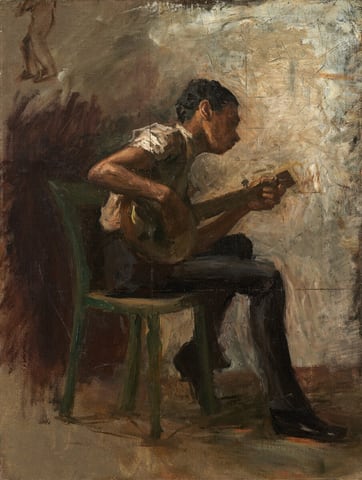
  1. A young, gangly, brown-skinned boy sits on a green chair and leans over the banjo he plays in this loosely painted, vertical composition. His body faces our right in profile, and his head leans to his left and away from us. Light comes from our left to highlight his ear and the side of his chin, but throws his profile into shadow against the lighter background. The boy has short black hair and wears a white shirt with the sleeves rolled up, black pants, and black shoes. The floor is loosely painted with streaks of earth brown, taupe, and dark moss green. The wall behind the boy is painted with visible strokes of parchment brown, peachy tan, pearl white, and fog gray. The space to our left of the boy is dark brown, and an outline of a standing person is sketched in the top left corner. A grid is overlaid across the boy’s body and the chair.
    Study for "The Dancing Lesson": The Banjo PlayerThomas Eakins, probably 1877Courtesy National Gallery of Art, Washington
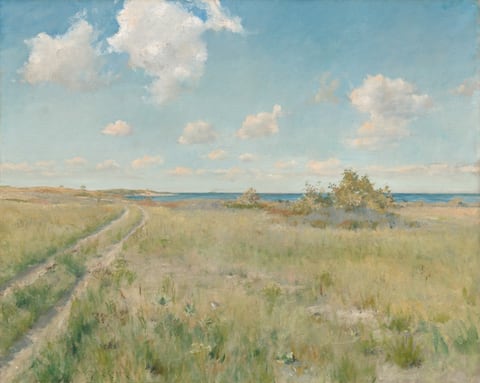
  2. The Old Road to the Sea, by William Merritt Chase, c. 1893
    The Old Road to the SeaWilliam Merritt Chase, c. 1893Courtesy of the Cleveland Museum of Art
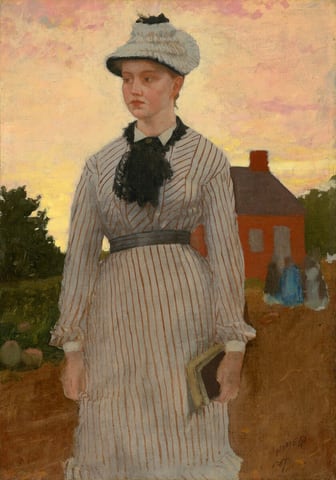
  3. Shown from the knees up, a pale-skinned woman stands close to us with a red schoolhouse in the distance under a sunset sky in this vertical painting. The woman’s body faces us, but she turns her head to look off to the left with light brown eyes. She has a short, straight nose, full pink lips, and a round face. Her blond hair is pulled up under a round white hat layered with ruffles, which lies like a pancake over the top of her head. Her white dress is vertically striped with thin rust-red lines and has a long-sleeved, tight-fitting bodice and a long skirt. A dark gray belt is cinched around her narrow waist, and she wears a black, lacy ruffle around her neck. The woman’s arms hang by her sides, and she holds two paperback-sized books in her left hand, to our right. An earth-brown lawn stretches back to the schoolhouse, which has crimson-red walls, a chimney, and a dark gray roof. Three forms painted with a few streaks of dark or light gray or topaz blue suggest people standing near the door of the schoolhouse. Trees and a grassy lawn beyond the building are loosely painted with blended strokes. The sky is shaded pale lemon yellow and light peach with touches of rose pink. The artist signed and dated the lower right corner, “HOMER 1873.”
    The Red School HouseWinslow Homer, 1873Courtesy National Gallery of Art, Washington
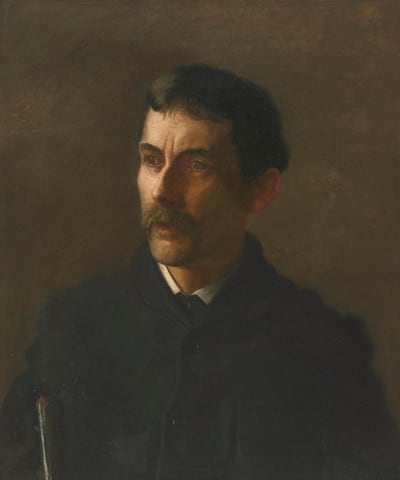
  4. Artist: Thomas Cowperthwaite Eakins, Sitter: Talcott Williams, Current owner: National Portrait Gallery, Smithsonian Institution
    Talcott WilliamsThomas Eakins, c. 1889Courtesy of the National Portrait Gallery, Smithsonian Institution

First room, south wall

  1. Alvan Clark, 1870s
    Alvan ClarkUnrecorded American maker, 1870sCourtesy of the Cleveland Museum of Art
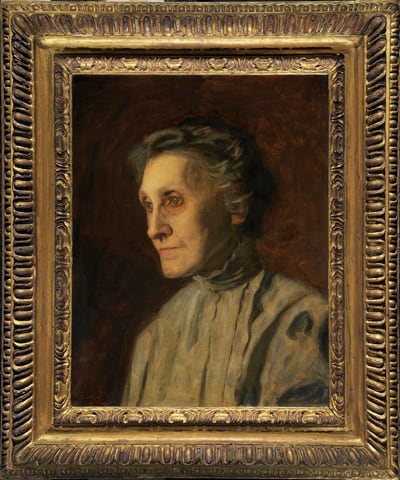
  2. Thomas Eakins
    Portrait of Mrs. Helen Mac Knight (Portrait of a Mother)Thomas Eakins, (c. 1903)Courtesy of the Hirshhorn Museum and Sculpture Garden, Smithsonian Institution
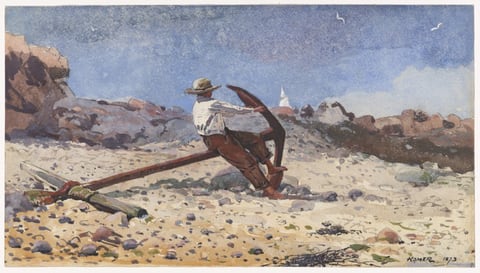
  3. Boy with Anchor, by Winslow Homer, 1873
    Boy with AnchorWinslow Homer, 1873Courtesy of the Cleveland Museum of Art
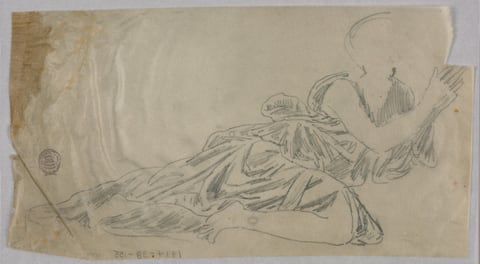
  4. DRAPERY STUDY
    Drapery StudyFrancis Augustus Lathrop, ca. 1895Courtesy of Cooper Hewitt, Smithsonian Design Museum

Second room, south wall
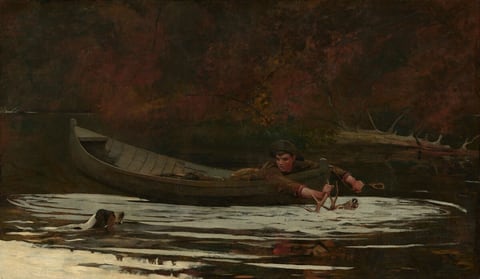
  1. A young man with a peachy, ruddy complexion lies on his stomach in a wooden rowboat on a river, reaching forward to grasp the horn of a stag almost completely submerged in the rippling water with one hand. On the opposite riverbank, gold, rust, and scarlet-red trees span the width of this horizontal painting. The boy’s arms straddle the stern of the boat so one holds the antler with his right hand, closer to us, while the other clutches a rope with a loop at the end. He turns his face, mouth agape and cheeks flushed, over his right shoulder to look to our left, at a dog swimming toward the boat. The dog has white and caramel-brown markings, with dark brown ears. The boy wears earth-brown clothing and the front of his wide-brimmed hat is pushed up to reveal dark eyes and sable-brown bangs and brows. The stag and dog are between us and the boat, and are surrounded by thick brushstrokes of parchment white to create ripples in the forest-green water. Only the open muzzle, part of the eye, and the tips of the stag’s antlers are above the water’s surface. To our right, a bare, fallen tree lies along the far riverbank parallel to the boat. The boat and water fill the lower half of the scene and the autumn trees fill the upper half. The artist has signed and dated the painting in the lower right, “Winslow Homer 1892.”
    Hound and HunterWinslow Homer, 1892Courtesy National Gallery of Art, Washington
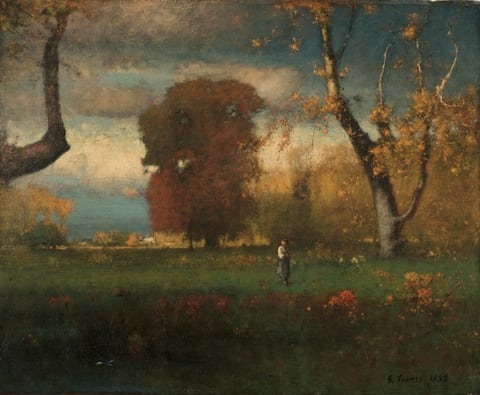
  2. Landscape, by George Inness, 1888
    LandscapeGeorge Inness, 1888Courtesy of the Cleveland Museum of Art
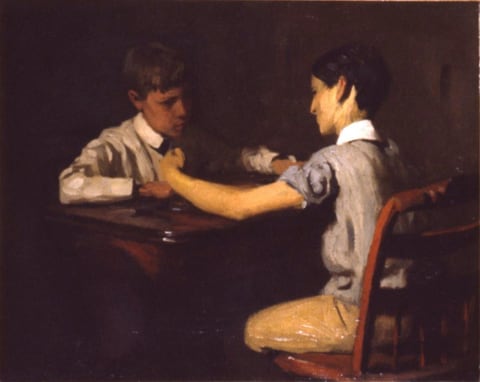
  3. Checker Players, by Thomas Anshutz, ca. 1895
    Checker PlayersThomas Anshutz, ca. 1895Courtesy of the Smithsonian American Art Museum

Second room, north wall
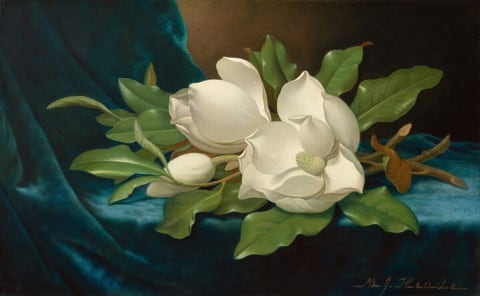
  1. Twigs of a magnolia tree with light green, glossy leaves and three cream-white blossoms lie on a sapphire-blue cloth in this horizontal still life painting. Brightly lit from our left, the blossoms and leaves nearly fill the composition, and the cut ends lie on the fabric to our right. The blue fabric cascades from the upper left and across the table or ledge. The three flowers are in various stages of bloom. The tightest bud is to our left, overlapped by a stem and the tender, unfurling leaves of a branch. The blossom next to it, at the center, is starting to open. The petals of the third blossom, to our right, splay open around the flower’s oval-shaped stamen. Light glints off the waxy leaves surrounding the flowers. The tawny-brown underside of one leaf is visible where it turns over, near the cut ends of the branches. Light shimmering on the fabric darkens from bright blue to our right, to deep royal blue in the shadows to the upper left, suggesting the fabric is velvet. The background is streaked with tan and pine green behind the fabric, and becomes nearly black in the shadows of the upper right corner and along the bottom edge. The artist signed the lower right corner, "MJ. Heade."
    Giant Magnolias on a Blue Velvet ClothMartin Johnson Heade, c. 1890Courtesy National Gallery of Art, Washington
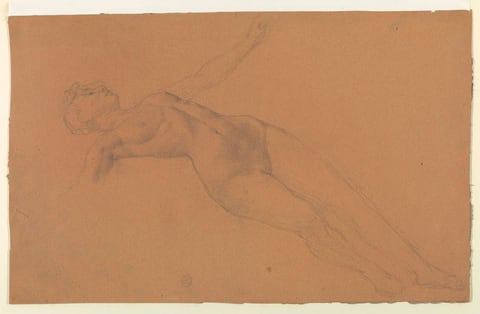
  2. STUDY FOR "DIANA AND HER ATTENDANTS AMONG THE CONSTELLATIONS"
    Study for "Diana and Her Attendants among the Constellations"Francis Augustus Lathrop, ca. 1894Courtesy of Cooper Hewitt, Smithsonian Design Museum
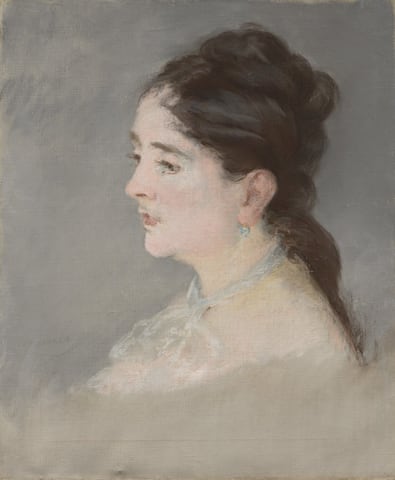
  3. Claire Campbell, by Édouard Manet, 1876
    Claire CampbellÉdouard Manet, 1876Courtesy of the Cleveland Museum of Art

Third room, north wall
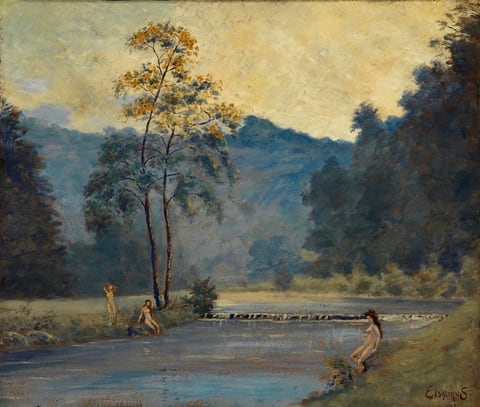
  1. Three Girls and River, by Louis M. Eilshemius, 1907
    Three Girls and RiverLouis M. Eilshemius, 1907Courtesy of the Smithsonian American Art Museum
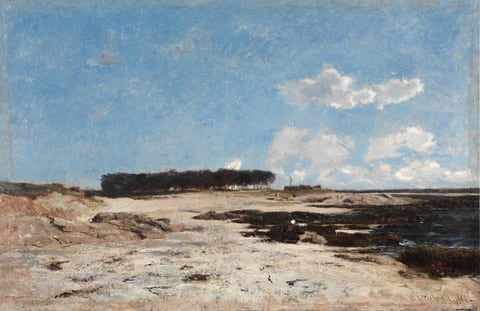
  2. Pointe de Cabellou, Brittany, by William L. Picknell, 1881
    Pointe de Cabellou, BrittanyWilliam L. Picknell, 1881Courtesy of the Cleveland Museum of Art

Walk on

  • The American Gilded Age, room 2
  • William L. Picknell's contemporaries 8 works
  • 19th-century United States 198 works
Ochre Editions

The world's museums, on your wall. Every work here is a reproduction of a public-domain original, credited to the museum that holds it.

Shop

All artCollectionsLimited dropsPrints and framing

Help

Find an orderShippingReturnsVerify a certificate

About

About Ochre EditionsMuseum creditsFor agentsDevelopers

Legal

Terms of UseTerms of SaleLimited Editions and CertificatesPrivacy PolicyCookie PolicyAcceptable Use PolicyAgent & API TermsCopyright and DMCA PolicyPrinting Your Own PhotoVulnerability Disclosure PolicyAccessibility StatementOpen-Access Credits
© 2026 Ochre EditionsPrices in US dollars. Prints ship within the United States.