The Mill1645/1648
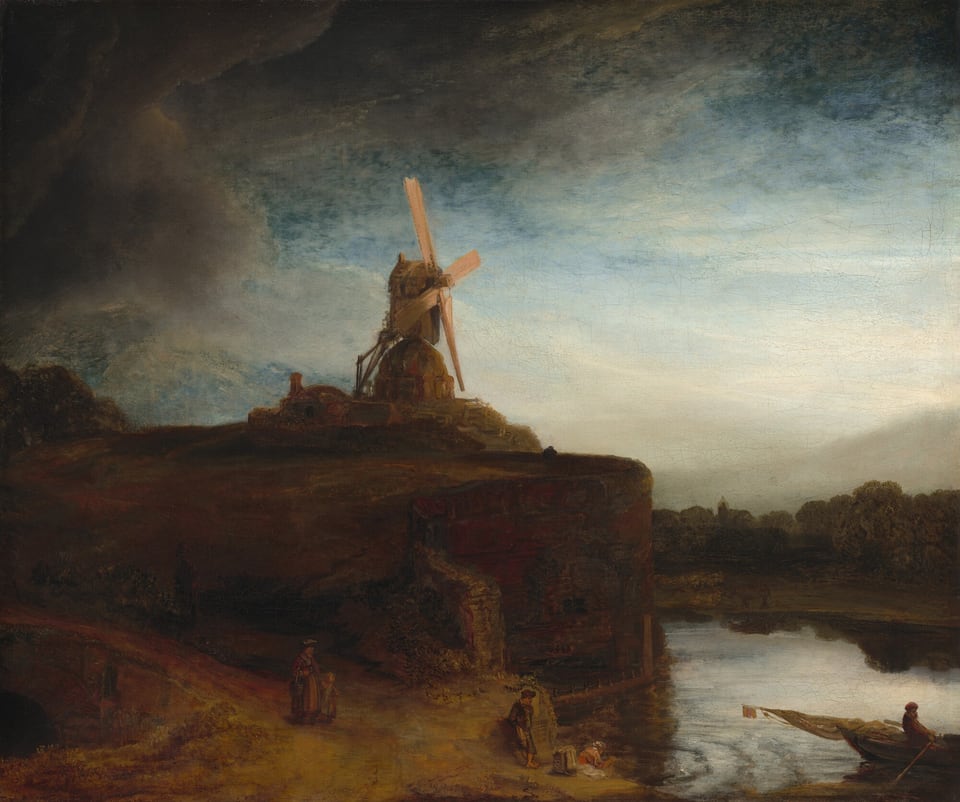
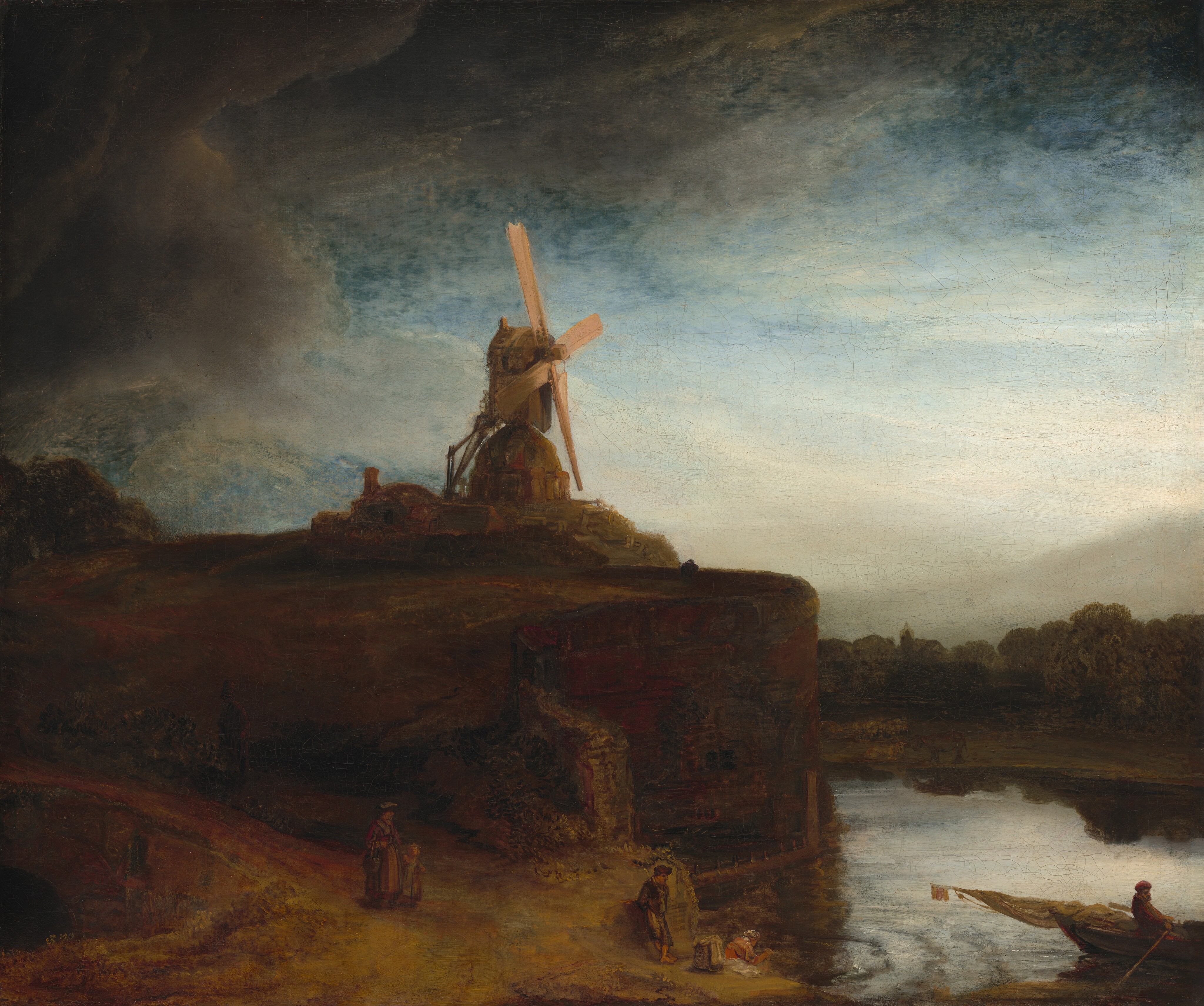
A windmill stands dark on a bastion above the water, its sails catching the light against a stormy sky, while a woman washes clothes at the bank, a mother and child walk down the path and a man in a red jacket rows past. More about this work
About this work
A windmill stands dark on a bastion above the water, its sails catching the light against a stormy sky, while a woman washes clothes at the bank, a mother and child walk down the path and a man in a red jacket rows past. In the nineteenth century The Mill was among the most admired paintings in Britain, and its sale to an American collector in 1911 caused a public outcry. Its attribution to Rembrandt has been debated, and cleaning in the 1970s revealed a far brighter sky than had long been seen, restoring the drama of light breaking through cloud.
Written by Ochre Editions.
What you’re looking at
A windmill stands on a promontory cutting into a waterway under a partially stormy sky in this square landcape painting. The promontory and mill are painted in muted tones of brown and rust orange, while steel-gray and white clouds encircle a topaz-blue sky above. The promontory juts into the scene from our left, and the front of the windmill is angled to our right so its golden-tan sails catch the light. Silvery water winds around the base of the promontory and extends to a dark green, shadowy bank on the far side. A boat in the lower right corner of the composition is rowed by a man wearing a red jacket and cap. A path runs to the water’s edge from the left edge of the painting, in front of the promontory’s retaining wall, which is shored up with stones or panels. A person in dark clothing close to the windmill seems to rest their arms on the retaining wall, their back to us. Closer to us, a woman holds a child’s hand as they walk down the path to the bank. A bearded man with tattered brown clothes and bare feet stands leaning against the wall near a woman wearing burnt-orange garment. She sits or kneels at the water’s edge in front of a basket of clothes and holds up a brown cloth. The olive-green forms of the trees on the far bank are reflected in the water, and closer inspection reveals two cows near the water there. Charcoal-gray clouds pile up along the left of the painting and span the top edge. There is a brilliant blue sky beyond and a screen of white clouds near the horizon, which comes about a third of the way up the canvas.
Description from the National Gallery of Art.
How it was made
- Oil paint
- Pigment ground in a drying oil, usually linseed. It dries slowly, so painters could blend on the canvas, build up thin translucent glazes, and rework a picture over weeks. Canvas replaced wooden panels in the 1500s because it is lighter and can be rolled.
Rembrandt van Rijn
Dutch, 1606–1669 · Born in Leiden; died in Amsterdam.
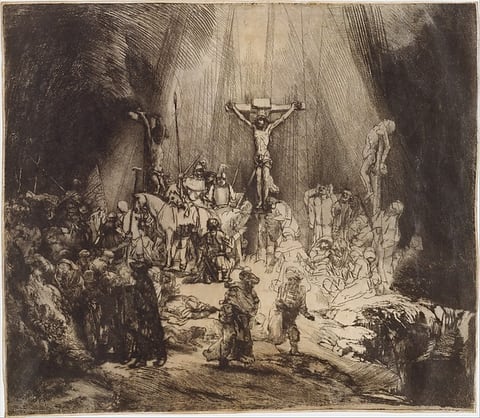
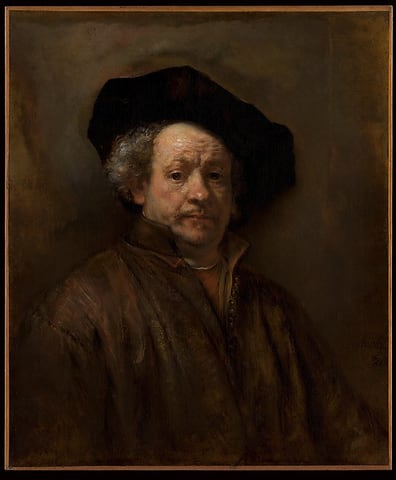
Rembrandt trained in Leiden and Amsterdam, settled in Amsterdam in the early 1630s and became the city’s most sought-after portraitist. His later work grows rougher and more searching, with thick paint, deep shadow and faces that seem lost in thought, as in Aristotle with a Bust of Homer, painted for a Sicilian collector. He was also the leading etcher of his age, reworking plates through many states and making the medium as expressive as painting.
Written by Ochre Editions.
Rights and the museum’s record
Public domain. The National Gallery of Art has dedicated this image to the public domain under CC0, so anyone may copy, adapt and use it, for any purpose, without asking. Our prints and files are reproductions made from the museum’s image; the museum doesn’t endorse them.
- Object number
- 1942.9.62
- Credit
- Courtesy National Gallery of Art, Washington
- Type
- Painting
- Licence
- CC0 1.0 Universal
- Museum record
- See it on the museum’s site
Report this work
More by Rembrandt van Rijn
All their works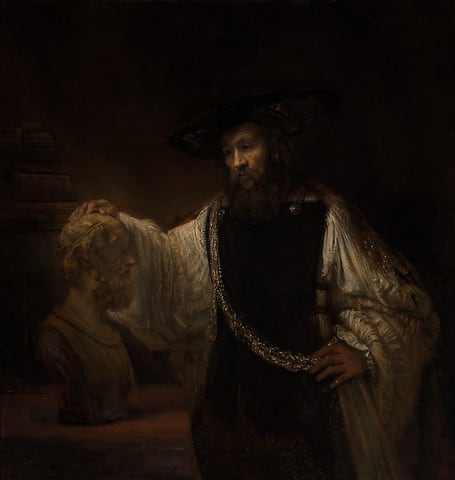
Close in colour