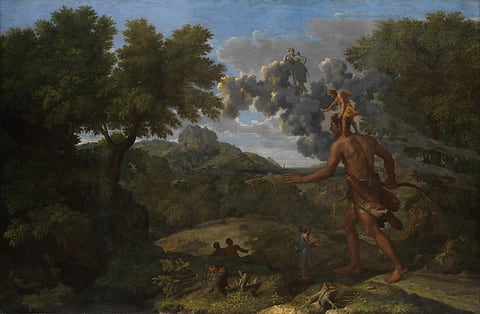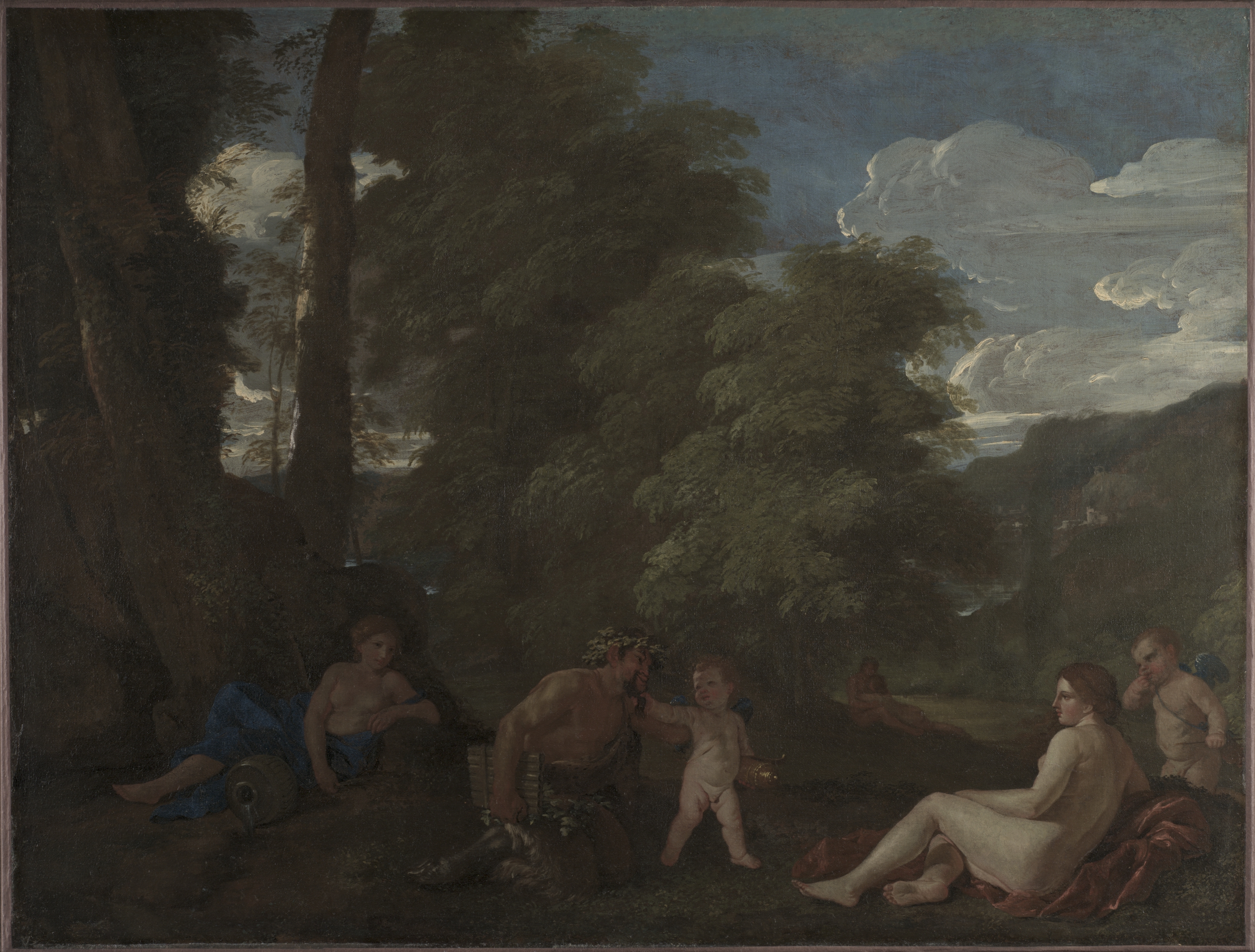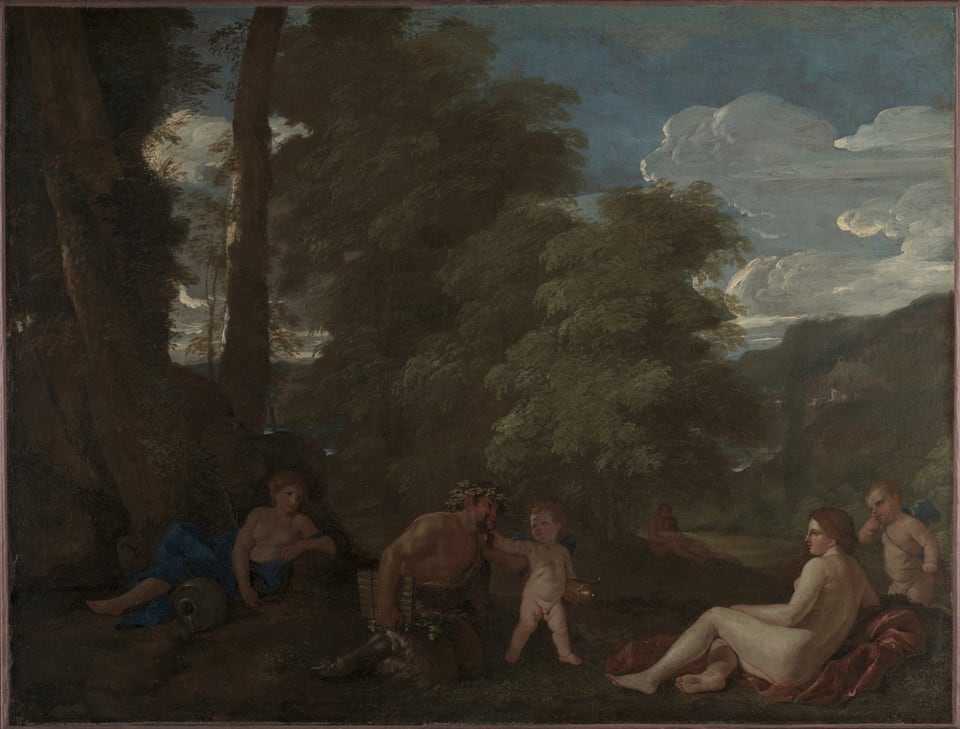
Nymphs and a Satyr (Amor Vincit Omnia)c. 1625–27
Like his colleague Claude Lorrain, Poussin depicted historical and mythological subjects in landscapes inspired by the countryside around Rome. More about this work
About this work
Like his colleague Claude Lorrain, Poussin depicted historical and mythological subjects in landscapes inspired by the countryside around Rome. His themes were often complex, and frequently incorporated witty allusions to classical texts. Here, a playful cupid tugs Pan, the goatlegged Greek god of the woods, toward Venus, the goddess of love. The painting cleverly illustrates the Latin phrase amor vincit omnia, or “love conquers all” (in Greek, pan means “all”). The woodland setting represents the idyllic paradise of Pan’s home.
Text from the Cleveland Museum of Art.
How it was made
- Oil paint
- Pigment ground in a drying oil, usually linseed. It dries slowly, so painters could blend on the canvas, build up thin translucent glazes, and rework a picture over weeks. Canvas replaced wooden panels in the 1500s because it is lighter and can be rolled.
Nicolas Poussin
French, 1594–1665 · Born in Les Andelys; died in Rome.
Poussin left Normandy for Paris and in 1624 settled in Rome, where he spent almost all his career. After an early public commission for St Peter’s, he worked mainly for private collectors on easel paintings of classical, biblical and mythological subjects, ordered with rigorous clarity and reasoned gesture. A brief, unhappy spell as court painter in Paris in 1640–42 confirmed his preference for Rome. His later landscapes give nature a calm, architectural order, and his example became the touchstone of the French Academy.
Written by Ochre Editions.
Rights and the museum’s record
Public domain. The Cleveland Museum of Art has dedicated this image to the public domain under CC0, so anyone may copy, adapt and use it, for any purpose, without asking. Our prints and files are reproductions made from the museum’s image; the museum doesn’t endorse them.
- Object number
- 1926.26
- Credit
- Courtesy of the Cleveland Museum of Art
- Type
- Painting
- Department
- European Painting and Sculpture
- Licence
- CC0 1.0 Universal
- Museum record
- See it on the museum’s site