Rouen Cathedral, West Façade1894
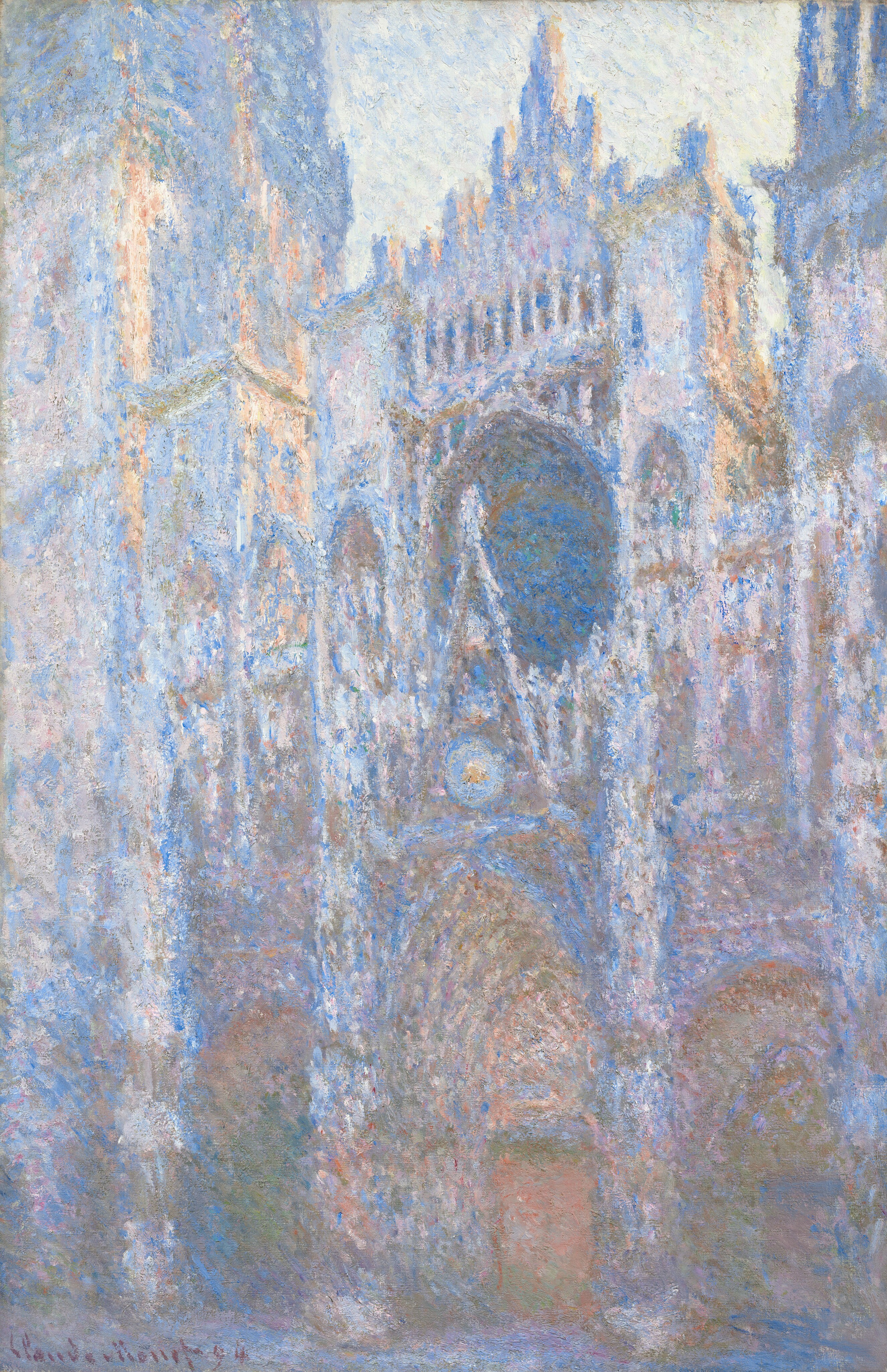
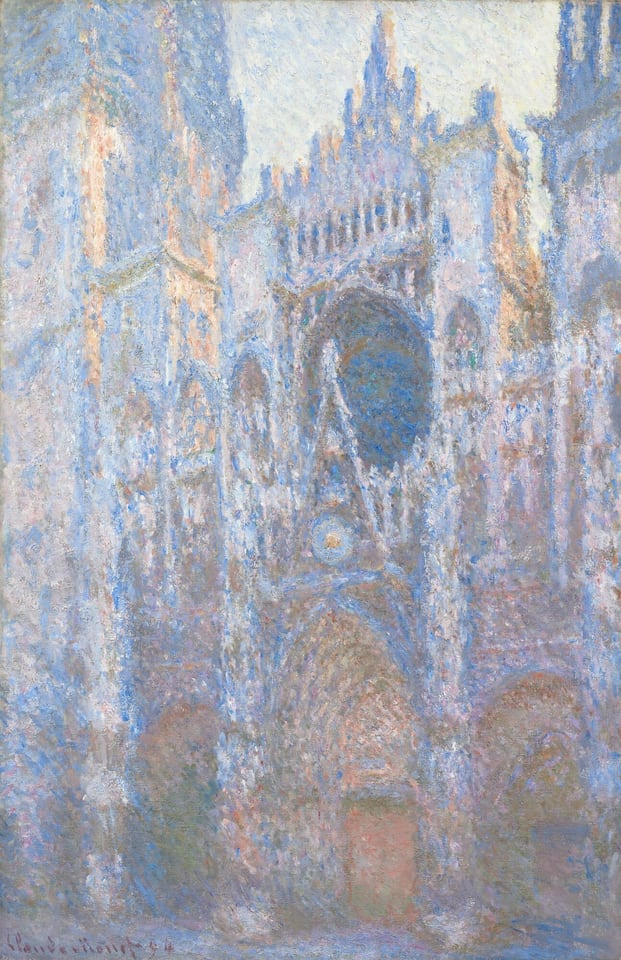
The west front of Rouen Cathedral fills the canvas, its portal, gable, rose window and spires dissolving into a crust of blue, peach, lavender and brown paint. More about this work
About this work
The west front of Rouen Cathedral fills the canvas, its portal, gable, rose window and spires dissolving into a crust of blue, peach, lavender and brown paint. In 1892 and 1893 Monet rented rooms opposite the cathedral and painted its façade more than thirty times, at different hours and in different weather, moving between canvases as the light shifted. He finished them in his studio and dated many 1894. The thick, layered paint seems to echo the weathered stone itself, while the true subject is the changing envelope of light.
Written by Ochre Editions.
What you’re looking at
We look up at the exterior of a church that soars the height of this vertical painting. The church is painted with visible dabs and strokes of azure blue, peach, lavender purple, and camel brown to create a blurred look, as if seeing a reflection in the rippling surface of a puddle. The church façade is angled to our left, away from us. The main door and its surround takes up the center of the composition, where a rectangular door is set within nested, pointed arches that lead up to a narrow, tall, triangular gable. The point of that gable overlaps the round, dark rose window, which is the same width as the portal surround below. Spires flank the central section and rise precipitously off the top edge of the painting. The sky above is painted with daubs of white and pale blue. The artist signed and dated the lower left, “Claude Monet 94.”
Description from the National Gallery of Art.
How it was made
- Oil paint
- Pigment ground in a drying oil, usually linseed. It dries slowly, so painters could blend on the canvas, build up thin translucent glazes, and rework a picture over weeks. Canvas replaced wooden panels in the 1500s because it is lighter and can be rolled.
Claude Monet
French, 1840–1926
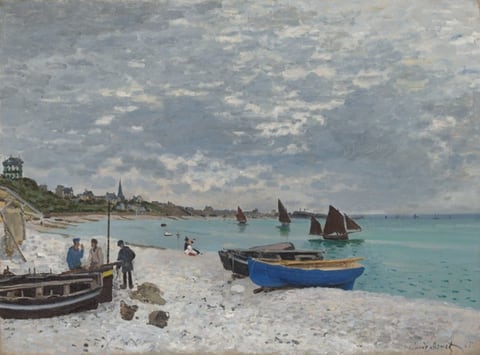
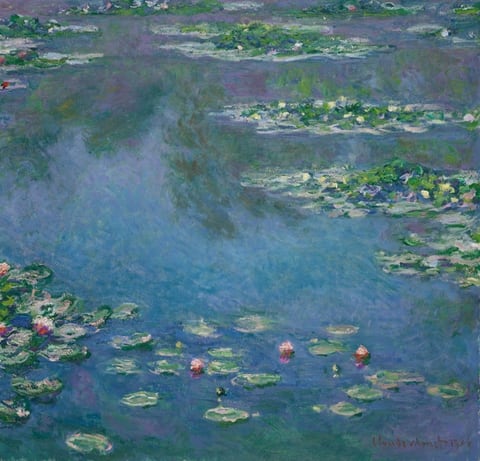
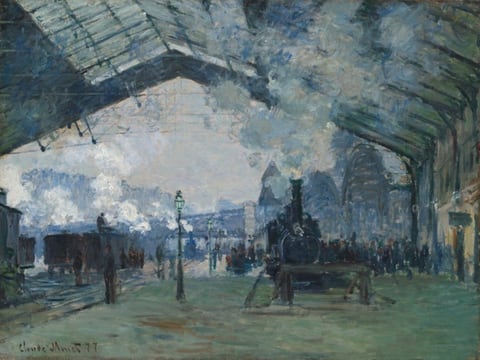
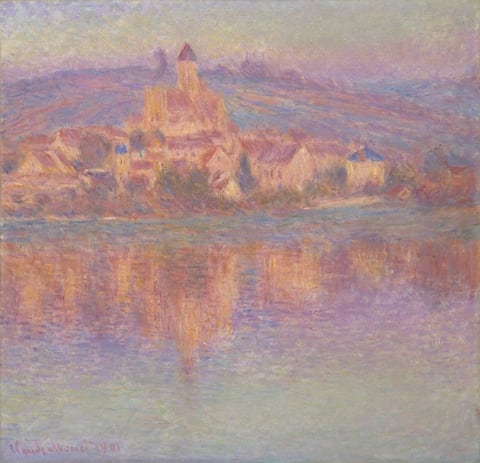
Monet grew up in Le Havre, where Eugène Boudin encouraged him to paint outdoors. In Paris he met Renoir, Sisley and Bazille, and his Impression, Sunrise gave the Impressionist movement its name in 1874. He made a lifelong study of changing light, painting the Gare Saint-Lazare, haystacks, poplars and Rouen Cathedral in series. From 1883 he lived at Giverny, where he built the water garden that filled the last three decades of his work.
Written by Ochre Editions.
Impressionism
Painters in 1870s Paris who worked quickly, often outdoors, to catch light as it changed.
Rights and the museum’s record
Public domain. The National Gallery of Art has dedicated this image to the public domain under CC0, so anyone may copy, adapt and use it, for any purpose, without asking. Our prints and files are reproductions made from the museum’s image; the museum doesn’t endorse them.
- Object number
- 1963.10.49
- Credit
- Courtesy National Gallery of Art, Washington
- Type
- Painting
- Licence
- CC0 1.0 Universal
- Museum record
- See it on the museum’s site