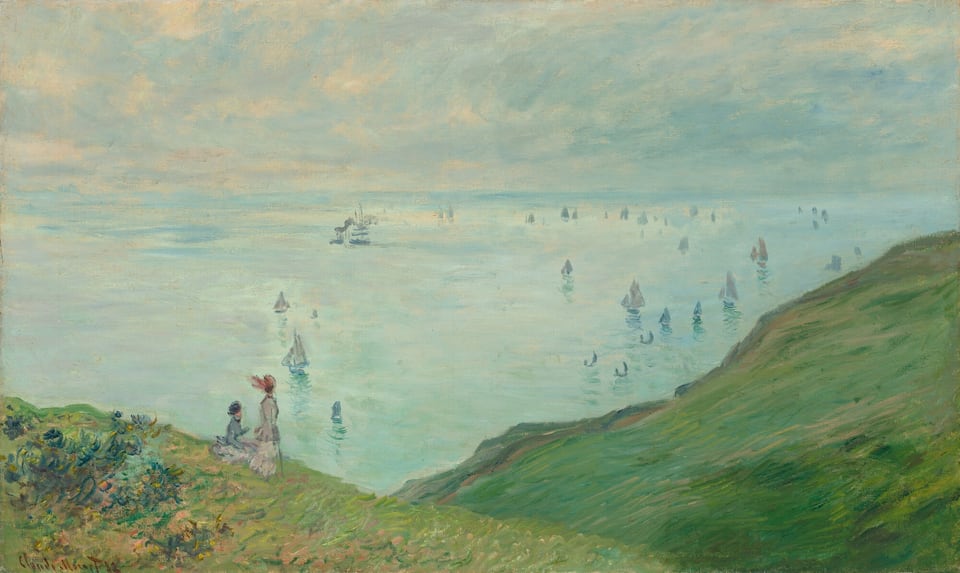
Cliffs at Pourville1882
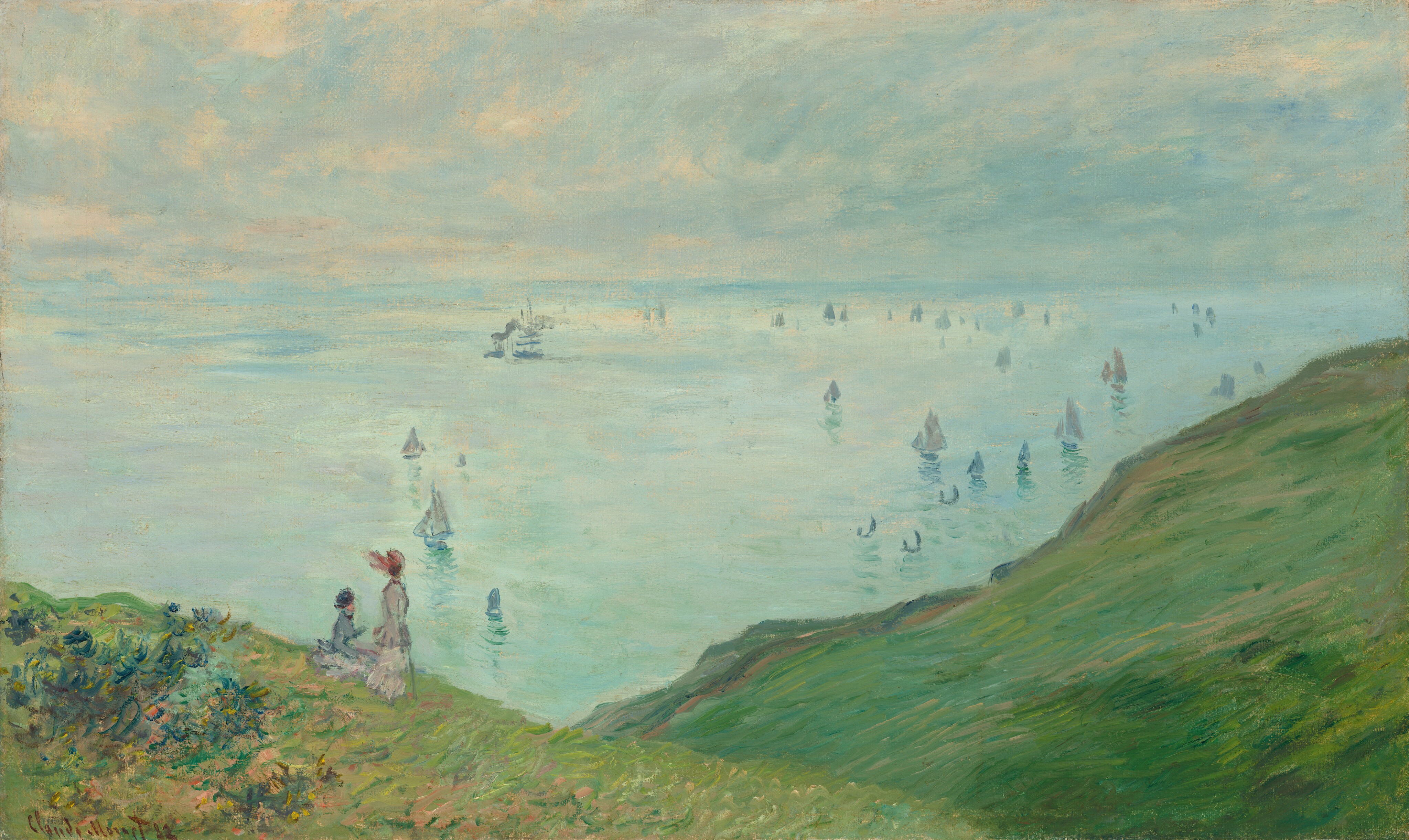
Two women in dusky pink and grey, one seated and one standing with a red veil lifted by the wind, look out from a green clifftop over a sea scattered with sailboats and a steamer. More about this work
About this work
Two women in dusky pink and grey, one seated and one standing with a red veil lifted by the wind, look out from a green clifftop over a sea scattered with sailboats and a steamer. Monet spent much of 1882 at Pourville on the Normandy coast near Dieppe, painting the cliffs, beaches and changing sea. The brushwork is loose and quick, with dashes of green, peach and blue on the hills and paint so thin in the sky that the weave of the canvas shows through, an attempt to catch a breezy moment as directly as possible.
Written by Ochre Editions.
What you’re looking at
From a high perspective, we look beyond two overlapping, emerald-green hills to a body of powder-blue water dotted with sailboats in this loosely painted horizontal landscape. Closest to us, the hills create a shallow V that spans the lower third of the composition, with the right-hand hill rising to more than halfway up the right edge. The hills are painted with dashes and long strokes mostly in seafoam, shamrock, and celery green, with some swipes of peach, goldenrod yellow, and royal blue. On the hill to our left, one woman sits and the other stands next to her. They wear hats, long-sleeved, fitted jackets, and long skirts in tones of dusky pink and dove gray. A touch of peach on the seated woman, to our left, gives the impression of a pale face. A red veil or scarf at the back of the other woman’s hat is lifted, as if in the wind. The water is painted with blended strokes of pale blue, light turquoise, smoky mauve pink, and touches of soft peach. The horizon comes two-thirds of the way up the composition, and the sky is painted with the same tones of blue, green, and peach to suggest a screen of clouds. Triangles and dashes of slate blue suggest about three dozen sailboats, rowboats, and one steamship in the rippling water. Squiggles of teal and sage green create reflections for some of the boats. The brushstrokes are visible throughout. In some areas, the paint is so thinly applied that the texture of the canvas shows through, especially in the sky. The artist signed the work in the lower left corner: “Claude Monet 82.”
Description from the National Gallery of Art.
How it was made
- Oil paint
- Pigment ground in a drying oil, usually linseed. It dries slowly, so painters could blend on the canvas, build up thin translucent glazes, and rework a picture over weeks. Canvas replaced wooden panels in the 1500s because it is lighter and can be rolled.
Claude Monet
French, 1840–1926
Monet grew up in Le Havre, where Eugène Boudin encouraged him to paint outdoors. In Paris he met Renoir, Sisley and Bazille, and his Impression, Sunrise gave the Impressionist movement its name in 1874. He made a lifelong study of changing light, painting the Gare Saint-Lazare, haystacks, poplars and Rouen Cathedral in series. From 1883 he lived at Giverny, where he built the water garden that filled the last three decades of his work.
Written by Ochre Editions.
Impressionism
Painters in 1870s Paris who worked quickly, often outdoors, to catch light as it changed.
Rights and the museum’s record
Public domain. The National Gallery of Art has dedicated this image to the public domain under CC0, so anyone may copy, adapt and use it, for any purpose, without asking. Our prints and files are reproductions made from the museum’s image; the museum doesn’t endorse them.
- Object number
- 1985.64.27
- Credit
- Courtesy National Gallery of Art, Washington
- Type
- Painting
- Licence
- CC0 1.0 Universal
- Museum record
- See it on the museum’s site
Report this work
More by Claude Monet
All their works
Close in colour