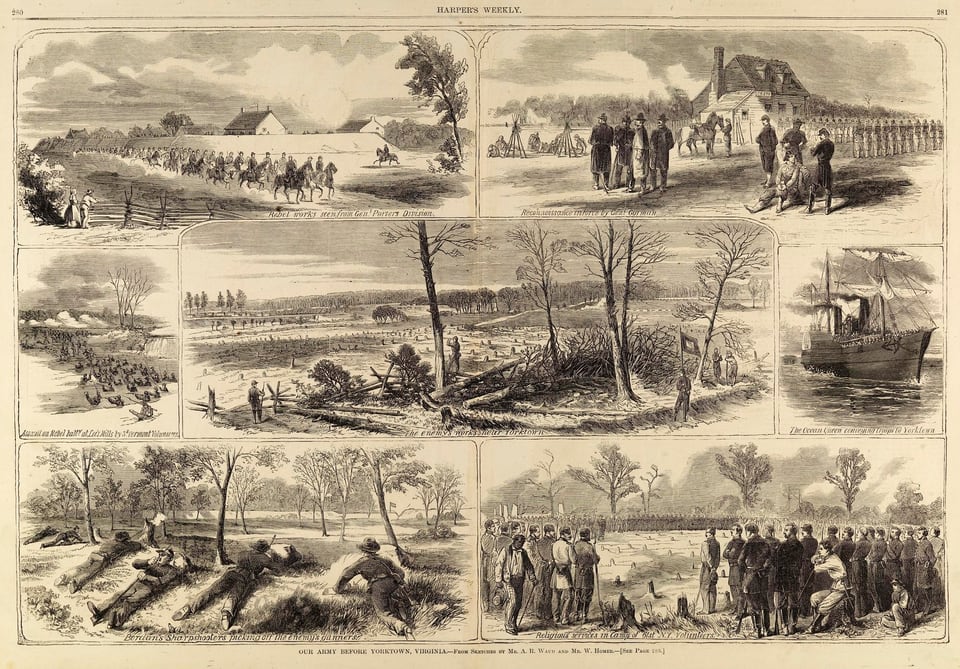
Our Army before Yorktown, Virginia, from Harper's Weekly, May 3, 18621862
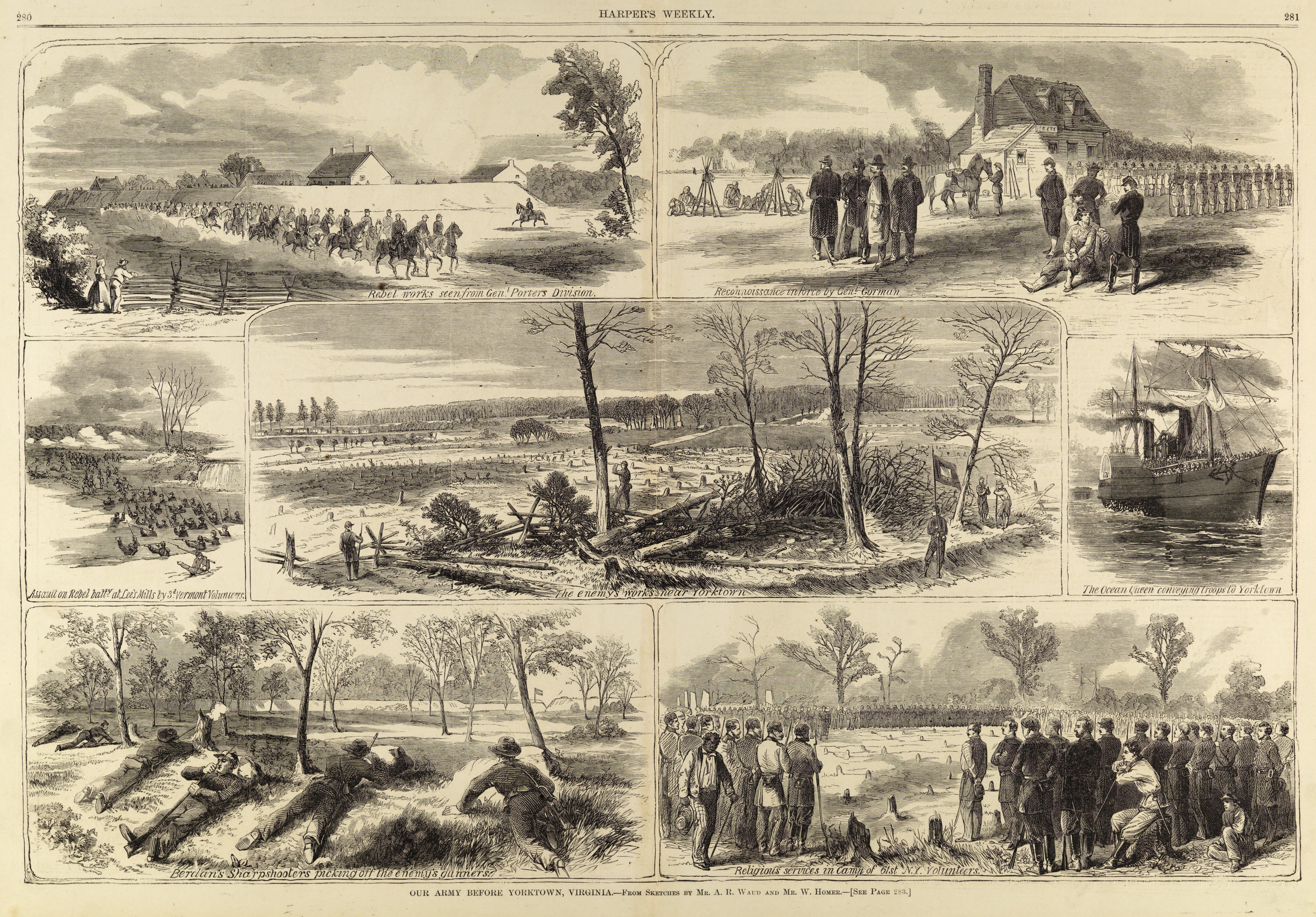
This wood engraving, published in Harper’s Weekly on May 3, 1862, shows Union forces during the siege of Yorktown, Virginia, early in General McClellan’s Peninsula Campaign. More about this work
About this work
This wood engraving, published in Harper’s Weekly on May 3, 1862, shows Union forces during the siege of Yorktown, Virginia, early in General McClellan’s Peninsula Campaign. Winslow Homer, then a young illustrator, had travelled with the army that spring, and his drawings were cut into woodblocks by professional engravers in New York so they could be printed with the weekly’s text. Such images brought the war into American homes and gave Homer the close knowledge of soldiers’ lives that shaped his first paintings.
Written by Ochre Editions.
How it was made
- Engraving
- Lines cut directly into a metal plate with a steel burin, which makes them swell and taper. It took years to master, and for centuries it was how paintings travelled as pictures.
Winslow Homer
American, 1836–1910 · Born in Boston, Massachusetts; died in Prouts Neck, Maine.
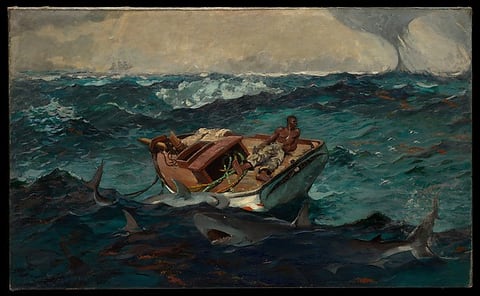
Homer began as an illustrator, covering the Civil War for Harper’s Weekly, and first made his name in painting with scenes of soldiers and country life. A stay at the fishing village of Cullercoats on the English coast in 1881–82 turned him towards the sea, and from 1883 he lived at Prouts Neck, Maine, painting the Atlantic in all weathers. He was also a fluent watercolourist in the Adirondacks, Canada and the Caribbean, and The Gulf Stream draws on those southern journeys.
Written by Ochre Editions.
Rights and the museum’s record
Public domain. The Smithsonian American Art Museum has dedicated this image to the public domain under CC0, so anyone may copy, adapt and use it, for any purpose, without asking. Our prints and files are reproductions made from the museum’s image; the museum doesn’t endorse them.
- Object number
- 1996.63.116
- Credit
- Courtesy of the Smithsonian American Art Museum
- Type
- Graphic Arts-Print
- Department
- Graphic Arts
- Licence
- CC0 1.0 Universal
- Museum record
- See it on the museum’s site
Report this work
More by Winslow Homer
All their works
Close in colour