Skip to content
Ochre Editions
ArtArtistsCollectionsGalleriesDrops
SearchSign inCart (0)
The galleries · Style galleries

Georgian Britain

Portraits, conversation pieces and watercolour landscapes from Hogarth to Constable.

63 works · hang 2107 ·

Share Georgian Britain, in the galleries

The rooms are imagined; every work on their walls is real.

Walk this roomRehang this room

Section 1, north wall

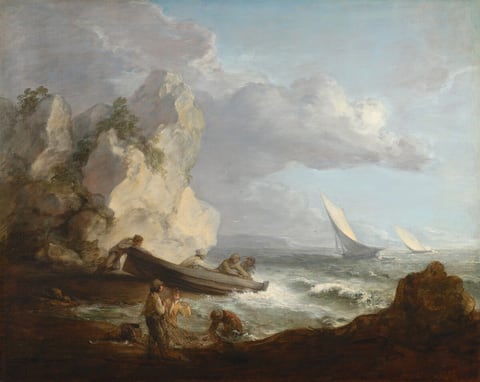
  1. From a rocky shoreline, we look on several light-skinned people working by the sea with a boat and a net in this freely painted, almost square seascape. The scene is framed by a silhouette of low boulders along the lower right corner, and a towering cream-white rock rising two-thirds of the way up the composition to our left. Scrubby, celery-green vegetation grows on the rocky outcropping. Near the center, close to the towering white rocks, three people sit, reaching for something near one end of a boat while a fourth person braces against the rock, presumably to push the boat out to the sea. Closer to us, three people on the shore work with a net. Two stand with the net hooked over their shoulders, and a third person crouches in the water with head down. The people all wear simple shirts and pants in shades of tan, mustard yellow, burnt orange, and pale blue. All but two wear hats. The sea meets the shore with frothy white foam and cresting, low waves. The sea beyond fades from pale sage green to arctic blue along the horizon, which comes about a third of the way up the composition. Two sail boats tilt against the wind in the distance. Pale, smoky lavender-purple clouds drift across the ice-blue sky.
    Seashore with FishermenThomas Gainsborough, c. 1781/1782Courtesy National Gallery of Art, Washington
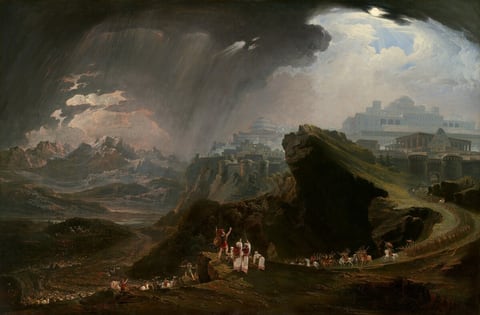
  2. Armies of men march and battle along a rocky outcropping set among huge rock formations and massive buildings under a stormy sky in this horizontal landscape painting. The people we can see all have pale skin. Sheets of rain fall from flint-gray clouds on our left into a valley, though hints of peach brighten the clouds along the mountainous horizon there. In the right half of the sky, light pours down from a brilliant white sun that breaks through white clouds to reveal topaz-blue patches of sky. The horizon comes about halfway up the composition and is lined with rugged white, pale pink, and olive-green mountains on our left and silvery-white buildings along the right half. These structures include two domed buildings and a colosseum among many others. The buildings are all enclosed within city walls buttressed with towers. The land dips precipitously from the rocky cliffs supporting the buildings, to sweep down toward us. A huge outcropping angles up like a ramp between us and the buildings in the distance. A road runs from the walled town toward us, down along the ridge and in front of the outcropping. Countless warriors march in rows of four or five across on the road past a man wearing a feathered helmet and armored breastplate. This man, Joshua, stands on a rocky precipice facing away from us with his right hand raised. He wears a scarlet-red toga under his breastplate, and a royal-blue cape flutters at his left side. He holds a round, copper-colored shield and a spear in his other hand. Two men with gray beards stand near Joshua with their backs to us. Both gesture up to the sky. One holds a slender staff and the other a curling horn. They and another pair of men, who stoop to hold poles used to carry a chest, all wear long, ivory-white robes, cherry-red drapery, and white turbans. The column of soldiers on foot and horseback pass in front of Joshua to a massive battlefield to our left. The fight takes place in a valley that leads back to a river. A bolt of lightning zigzags from the storm clouds and strikes a city in the deep distance. The artist signed the painting in the lower right, “J. Martin.”
    Joshua Commanding the Sun to Stand Still upon GibeonJohn Martin, 1816Courtesy National Gallery of Art, Washington

Section 1, south wall
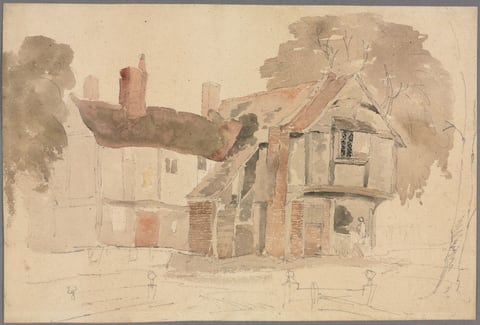
  1. Bray Church Yard, by John Varley, 1807
    Bray Church YardJohn Varley, 1807Courtesy of the Cleveland Museum of Art
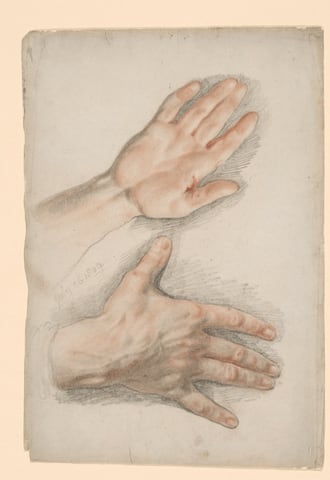
  2. A work made of red and black chalk on gray wove paper.
    Two Studies of a Right HandThomas Lawrence, July 26, 1800Courtesy of the Art Institute of Chicago
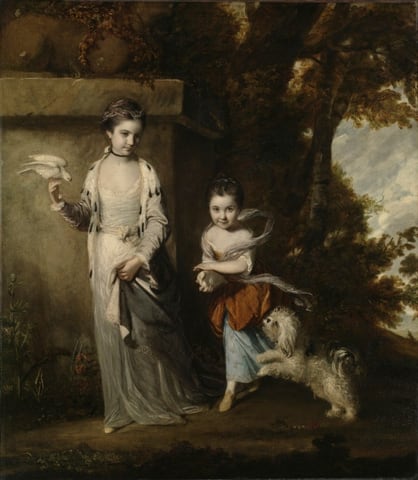
  3. Portrait of the Ladies Amabel and Mary Jemima Yorke, by Joshua Reynolds, c. 1761
    Portrait of the Ladies Amabel and Mary Jemima YorkeJoshua Reynolds, c. 1761Courtesy of the Cleveland Museum of Art
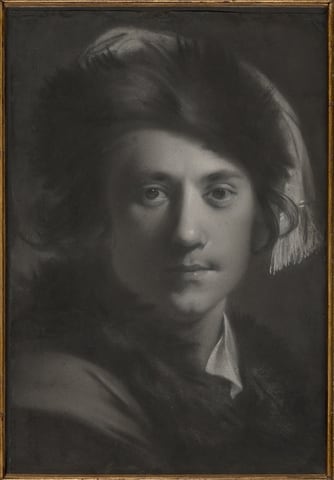
  4. Black, gray pastel portrait of man in a fur hat.
    Self-Portrait in a Fur CapJoseph Wright of Derby, 1765/68Courtesy of the Art Institute of Chicago

Section 2, south wall
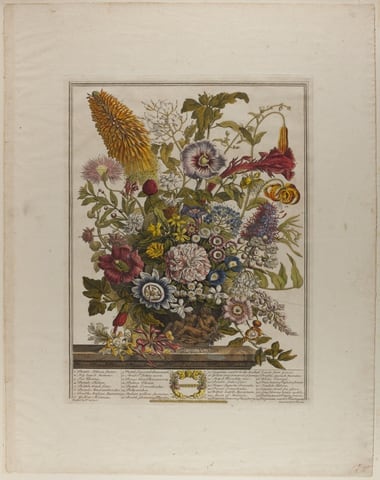
  1. A work made of engraving in black ink with opaque and translucent watercolor on cream laid paper.
    August, from Twelve Months of FlowersHenry Fletcher, n.d.Courtesy of the Art Institute of Chicago
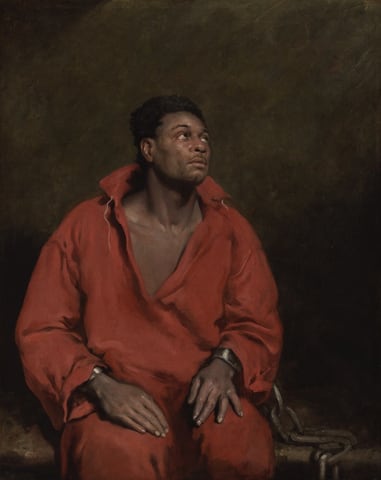
  2. Painting of a dark-skinned man seated and wearing a red open-necked tunic. He looks up to the right. His wrists are shackled and a large chain rests at his right, running down the bench he sits upon.
    The Captive Slave (Ira Aldridge)John Philip Simpson, 1827Courtesy of the Art Institute of Chicago
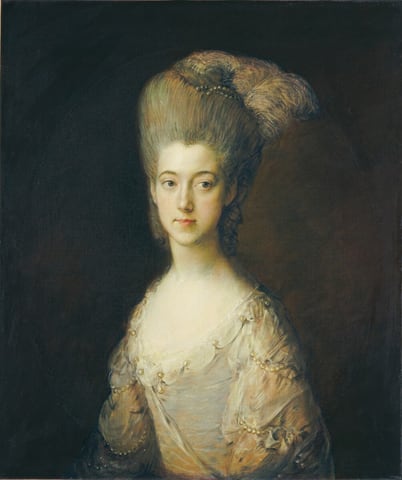
  3. Shown from the waist up, a young, pale-skinned woman with her gray hair piled high atop her head is lit starkly against a dark background in this vertical portrait painting. The woman’s shoulders are angled to our left. Her face is square to us, but she looks off to our right from the corners of her eyes, which are gray rimmed with golden brown around the pupils. She has a thin face, smooth cheeks, a bow-shaped pink mouth, and a narrow chin. Her hair is mostly swept up high under a bank of pearl-white feathers and some sparkling ornaments. A few ringlets hang down the back of her neck. The bodice of her white dress scoops low across her chest and sits just above her sloping shoulders. The dress is adorned with pearls on the sleeves and around the neckline, and the fabric shimmers from silvery white to pale gold. The background is earth-brown around her face and deepens to almost black in the corners.
    Mrs. Paul Cobb MethuenThomas Gainsborough, c. 1776/1777Courtesy National Gallery of Art, Washington

Section 2, north wall
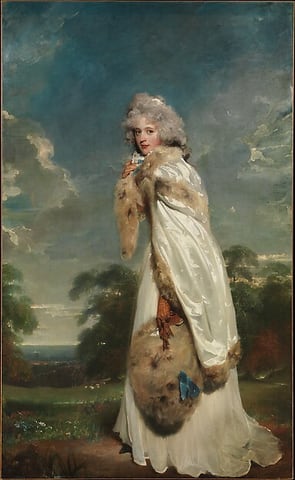
  1. Elizabeth Farren (born about 1759, died 1829), Later Countess of Derby, by Thomas Lawrence, 1790
    Elizabeth Farren (born about 1759, died 1829), Later Countess of DerbyThomas Lawrence, 1790Courtesy of The Metropolitan Museum of Art
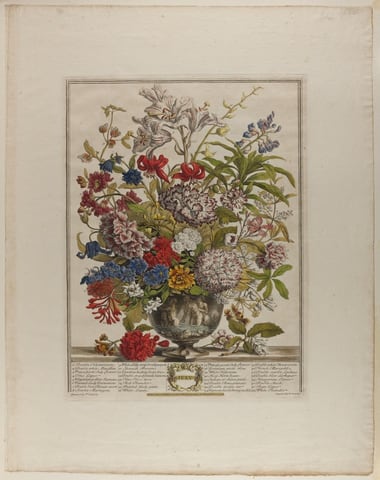
  2. A work made of engraving in black ink with opaque and translucent watercolor on cream laid paper.
    July, from Twelve Months of FlowersHenry Fletcher, n.d.Courtesy of the Art Institute of Chicago
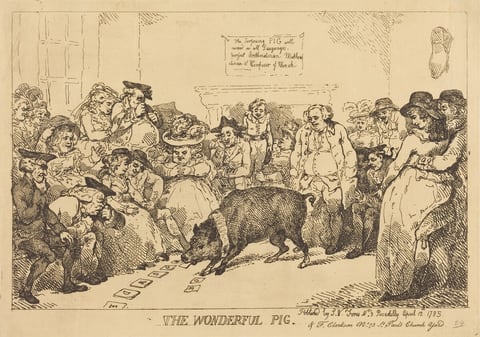
  3. This is a drawing showing a pig performing a trick for an audience. It depicts a group of people watching the pig interacting with cards on the floor. The detailed image shows the varied facial expressions of the audience members. There is text at the top of the image suggesting the pig has a unique ability, possibly related to languages. The drawing captures a moment of entertainment in a satirical style, with lines and cross-hatching used to emphasize the humor.
    The Wonderful PigThomas Rowlandson, 1785Courtesy National Gallery of Art, Washington
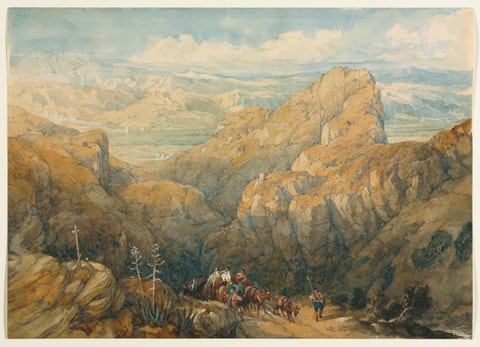
  4. Descent into the Plain of Granada, by David Roberts, 1834
    Descent into the Plain of GranadaDavid Roberts, 1834Courtesy of the Cleveland Museum of Art

Section 3, north wall
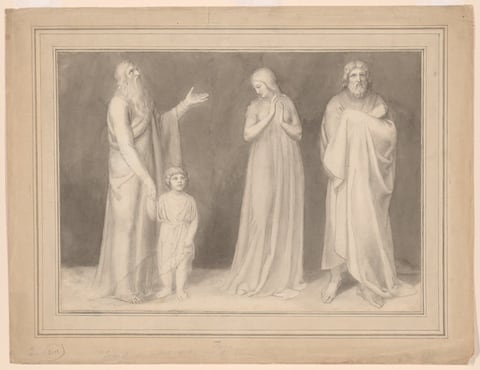
  1. A work made of pen and black ink and brush and black ink wash, with touches of pen and brown ink, on ivory laid paper.
    Hannah Presenting Samuel to EliJohn Flaxman, c. 1783Courtesy of the Art Institute of Chicago
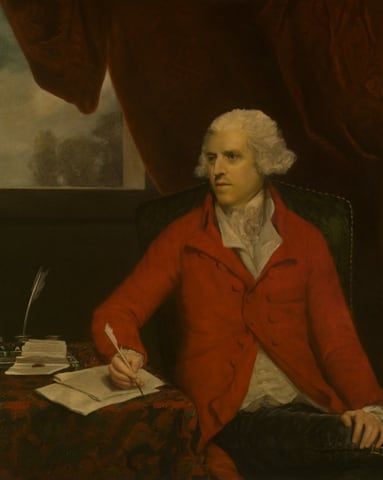
  2. A work made of oil on canvas.
    Sir Thomas Rumbold, Bt.Joshua Reynolds, 1788Courtesy of the Art Institute of Chicago
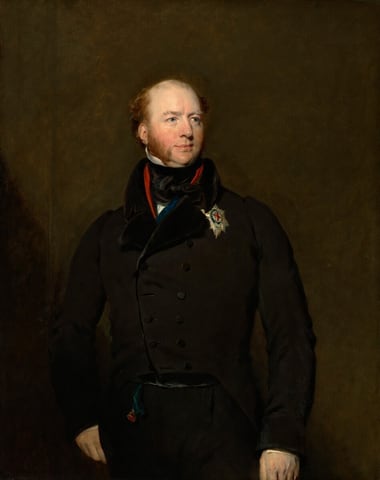
  3. The image displays a man in a portrait from the waist up, in a three-quarter view. He is facing slightly to the right and looking into the distance with a calm expression. The man has fair skin, light reddish-brown hair, sideburns, a defined nose, and a slightly upturned chin. He is wearing a black double-breasted coat with a high collar, a dark waistcoat, a white shirt, and a medal on his chest with an insignia and ribbon. The background is plain and deep brown.
    Francis Charles Seymour-Conway, 3rd Marquess of HertfordThomas Lawrence, c. 1822/1823Courtesy National Gallery of Art, Washington

Walk on

  • Georgian Britain, room 2
  • More by Thomas Lawrence 7 works
  • 19th-century Britain 40 works
Ochre Editions

The world's museums, on your wall. Every work here is a reproduction of a public-domain original, credited to the museum that holds it.

Shop

All artCollectionsLimited dropsPrints and framing

Help

Find an orderShippingReturnsVerify a certificate

About

About Ochre EditionsMuseum creditsFor agentsDevelopers

Legal

Terms of UseTerms of SaleLimited Editions and CertificatesPrivacy PolicyCookie PolicyAcceptable Use PolicyAgent & API TermsCopyright and DMCA PolicyPrinting Your Own PhotoVulnerability Disclosure PolicyAccessibility StatementOpen-Access Credits
© 2026 Ochre EditionsPrices in US dollars. Prints ship within the United States.