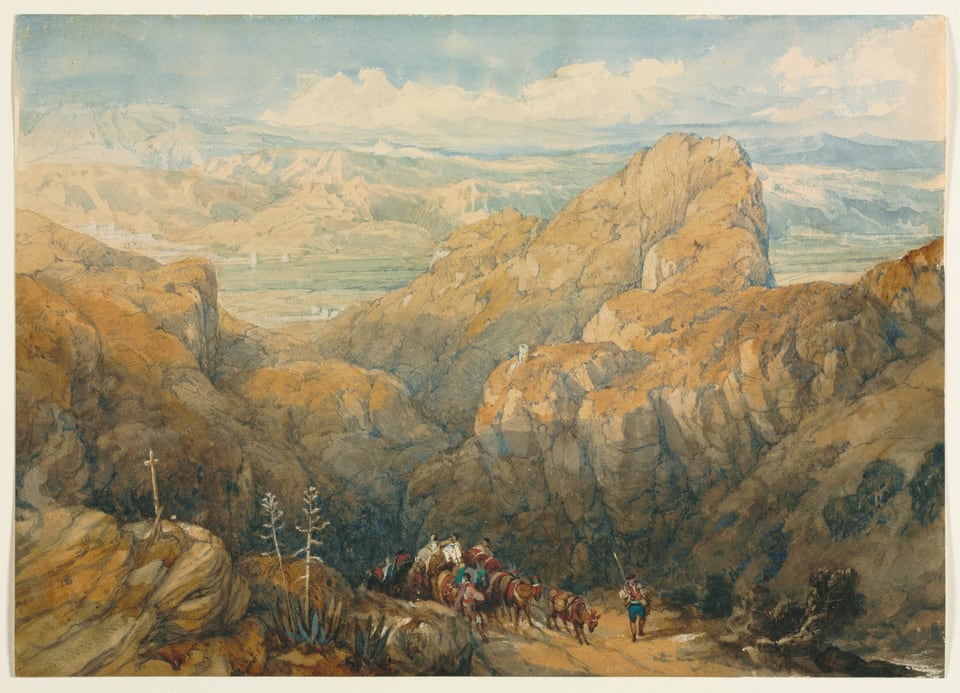
Descent into the Plain of Granada1834
Later celebrated for his topographical landscapes of the Middle East, David Roberts’s first extended trip abroad was in 1832 when he traveled through France to Spain over a period of 10 months. More about this work
About this work
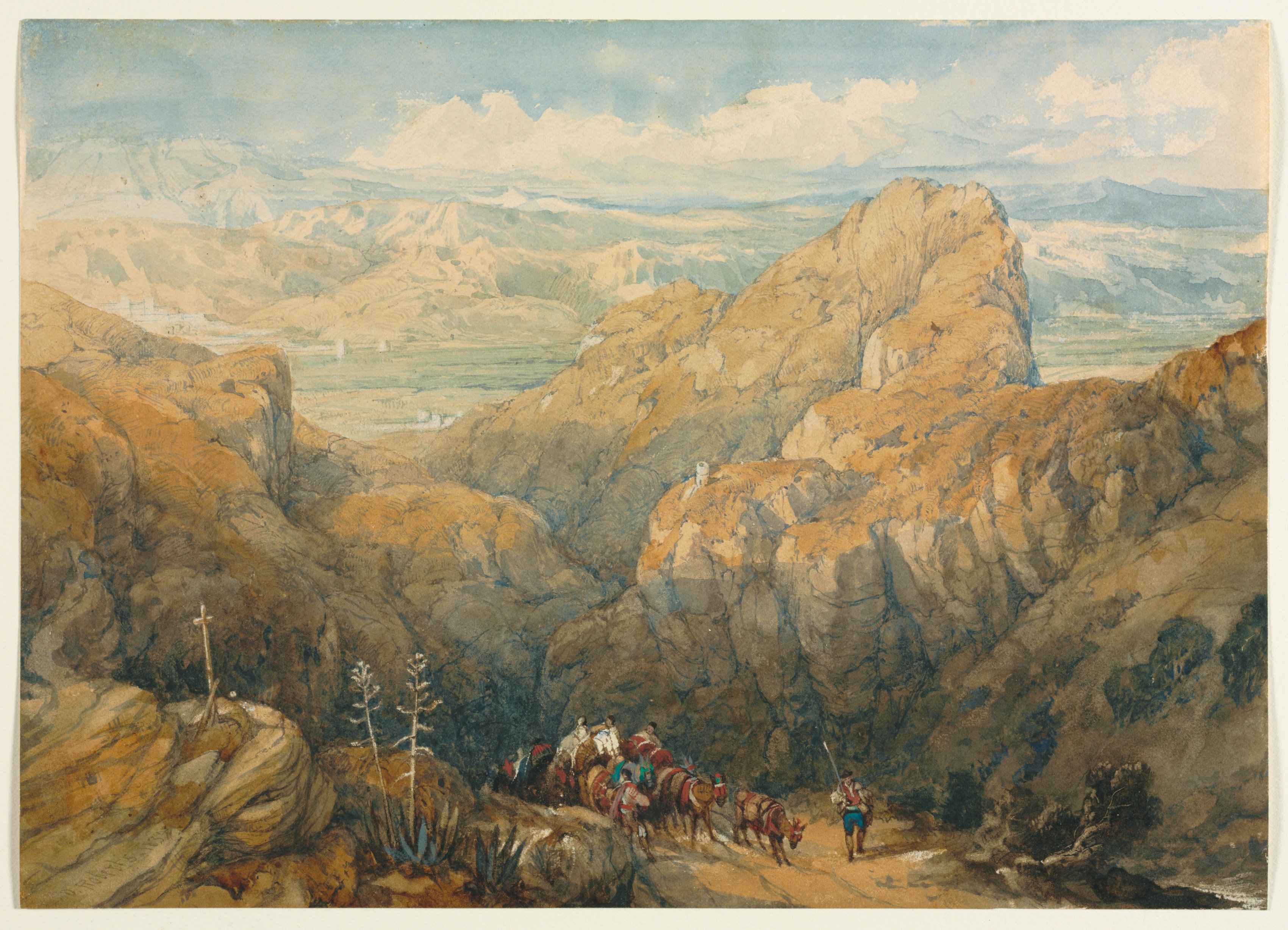
Later celebrated for his topographical landscapes of the Middle East, David Roberts’s first extended trip abroad was in 1832 when he traveled through France to Spain over a period of 10 months. This watercolor records a scene from Roberts’s journey from Madrid to Andalusia. He described the trip in a letter to his sister: "I jogged on a considerable part of the way on foot, happy and contented. Granada is in the most beautiful situation that can be imagined. It lies at the foot of a ridge of high mountains, called the Sierra Nevada, or the Mountains of Snow." Replete with burdened mules, a lone figure on foot, and sun-drenched mountains with a view of Granada in the distance, this watercolor vividly illustrates the artist’s recollections.
Text from the Cleveland Museum of Art.
How it was made
- Opaque watercolour
- Watercolour made opaque with white or chalk and laid in flat, even layers. Persian and Indian painters ground their colours from minerals, applied them with the finest brushes and burnished the finished page.
- Watercolour
- Pigment in gum arabic, thinned with water and laid in transparent washes. Nothing white is painted: the light is the paper showing through.
- Graphite
- Pencil. Graphite has been used for drawing since the 1500s; in 1795 Nicolas-Jacques Conté mixed it with clay, so its hardness could be graded.
David Roberts
Scottish, 1796–1864
Rights and the museum’s record
Public domain. The Cleveland Museum of Art has dedicated this image to the public domain under CC0, so anyone may copy, adapt and use it, for any purpose, without asking. Our prints and files are reproductions made from the museum’s image; the museum doesn’t endorse them.
- Object number
- 1940.563
- Credit
- Courtesy of the Cleveland Museum of Art
- Type
- Drawing
- Department
- Drawings
- Licence
- CC0 1.0 Universal
- Museum record
- See it on the museum’s site
Report this work
Close in colour